Q.Find the area bounded by the curve y=cosx between x=0 and x=2π
🔒You're viewing a preview — the full solution, concept, methods & PYQ mapping are locked.
🔒 Start your 14-day free trial to unlock the full solution →Concept understanding — Area Under Curve
Area Under a Curve
How do you measure the area of a region whose top edge is curved rather than a straight line? For rectangles and triangles we have formulas, but a shape bounded above by y=f(x) has no simple side lengths to plug in. The definite integral is the tool built exactly for this.
The core idea: area as a limit of strips
Take the region under y=f(x) (with f(x)≥0), above the x-axis, between x=a and x=b. Slice it into many thin vertical strips. A strip at position x with tiny width dx is almost a rectangle of height f(x), so its area is about f(x)dx. Add up all the strips and let their width shrink to zero: the sum becomes the definite integral
Area=∫abf(x)dx.
This is why the integral is the area — it is the exact total of infinitely many infinitesimally thin rectangles.
How to compute it
Find an antiderivative F(x) (so F′(x)=f(x)) and evaluate at the two limits — the Fundamental Theorem of Calculus:
∫abf(x)dx=F(b)−F(a).
For example, the area under y=x2 from 0 to 1 is [3x3]01=31.
Cases you must handle carefully
The integral gives signed area. Where the curve dips below the x-axis, f(x)<0 and ∫fdx comes out negative. For the geometric (positive) area of such a stretch, integrate the absolute value or take the magnitude of that piece: Area=∫ab∣f(x)∣dx.
If a curve crosses the x-axis inside [a,b], split the integral at each crossing and add the sizes of the parts.
Area with respect to the y-axis
When the region is bounded by a curve x=g(y) and the y-axis between y=c and y=d, slice horizontally instead: …
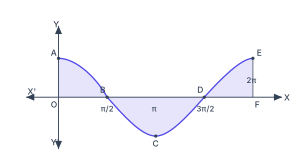
The key idea is that area is always positive, so we must split the interval wherever the curve crosses the x‑axis.
Step 1: Find where cosx=0 in [0,2π].
cosx=0 at x=2π and x=23π.
Step 2: On [0,2π], cosx≥0; on [2π,23π], cosx≤0; on [23π,2π], cosx≥0.
Step 3: Total area = …
The area bounded by y=cosx from x=0 to x=2π is 4 square units. Because the curve dips below the x‑axis, we must split the interval and take absolute values — the net signed area is zero, but the geometric area is 4.
Why area under a curve isn’t always “just integrate”
When a student first sees “area bounded by the curve”, the reflex is to compute ∫02πcosxdx. That integral evaluates to 0, which is true for the signed area — but the question asks for the geometric area, the actual region enclosed between the curve and the x‑axis. The curve y=cosx crosses the x‑axis at x=π/2 and x=3π/2, so parts of it lie below the axis. Area is always positive, so we must take the absolute value of each piece.
A common mistake is to compute ∫02πcosxdx=0 and conclude the area is zero. That gives the net signed area, not the total geometric area. Always check where the curve is above or below the axis.
Step‑by‑step solution
1. Identify the zeroes of cosx in [0,2π]
cosx=0 when x=2π and x=23π. These split the interval into three parts:
[0,π/2], [π/2,3π/2], [3π/2,2π].
2. Determine the sign of cosx on each subinterval
- On [0,π/2]: cosx≥0 (starts at 1, falls to 0).
- On [π/2,3π/2]: cosx≤0 (goes from 0 to −1 and back to 0).
- On [3π/2,2π]: cosx≥0 (rises from 0 to 1).
3. Write the area as a sum of absolute integrals
The total geometric area A is:
A=∫0π/2cosxdx+∫π/23π/2(−cosx)dx+∫3π/22πcosxdx
4. Evaluate each integral
- First piece: ∫0π/2cosxdx=[sinx]0π/2=sin(π/2)−sin0=1−0=1. …
Method: Area of a periodic curve over a full period (modulus)
Use this for "area bounded by the curve" over an interval where a periodic function (like cosx over [0,2π]) is above the axis on some sub-intervals and below on others.
Steps
Step 1: Find all axis crossings in the interval.
Solve f(x)=0; for cosx on [0,2π] the crossings are x=2π and x=23π, splitting the range into three pieces.
Step 2: Fix the sign on each sub-interval.
Integrate f where it is positive and −f where it is negative, so every contribution is positive.
Step 3: Sum the pieces. …
Common Mistakes
Mistake 1: Concluding the area is zero from ∫02πcosxdx=0.
Why it's wrong: that integral is the net signed value; the positive lobes and the negative lobe cancel, but real area is enclosed. Correct approach: integrate ∣cosx∣ by splitting at the zeros x=2π,23π, giving 1+2+1=4.
Mistake 2: Splitting at only one crossing. …
Showing the 12 most recent of 20 on this concept.
- AP EAPCET 2026Set eng-2026-05-12-FN1 markMCQQ.The area of the region bounded by the curve xy=−a (a>1) and the lines x=−a and y=a is (A) a(a−1−loga) (B) a(a+1+loga) (C) a2−a+loga (D) a2−a−loga
›Reveal solutionSolution
The area enclosed by the rectangular hyperbola xy=−a and the lines x=−a, y=a works out, after a direct integration, to a(a−1−loga).
Concept and Intuition
xy=−a (a>0) is a hyperbola lying in the second and fourth quadrants (since the product of coordinates must be negative). We only need the branch in the second quadrant here (x<0,y>0, i.e. y=−a/x). The two given lines pin down a finite region between the curve and the corner point where the lines would meet.
Step-by-Step Solution
- Rewrite the curve as y=−xa (valid for x<0 here, giving y>0).
- Find where the curve meets x=−a: y=−a/(−a)=1, point (−a,1).
- Find where the curve meets y=a: a=−a/x⇒x=−1, point (−1,a).
- For x∈[−a,−1], the curve y=−a/x lies below the line y=a (check at x=−1: curve value =a, equal; at x=−a: curve value=1<a since a>1). So the vertical strip between the curve and the top line y=a, from x=−a to x=−1, is exactly the bounded region.
- Area =∫−a−1[a−(−xa)]dx=∫−a−1(a+xa)dx. …
- AP EAPCET 2026Set eng-2026-05-13-FN1 markMCQQ.The area of the region bounded by the curve y=x2+x, the lines y=x, x=1 and y=2 is (A) 512 (B) 27 (C) 54 (D) 31
›Reveal solutionSolution
The four boundary curves pin down a single closed loop from x=0 to x=1 between the parabola and the line y=x; its area is 31.
Concept and Intuition
When several curves are said to "bound a region," first locate every pairwise intersection — the closed loop's vertices are exactly these intersection points, and its area is found by integrating (upper curve minus lower curve) over the right interval.
Step-by-Step Solution
- Intersection of y=x2+x and y=x: x2+x=x⇒x2=0⇒x=0. They only touch at (0,0), and since x2+x−x=x2≥0, the parabola is above the line for all other x.
- Intersection of y=x and x=1: point (1,1).
- Intersection of y=x2+x and x=1: point (1,2).
- Intersection of y=x2+x and y=2: x2+x−2=0⇒(x−1)(x+2)=0⇒x=1 (the relevant root, giving (1,2) again). …
- AP EAPCET 2026Set eng-2026-05-14-AN1 markMCQQ.The area of the region enclosed between the curve y=loge(x+e) and the coordinate axes is (A) 4 (B) 3 (C) 2 (D) 1
›Reveal solutionSolution
The region bounded by y=log(x+e) and the two coordinate axes is a simple region between x=1−e (where the curve meets the x-axis) and x=0 (where it meets the y-axis); the area works out to exactly 1.
Concept and Intuition
To find the area enclosed between a curve and the coordinate axes, first locate where the curve crosses each axis — those crossing points bound the finite region. Here y=log(x+e) is a shifted, increasing logarithm; it crosses the y-axis at x=0 (giving y=loge=1) and the x-axis where log(x+e)=0, i.e. x+e=1, so x=1−e. Since the curve is positive throughout (1−e,0), the enclosed area is simply the definite integral of y over that interval.
Step-by-Step Solution
- Find the y-axis intercept: at x=0, y=log(0+e)=loge=1.
- Find the x-axis intercept: set log(x+e)=0⇒x+e=1⇒x=1−e (note 1−e≈−1.718).
- For x∈(1−e,0), the curve is increasing from 0 up to 1, staying non-negative, so the enclosed area is Area=∫1−e0log(x+e)dx. …
- AP EAPCET 2026Set eng-2026-05-15-AN1 markMCQQ.The area enclosed between the curves y2=x and y=∣x∣ is (A) 61 (B) 31 (C) 21 (D) 32
›Reveal solutionSolution
Because y2=x only exists for x≥0, y=∣x∣ effectively reduces to the single ray y=x there; the enclosed area between the parabola and this line, from (0,0) to (1,1), is 61.
Concept and Intuition
y=∣x∣ is a V-shaped pair of rays, but the parabola y2=x only exists where x≥0 (since y2 can't be negative). So on the left half (x<0) there is no parabola to intersect the left ray of ∣x∣ — the only relevant intersection is between the parabola and the right ray y=x (x≥0). This reduces the problem to the classic area between y2=x and y=x.
Step-by-Step Solution
- Find intersection points: set y=x into y2=x: x2=x⇒x=0 or x=1. Points: (0,0) and (1,1).
- On [0,1], compare x (upper parabola branch) with x (the line): at x=0.25, x=0.5>0.25=x, so the parabola is above the line throughout (0,1). …
- AP EAPCET 2026Set eng-2026-05-18-FN1 markMCQQ.The Area (in sq. units) of the region bounded by x=0,x=2π, X-axis, y=cosx and y=tanx is (A) 25−1+21log(25−1) (B) 23−5+log(25−1) (C) 25−1−log(25−1) (D) 23−5+21log(25+1)
›Reveal solutionSolution
Since tanx→∞ at π/2, the finite region is bounded above by the lower of cosx and tanx; splitting the integral at their intersection point gives 23−5+21log25+1.
Concept and Intuition
cosx and tanx cross exactly once in (0,π/2). Since tanx diverges as x→π/2−, a region bounded by the upper envelope of the two curves would have infinite area; the sensible, finite area bounded by the x-axis and both curves on [0,π/2] is the area under whichever curve is lower at each x — i.e. under tanx before the crossing and under cosx after it.
Step-by-Step Solution
- Find the crossing point: cosx=tanx=cosxsinx⇒cos2x=sinx⇒1−sin2x=sinx⇒sin2x+sinx−1=0.
sinx0=2−1+5=s(taking the root in [0,1]).
Note also cos2x0=sinx0=s (directly from the defining equation), so cosx0=s.
2. Near x=0: cos0=1>tan0=0, so cosx is the upper curve, tanx the lower, for x∈(0,x0).
Near x=π/2: tanx→∞>cosx→0, so tanx is upper, cosx lower, for x∈(x0,π/2).
3. The finite bounded area is therefore
A=∫0x0tanxdx+∫x0π/2cosxdx.
- First piece: ∫0x0tanxdx=[−log(cosx)]0x0=−log(cosx0)=−logs=−21logs.
- Second piece: ∫x0π/2cosxdx=[sinx]x0π/2=1−sinx0=1−s. …
- AP EAPCET 2025Set eng-2025-05-22-FN1 markMCQQ.The area of the region lying between the curves y=4−x2, y2=3x and the Y-axis is (A) 3π−231 (B) 6π+231 (C) 3π+231 (D) 6π−231
›Reveal solutionSolution
Integrating with respect to y in two pieces — the parabola from y=0 to 3 and the circle from y=3 to 2 — gives the enclosed area as 3π−231.
Concept and Intuition
When a region's boundary is naturally expressed as x=x(y) for both curves (here x=4−y2 for the circle and x=y2/3 for the parabola), integrating along y with the y-axis as the common left boundary is far cleaner than integrating along x.
Step-by-Step Solution
- Find the intersection of y=4−x2 (so y2=4−x2) and y2=3x: 3x=4−x2⇒x2+3x−4=0⇒(x+4)(x−1)=0. Since x≥0 on the parabola, x=1, giving y=3.
- The circle meets the y-axis at (0,2); the parabola meets it at the origin (0,0).
- The enclosed region has: the y-axis as its left edge from (0,0) to (0,2); the parabola x=y2/3 as its right edge for y∈[0,3]; and the circle x=4−y2 as its right edge for y∈[3,2].
- Area =∫033y2dy+∫324−y2dy.
- First integral: ∫033y2dy=91[y3]03=933=33=31. …
- AP EAPCET 2025Set eng-2025-05-23-FN1 markMCQQ.The area (in sq. units) of the region bounded by the lines x=0, x=2π and f(x)=sinx, g(x)=cosx is (A) 2(2−1) (B) 2(3−1) (C) 2(2+1) (D) 32+1
›Reveal solutionSolution
The two curves sinx and cosx cross at x=π/4 inside [0,π/2], so the enclosed area is the sum of two pieces, each evaluating to 2−1, giving total 2(2−1).
Concept and Intuition
Since sinx and cosx swap which one is larger at x=π/4, the area between them over [0,π/2] must be split at that crossing point and the absolute difference integrated on each side.
Step-by-Step Solution
- On [0,π/4]: cosx≥sinx, so area contribution is ∫0π/4(cosx−sinx)dx=[sinx+cosx]0π/4=(22+22)−(0+1)=2−1. …
- AP EAPCET 2025Set eng-2025-05-26-AN1 markMCQQ.The area of the region (in sq.units) bounded by the curves x2+y2=16 and y2=6x is (A) 4π+43 (B) 32(4π+3) (C) 34(4π+3) (D) 34π+3
›Reveal solutionSolution
The region common to the circle x2+y2=16 and parabola y2=6x is bounded by the parabola near the origin and the circle further out; integrating each piece and doubling for symmetry gives 34(4π+3).
Concept and Intuition
The parabola y2=6x opens rightward from the origin, and the circle has radius 4. Near the vertex, the parabola is the "narrower" curve (smaller ∣y∣ for given x), so it bounds the common region; farther out, the circle becomes narrower and takes over as the boundary. The crossover is exactly at their intersection point.
Step-by-Step Solution
- Intersection: substitute y2=6x into x2+y2=16: x2+6x−16=0⇒x=2 or x=−8 (rejected, since y2=6x≥0 needs x≥0). At x=2: y2=12⇒y=±23.
- For x∈[0,2]: parabola gives smaller ∣y∣ than the circle (check at x=1: parabola ∣y∣=6≈2.45, circle ∣y∣=15≈3.87) — so the parabola bounds the region here.
- For x∈[2,4]: circle gives smaller ∣y∣ (check at x=3: parabola ∣y∣=18≈4.24, circle ∣y∣=7≈2.65) — circle bounds here.
- Area (using symmetry about the x-axis, factor 2):
A=2[∫026xdx+∫2416−x2dx].
- ∫026xdx=6⋅32x3/202=6⋅32⋅22=383.
- Using ∫16−x2dx=2x16−x2+8sin−14x: …
- AP EAPCET 2024Set eng-2024-05-18-FN1 markMCQQ.The area of the region (in sq. units) enclosed by the curve y=x3−19x+30 and the X-axis is (A) 2167 (B) 2517 (C) 36 (D) 72
›Reveal solutionSolution
The cubic has roots −5,2,3; summing the (unsigned) areas of the two lobes between consecutive roots gives 517/2.
Concept and Intuition
The total area enclosed between a cubic and the x-axis over an interval with sign changes is the sum of the absolute areas of each lobe — you cannot simply integrate straight from the leftmost to rightmost root, because the regions above and below the axis would partially cancel.
Step-by-Step Solution
- Find the roots of x3−19x+30=0. Testing x=2: 8−38+30=0 ✓. Dividing out (x−2): x3−19x+30=(x−2)(x2+2x−15)=(x−2)(x+5)(x−3).
- Roots in order: x=−5,2,3.
- Determine sign of y on each interval: at x=0 (in (−5,2)), y=30>0; at x=2.5 (in (2,3)), y=15.625−47.5+30=−1.875<0.
- Antiderivative: F(x)=4x4−219x2+30x.
- F(−5)=4625−219⋅25−150=156.25−237.5−150=−231.25.
- F(2)=4−38+60=26.
- F(3)=20.25−85.5+90=24.75. …
- AP EAPCET 2024Set eng-2024-05-19-AN1 markMCQQ.The area (in sq. units) of the smaller region lying above the X-axis and bounded between the circle x2+y2=2ax and the parabola y2=ax is (A) 2a2(4π−32) (B) a2(4π−32) (C) a2(4π+32) (D) a2(4π2−31)
›Reveal solutionSolution
The circle and parabola meet at x=0 and x=a; integrating the gap between the (higher) circle and the (lower) parabola over [0,a] gives the smaller enclosed area a2(4π−32).
Concept and Intuition
The circle x2+y2=2ax, i.e. (x−a)2+y2=a2, is centered at (a,0) with radius a, so it passes through the origin and through (2a,0). The parabola y2=ax opens rightward from the origin. Near x=0 the circle bulges upward faster than the parabola (its upper-half slope near the origin is steeper), and they cross again at x=a — the "smaller" lens-shaped region above the x-axis is exactly the strip between the two curves over x∈[0,a].
Step-by-Step Solution
- Find intersections: substitute y2=ax into x2+y2=2ax: x2+ax=2ax⇒x2−ax=0⇒x(x−a)=0⇒x=0 or x=a.
- At x=a: y2=a⋅a=a2⇒y=±a; take y=a for the region above the x-axis. So the curves cross at (0,0) and (a,a).
- For 0<x<a, compare the upper branches: circle gives y=2ax−x2, parabola gives y=ax. Near x=0+, 2ax−x2≈2ax>ax, so the circle lies above the parabola throughout (0,a) — this strip is the smaller enclosed region.
- Area =∫0a[2ax−x2−ax]dx.
- For ∫0aaxdx=a⋅32x3/20a=a⋅32a3/2=32a2. …
- AP EAPCET 2024Set eng-2024-05-21-FN1 markMCQQ.The area of the region under the curve y=∣sinx−cosx∣, 0≤x≤2π and above x-axis, is (in square units) (A) 22 (B) 22−1 (C) 2(2−1) (D) 2(2+1)
›Reveal solutionSolution
Split the region at x=π/4 where sinx=cosx, integrate each branch of the absolute value separately, and add.
Concept and Intuition
∣sinx−cosx∣ is cosx−sinx for x<π/4 (where cosine dominates) and sinx−cosx for x>π/4 (where sine dominates) — the area under an absolute-value curve must be computed piecewise across the sign change.
Step-by-Step Solution
- sinx=cosx at x=π/4 within [0,π/2]; for x<π/4, cosx>sinx, so ∣sinx−cosx∣=cosx−sinx; for x>π/4, it's sinx−cosx.
- ∫0π/4(cosx−sinx)dx=[sinx+cosx]0π/4=(22+22)−(0+1)=2−1. …
- AP EAPCET 2024Set eng-2024-05-22-FN1 markMCQQ.The area (in sq. units) bounded by the curves x=y2 and x=3−2y2 is (A) 8 (B) 38 (C) 4 (D) 6
›Reveal solutionSolution
Integrate horizontally (with respect to y) since both curves are given as x= function of y. Answer: 4 square units.
Concept and Intuition
Both curves open sideways (they're expressed as x in terms of y), so it's natural to integrate along y, treating the region as bounded on the right by x=3−2y2 and on the left by x=y2, between their points of intersection.
Step-by-Step Solution
- Find intersection points: set y2=3−2y2⇒3y2=3⇒y2=1⇒y=±1.
- For −1≤y≤1, check which curve is to the right: at y=0, x=y2=0 vs x=3−2y2=3, so 3−2y2≥y2 throughout this range.
- Area =∫−11[(3−2y2)−y2]dy=∫−11(3−3y2)dy. …
🎓Unlock everything free for 14 days
- ✓Full step-by-step solutions
- ✓Concept-first explanations
- ✓Methods, shortcuts & mistakes
- ✓PYQ mapping + timed mock tests
Full access for 14 days. No credit card required.