Q.State the working principle of potentiometer. Explain with the help of a circuit diagram how the EMF of two primary cells are compared by using the potentiometer. Find the resistivity of a conductor which carries a current density of 2.5 x 10^6 Am^-2 when an electric field of 15 Vm^-1 is applied across it.
You're viewing a preview — the full solution, concept, methods & PYQ mapping are locked.
Start your 14-day free trial to unlock the full solution →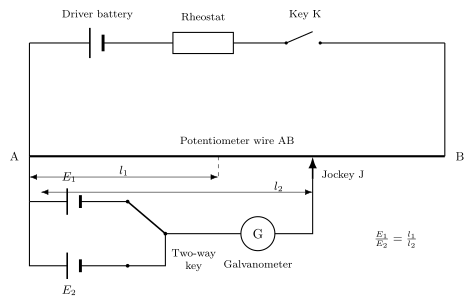
A potentiometer compares two EMFs via their null-point balancing lengths on a uniform wire (E1/E2 = l1/l2); separately, resistivity is found from ρ = E/J.
Principle of the potentiometer: A potentiometer consists of a long uniform wire of resistance per unit length r, through which a constant current I is maintained by a driver battery (via a rheostat and key in the primary circuit). Since I and r are constant along the wire, the potential drop per unit length (the potential gradient, k = I r) is uniform throughout the wire. Hence the potential difference between any two points on the wire is directly proportional to the length of wire between them: V ∝ l. This proportionality is the basic principle of the potentiometer, and it allows the potentiometer to compare/measure potential differences (or EMFs) very precisely by a null-deflection method, without drawing any current from the source being measured.
…
Unlock everything free for 14 days
- Full step-by-step solutions
- Concept-first explanations
- Methods, shortcuts & mistakes
- PYQ mapping + timed mock tests
Full access for 14 days. No credit card required.