Q.State the principle of a potentiometer. Describe briefly with the help of a circuit diagram, how this device is used to compare the e.m.f.s of two cells. (Marks split: 1+4)
You're viewing a preview — the full solution, concept, methods & PYQ mapping are locked.
Start your 14-day free trial to unlock the full solution →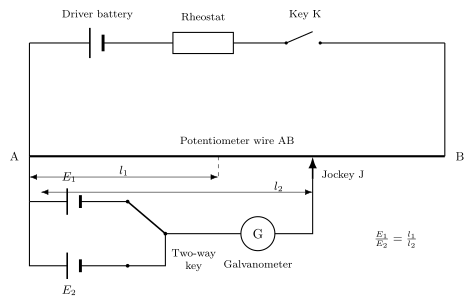
A potentiometer measures emf without drawing current from the cell (null-deflection method), by balancing it against a known, proportional potential drop along a uniform wire.
Principle: When a steady current is maintained through a wire of uniform cross-section and material, the potential drop across any length of the wire is directly proportional to that length: , i.e. , where (the potential gradient) is constant along the wire.
Comparing emfs of two cells: A potentiometer wire AB is connected in series with a driver battery (of emf greater than either cell) and a rheostat, so a steady current flows through the wire, setting up a uniform potential gradient along it.
The two cells (emfs and ) are connected, one at a time (via a two-way key), in a secondary loop containing a galvanometer and a jockey that touches the wire at a variable point.
…
Unlock everything free for 14 days
- Full step-by-step solutions
- Concept-first explanations
- Methods, shortcuts & mistakes
- PYQ mapping + timed mock tests
Full access for 14 days. No credit card required.