Q.(a) State Kirchoff's law for an electrical network. Using these laws deduce the condition for balance in a Wheatstone Bridge.
You're viewing a preview — the full solution, concept, methods & PYQ mapping are locked.
Start your 14-day free trial to unlock the full solution →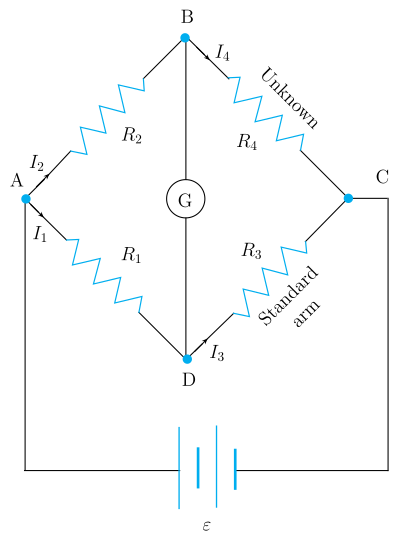
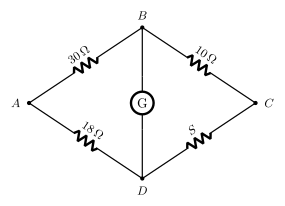
Kirchhoff's current law (junction rule) and voltage law (loop rule) applied to a Wheatstone bridge circuit give the balance condition P/Q = R/S; for three identical resistors in parallel with combined resistance R/3, each resistor must itself equal R.
(a) Kirchhoff's laws and the Wheatstone bridge:
Kirchhoff's Current Law (Junction/First Law): At any junction in an electrical network, the algebraic sum of currents meeting at that junction is zero (i.e. total current entering = total current leaving). This follows from conservation of charge.
Kirchhoff's Voltage Law (Loop/Second Law): In any closed loop of a network, the algebraic sum of the potential differences (IR products) and the emfs is zero. This follows from conservation of energy.
Wheatstone bridge: It is a network of four resistors P, Q, R, S arranged in a rhombus/diamond, with a battery connected across one diagonal (through the P–Q side and R–S side) and a galvanometer connected across the other diagonal, connecting the P–Q junction to the R–S junction. At balance, no current flows through the galvanometer.
Apply KCL at the two junctions: if flows through P then also through R (since the galvanometer carries no current), and flows through Q then also through S.
Apply KVL to the loop containing P, the galvanometer, and Q: since no current (and hence no potential drop) occurs across the galvanometer at balance, the junction of P–Q and the junction of R–S are at the same potential, so
Dividing these two equations: …
Unlock everything free for 14 days
- Full step-by-step solutions
- Concept-first explanations
- Methods, shortcuts & mistakes
- PYQ mapping + timed mock tests
Full access for 14 days. No credit card required.