Q.Assertion (A) : In a Wheatstone bridge circuit, if we interchange the position of the cell and the galvanometer, the balance condition remains unchanged. Reason (R) : , so the balance condition remains the same. (A) Both Assertion (A) and Reason (R) are true and Reason (R) is the correct explanation of the Assertion (A). (B) Both Assertion (A) and Reason (R) are true, but Reason (R) is not the correct explanation of the Assertion (A). (C) Assertion (A) is true, but Reason (R) is false. (D) Both Assertion (A) and Reason (R) are false.
You're viewing a preview — the full solution, concept, methods & PYQ mapping are locked.
Start your 14-day free trial to unlock the full solution →The assertion is true because the Wheatstone bridge is a reciprocal network, but the reason given (a trivial algebraic manipulation) does not explain why interchanging the cell and galvanometer preserves balance. The correct option is (B).
The Wheatstone bridge is a beautiful example of a reciprocal circuit. When balanced, no current flows through the galvanometer because the potential difference across it is zero. The question asks whether swapping the positions of the cell and galvanometer affects this balance condition.
The assertion claims the balance condition remains unchanged after the swap. This is indeed true, and follows from the reciprocity theorem in circuit theory: in a linear, bilateral network (one with resistors only, no diodes or other one-way elements), interchanging a voltage source and a current-measuring device does not change the current through the measuring device.
The reason given, however, is just the algebraic statement that implies . While mathematically correct, this doesn't explain anything about the physical interchange of components. It's a red herring.
Let me show why the assertion is actually true:
-
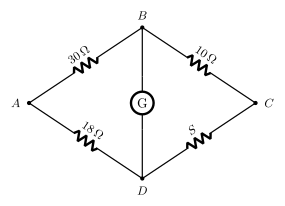
Original configuration: The cell is connected between two opposite nodes (say A and C), and the galvanometer between the other two (B and D). At balance, the potentials at B and D are equal, so .
-
Deriving the balance condition: Using voltage dividers along the two arms:
Setting gives , which simplifies to .
-
After interchange: Now the cell is between B and D, and the galvanometer between A and C. For balance, we need (no current through the galvanometer).
-
New balance condition: With the cell across B–D, we can write: …
Unlock everything free for 14 days
- Full step-by-step solutions
- Concept-first explanations
- Methods, shortcuts & mistakes
- PYQ mapping + timed mock tests
Full access for 14 days. No credit card required.