Q.Four point charges qA=2μC, qB=−5μC, qC=2μC, and qD=−5μC are located at the corners of a square ABCD of side 10cm. What is the force on a charge of 1μC placed at the centre of the square?
🔒You're viewing a preview — the full solution, concept, methods & PYQ mapping are locked.
🔒 Start your 14-day free trial to unlock the full solution →Concept understanding — Coulomb Force Superposition
Coulomb Force Superposition – From Intuition to Precision
Imagine you're in a room with three friends. Each friend can push or pull you. If two friends push you from the same side, you feel a stronger push — the combined effect. If one pushes from the left and another from the right, you feel the net effect, which might be smaller or even zero if they push equally hard.
This is exactly how electric forces work. When multiple charged particles are present, each one exerts its own force on a given charge. The total force that charge feels is simply the vector sum of all the individual forces — as if each other charge were acting alone, completely ignoring the presence of the rest.
That's the core idea: forces add like arrows, not like numbers.
The Precise Statement
Fnet on q0=∑i=1nFi→0=4πε01∑i=1nri02q0qir^i0
Where:
- q0 is the charge you're calculating the force on
- qi are all other charges (excluding q0 itself)
- ri0 is the distance between qi and q0
- r^i0 is a unit vector pointing from qi to q0 (or away, depending on sign convention — be consistent)
The key point: Each pair of charges interacts independently. The presence of a third charge does not alter the force between the first two. This is what "superposition" means — the forces simply layer on top of each other.
Why This Matters (and a Common Trap)
Never add the magnitudes of forces directly unless all forces are along the same line and in the same direction. Force is a vector — direction matters.
If two forces point in opposite directions, they partially cancel. If they're at right angles, the net force is found using the Pythagorean theorem, not simple addition.
Example: Three charges on a line:
- q1=+2μC at x=0
- q2=−1μC at x=3cm
- q0=+1μC at x=1cm
Step 1: Force from q1 on q0 — both positive, so repulsive. q0 is pushed to the right.
Step 2: Force from q2 on q0 — opposite signs, so attractive. q0 is pulled to the right (toward q2).
Step 3: Both forces point right. Now you add magnitudes: Fnet=F1→0+F2→0.
If q2 were also positive, the force from q2 would push q0 left, and you'd subtract.
The Deeper Reason
Coulomb's law is a linear law — the force is proportional to each charge individually. If you double q1, the force from q1 doubles, but the force from q2 stays the same. This linearity is what makes superposition possible. It's not a coincidence — it's a fundamental property of electromagnetic interactions at the classical level.
Superposition works because electric forces obey a linear inverse-square law. If the force depended on products of three charges (like q0q1q2), superposition would fail. It doesn't — and that's why we can break down any multi-charge problem into a series of two-charge calculations.
--- …
Why this formula?
Coulomb Force Superposition — Why the Formula Holds
The principle of superposition for Coulomb forces states that the net electrostatic force on a given charge due to a collection of other charges is the vector sum of the individual forces from each charge, as if the others were absent.
The Key Formula
If we have a charge q0 at position r0, and N other point charges q1,q2,…,qN at positions r1,r2,…,rN, the net force on q0 is:
Fnet=4πε01∑i=1N∣r0−ri∣2q0qir^0i
where r^0i is the unit vector pointing from qi to q0.
Why This Works — The Physical Reasoning
1. Coulomb's Law is a Two-Body Interaction
Coulomb's law describes the force between exactly two point charges. It depends only on:
- The product of their charges (q0qi)
- The inverse square of the distance between them
- The direction along the line joining them
Crucially, the force between q0 and qi does not depend on the presence of any other charges qj.
2. Forces Add as Vectors (Newton's Third Law + Linearity)
Electrostatic forces are real physical forces — they obey Newton's laws. If multiple forces act on the same charge, the net effect is the vector sum of each individual force. This is a fundamental property of forces in classical mechanics.
3. The Electric Field is Linear
A deeper reason: the electric field E obeys superposition. Since F=q0E, and E from multiple sources adds linearly, the force automatically adds linearly.
The electric field at r0 due to qi is:
Ei(r0)=4πε01∣r0−ri∣2qir^0i
Then:
Fnet=q0∑iEi=∑iFi
The Crucial Assumption (Why It's Not Trivial)
Superposition holds because Maxwell's equations are linear in the electric field. If the equations were nonlinear (e.g., if the field depended on E2), then the force from two charges together would not be the sum of the individual forces.
In electrostatics, the electric field satisfies:
∇⋅E=ε0ρ,∇×E=0
Both equations are linear — if E1 and E2 are solutions, then E1+E2 is also a solution. This linearity is the mathematical reason superposition works.
--- …
The key idea is the Principle of Superposition of Coulomb Forces. The net force on a charge is the vector sum of individual forces exerted by all other charges.
- Let q0=1μC be the charge at the center of the square. The distance from the center to each corner (A, B, C, D) is identical. Let this distance be r.
- The force FA exerted by qA on q0 is repulsive and directed away from A. The force FC exerted by qC on q0 is repulsive and directed away from C. Since qA=qC=2μC and the distances are equal, ∣FA∣=∣FC∣. As these forces act along the same diagonal (AC) in opposite directions, their vector sum is FA+FC=0. …
The problem involves calculating the net electrostatic force on a charge placed at the center of a square due to four charges at its corners. By applying Coulomb's Law and the Principle of Superposition, and recognizing the symmetry of the charge distribution, the forces from diagonally opposite charges cancel each other out, resulting in a net force of zero on the central charge.
When multiple charges exert forces on a single charge, the net force is the vector sum of all individual forces. This is known as the Principle of Superposition. Each individual force is calculated using Coulomb's Law, which describes the magnitude and direction of the electrostatic force between two point charges.
The magnitude of the electrostatic force between two point charges q1 and q2 separated by a distance r is given by Coulomb's Law:
F=kr2∣q1q2∣
where k=9×10⁹N⋅m2/C2 is Coulomb's constant. The force is repulsive if the charges have the same sign and attractive if they have opposite signs.
The key to solving this problem efficiently lies in understanding the vector nature of forces and recognizing the symmetry of the setup.
Let's break down the solution step-by-step:
-
Visualize the Setup and Determine Geometry
Imagine a square ABCD with side s=10cm=0.1m. Let the center of the square be point O. A charge q0=1μC is placed at O. The charges at the corners are:
- qA=2μC
- qB=−5μC
- qC=2μC
- qD=−5μC
First, we need to find the distance from each corner to the center of the square. The diagonal of the square is d=s2. The distance from a corner to the center, let's call it r, is half the diagonal:
r=2d=2s2
Substituting s=0.1m:
r=20.12=0.052m
It's often easier to work with r2:
r2=(0.052)2=(0.05)2×2=0.0025×2=0.005m2.
All four corner charges are equidistant from the center.
-
Calculate the Magnitudes of Individual Forces
We will calculate the magnitude of the force exerted by each corner charge on the central charge q0. Remember to use absolute values for charges in the magnitude calculation.
-
Force from qA on q0 (FA):
∣FA∣=kr2∣qAq0∣=(9×10⁹N⋅m2/C2)0.005m2∣(2×10−6C)(1×10−6C)∣
∣FA∣=(9×10⁹)0.0052×10−12=(9×10⁹)5×10−32×10−12
∣FA∣=518×10(9−12+3)=3.6×100=3.6N
-
Force from qB on q0 (FB):
∣FB∣=kr2∣qBq0∣=(9×10⁹N⋅m2/C2)0.005m2∣(−5×10−6C)(1×10−6C)∣
∣FB∣=(9×10⁹)0.0055×10−12=(9×10⁹)5×10−35×10−12
∣FB∣=9×10(9−12+3)=9×100=9N
-
Force from qC on q0 (FC):
Since qC=qA=2μC and the distance r is the same, the magnitude of the force will be identical to FA:
∣FC∣=∣FA∣=3.6N
-
Force from qD on q0 (FD):
Since qD=qB=−5μC and the distance r is the same, the magnitude of the force will be identical to FB:
∣FD∣=∣FB∣=9N
-
-
Determine the Directions of Individual Forces
The central charge q0=1μC is positive.
Let's assume the corners are labeled counter-clockwise starting from top-right: A (top-right), B (top-left), C (bottom-left), D (bottom-right). The center is O.
-
Force FA (from qA on q0): qA is positive, q0 is positive. The force is repulsive. This means FA points away from qA, along the diagonal from A through O, towards corner C.
(i.e., FA points from O towards C).
-
Force FC (from qC on q0): qC is positive, q0 is positive. The force is repulsive. This means FC points away from qC, along the diagonal from C through O, towards corner A.
(i.e., FC points from O towards A).
-
Force FB (from qB on q0): qB is negative, q0 is positive. The force is attractive. This means FB points towards qB, along the diagonal from O towards corner B.
(i.e., FB points from O towards B). …
-
Concept: Coulomb Force Superposition – net force is the vector sum of individual forces from each corner charge.
Step 1: Geometry
Side =0.1m, so half-diagonal (distance from centre to any corner) is
r=20.1=0.052m.
Step 2: Force from one corner
For a 1μC test charge at centre, magnitude from any corner charge q is
F=kr2∣q∣×1μC,k=9×10⁹N⋅m2/C2.
For ∣q∣=5μC:
F5=9×109×(0.052)25×10−6×10−6=9×109×0.0055×10−12=9N.
For ∣q∣=2μC:
F2=9×109×0.0052×10−12=3.6N.
Step 3: Vector addition …
Here are the most common mistakes students make when solving this classic Coulomb force superposition problem, along with how to avoid each.
1. Forgetting the Vector Nature of Force
The Mistake:
Students often compute the magnitude of the force from each q on Q correctly, but then simply add them as scalars (e.g., Fnet=F1+F2+F3).
Why it’s wrong:
Coulomb force is a vector. Forces from different charges point in different directions. Adding magnitudes directly ignores direction and gives an incorrect (usually larger) result.
How to Avoid:
Always draw a clear diagram showing the direction of each force vector. Use vector addition (component method or symmetry) — never scalar addition.
2. Not Using Symmetry to Simplify
The Mistake:
Students calculate all three force vectors explicitly, resolve into components, and sum — a long, error-prone process.
Why it’s wrong:
It wastes time and increases the chance of algebraic mistakes. The problem has perfect symmetry.
How to Avoid:
Recognize that the three charges are identical and placed at vertices of an equilateral triangle. The centroid is equidistant from all vertices. By symmetry, the three force vectors are equal in magnitude and spaced 120∘ apart. Their vector sum is zero.
Key result: The net force on Q at the centroid is Fnet=0.
3. Incorrect Distance Calculation
The Mistake:
Using l (side length) as the distance between a vertex charge and the centroid.
Why it’s wrong:
The distance from a vertex to the centroid of an equilateral triangle is not l. It is 3l.
How to Avoid:
Memorize or derive:
- Centroid divides the median in ratio 2:1.
- Median length =23l.
- Distance from vertex to centroid =32×median=32⋅23l=3l.
Use r=3l in Coulomb’s law.
4. Sign Confusion in Force Direction
The Mistake:
If Q and q have the same sign, students sometimes draw forces as attractive.
Why it’s wrong:
Like charges repel. All three forces on Q are repulsive and point radially outward from each vertex.
How to Avoid:
Always check: same sign → repulsion (force away from the other charge). Opposite sign → attraction (force toward the other charge). Draw arrows accordingly.
--- …
Showing the 12 most recent of 36 on this concept.
- AP EAPCET 2026Set eng-2026-05-13-FN1 markMCQQ.Two identical balls each of mass 340 g carry equal and opposite charge. They are suspended from a horizontal plate by silk threads each of length 1 m with a separation of 1.5 m between points of suspension. At equilibrium, if the distance between the balls is 30 cm then, magnitude of charge on each ball is (Acceleration due to gravity =10 ms−2) (A) 10−6 C (B) 10−5 C (C) 10−4 C (D) 10−3 C
›Reveal solutionSolution
Two oppositely charged balls hung from points 1.5 m apart pull together to a 30 cm separation; equating the horizontal Coulomb attraction to mgtanθ gives q≈10−6 C.
Concept and Intuition
Each ball hangs on a 1 m thread. If uncharged, gravity alone would make each thread hang straight down, so the two balls would sit directly below their suspension points — meaning the natural, force-free separation between the balls equals the 1.5 m separation between the suspension points. Because the two charges are opposite in sign, the Coulomb force between them is attractive, so the balls are pulled towards each other until they settle at the smaller observed separation of 30 cm. At equilibrium, each thread makes an angle θ with the vertical, and the horizontal component of tension balances the attractive electric force while the vertical component balances gravity — the classic "tan θ" trick used for suspended-charge problems.
Step-by-Step Solution
- Mass of each ball: m=340×10−3 kg, so mg=340×10−3×10=0.13 N.
- Natural separation (uncharged) = suspension-point separation = 1.5 m. Actual separation = 0.30 m, so total inward shift = 1.5−0.3=1.2 m, i.e. each ball/thread moves in by 0.6 m.
- Each thread has length 1 m and horizontal displacement 0.6 m: sinθ=0.6/1=0.6, so cosθ=0.8 and tanθ=0.6/0.8=0.75. …
- AP EAPCET 2026Set eng-2026-05-14-AN1 markMCQQ.If A, B and C represent the work done, distance and electric charge respectively, Then the physical quantity having the dimensions of ABC2 is (A) Permittivity (B) Permeability (C) Electric potential (D) Electric energy
›Reveal solutionSolution
Working out the dimensional formula of C2/(AB) (charge² over work·distance) shows it matches the dimensional formula of the permittivity of free space, ε0.
Concept and Intuition
Coulomb's law F=4πε01r2q1q2 directly ties ε0 to charge, force, and distance: ε0=4πFr2q2. Since force = work/distance, this becomes ε0∝(work)(distance)charge2 — exactly the combination C2/(AB) given in the problem (with A= work, B= distance, C= charge).
Step-by-Step Solution
- Write the dimensional formulas: [A]=work=ML2T−2, [B]=distance=L, [C]=charge=IT.
- Compute ABC2=(ML2T−2)(L)(IT)2=ML3T−2I2T2=I2T4M−1L−3.
- Recall ε0 from Coulomb's law: ε0=4πFr2q1q2, so [ε0]=(MLT−2)(L2)(IT)2=ML3T−2I2T2=I2T4M−1L−3.
- This exactly matches the dimensional formula computed for C2/(AB) in step 2. …
- AP EAPCET 2026Set eng-2026-05-14-AN1 markMCQQ.Charges q, 2q, 3q and 4q are placed at the corners A, B, C and D of a square as shown in the figure. The direction of electric field at the centre 'O' of the square is along [FIGURE: a square with A at the bottom-left carrying charge q, B at the bottom-right carrying charge 2q, C at the top-right carrying charge 3q, D at the top-left carrying charge 4q; O is the centre of the square; the diagonals AC and BD are drawn dashed, intersecting at O] (A) AB (B) CB (C) BD (D) AC
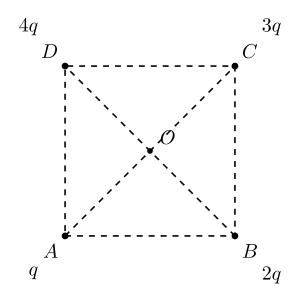
›Reveal solutionSolution
Since all four corners are equidistant from the centre, each charge contributes a field of magnitude ∝ its charge, directed away from itself through O. Vector-adding all four (or pairing diagonals first) gives a resultant pointing along CB.
Concept and Intuition
At the centre of a square, every corner is the same distance from O (half the diagonal), so the relative field contributions depend only on the charge magnitudes, each directed radially outward from its own corner (for positive charges) through O. The cleanest way to combine four such vectors is to pair the diagonally-opposite ones first, since their directions are exactly opposite (anti-parallel) along each diagonal — the pair simply nets to (larger charge − smaller charge) pointing away from the larger one, i.e. toward the smaller-charge corner.
Step-by-Step Solution
- Assign coordinates matching the figure: A(0,0)=q, B(1,0)=2q, C(1,1)=3q, D(0,1)=4q, centre O(0.5,0.5).
- Diagonal AC (A=q, C=3q): the two fields point in opposite directions along AC. Net magnitude ∝∣q−3q∣=2q, directed from C toward A (pointing away from the larger charge, C).
- Diagonal BD (B=2q, D=4q): similarly, net magnitude ∝∣2q−4q∣=2q, directed from D toward B (away from the larger charge, D).
- Both diagonals are perpendicular to each other, so resolve into x–y components and add:
- AC-pair vector: magnitude 2q along direction (−1,−1)/2 (toward A): components (−2q,−2q).
- BD-pair vector: magnitude 2q along direction (1,−1)/2 (toward B): components (2q,−2q). …
- AP EAPCET 2026Set eng-2026-05-13-AN1 markMCQQ.Two point charges Q and −4Q are separated by a distance r. If electric field at the location of Q is E, then the field at the location of −4Q is (A) E (B) −E (C) −4E (D) 4E
›Reveal solutionSolution
This tests careful use of Coulomb's law with vector direction: the field due to one point charge at the other charge's location is found by considering only the source charge's magnitude and sign, and both fields here point the same way along the line joining the charges.
Concept and Intuition
The electric field "at the location of Q" must be produced by the other charge, −4Q (a charge doesn't act on itself). Likewise, the field "at the location of −4Q" is produced only by Q. Both fields lie along the line joining the two charges, so we just need their magnitudes (Coulomb's law, E=kq/r2) and their directions (field points away from a positive source, toward a negative source).
Step-by-Step Solution
- Set up coordinates: put Q at the origin and −4Q at position x=r (so the vector from Q to −4Q points in +x^).
- Field at Q's location due to −4Q: since −4Q is negative, the field it creates points toward itself — i.e. from Q's position toward −4Q's position, which is the +x^ direction. Magnitude =r2k(4Q). So E=r24kQx^.
- Field at −4Q's location due to Q: since Q is positive, the field it creates points away from itself — i.e. also in the +x^ direction (away from Q, through −4Q's position and beyond). Magnitude =r2kQ. So this field =r2kQx^. …
- AP EAPCET 2026Set eng-2026-05-13-AN1 markMCQQ.If two positive charges each of 20 μC are placed at the two vertices of an equilateral triangle of side 50 cm and a third positive charge of 103 μC is placed at the centroid of the triangle, then the electrostatic potential energy of the system of three charges is (A) 14.4 J (B) 57.6 J (C) 28.8 J (D) 21.6 J
›Reveal solutionSolution
This tests computing total electrostatic potential energy of a 3-charge system by summing all three pairwise interaction energies, using the geometric fact that an equilateral triangle's centroid is at distance a/3 from each vertex.
Concept and Intuition
The total electrostatic potential energy of a system of point charges is the sum of the potential energies of every distinct pair:
U=∑i<jrijkqiqj.
Here two charges sit at vertices of an equilateral triangle (separated by the full side length a), and the third sits at the centroid. For an equilateral triangle of side a, the distance from the centroid to each vertex is the circumradius, R=3a (derivable from height h=23a and centroid dividing the median in ratio 2:1 from the vertex, giving R=32h=3a).
Step-by-Step Solution
- Side of triangle: a=50 cm=0.5 m.
- Charges at the two vertices: q1=q2=20 μC=20×10−6 C. Charge at centroid: q3=103 μC=103×10−6 C.
- Distance between the two vertex charges: r12=a=0.5 m.
- Distance from centroid to each vertex: r13=r23=3a=30.5 m.
- Pairwise energy between the two vertex charges:
U12=r12kq1q2=0.59×109×(20×10−6)2=0.59×109×4×10−10=0.53.6=7.2 J.
- Pairwise energy between a vertex charge and the centroid charge: U13=a/3kq1q3=0.5/39×109×20×10−6×103×10−6. …
- AP EAPCET 2026Set eng-2026-05-15-FN1 markMCQQ.Two similar rods of length l=1m carrying equal charges (q)=10−8C are placed as shown in figure. The electric field at point 'O' approximately is, if d=0.25m [FIGURE: one rod is vertical carrying positive charge, standing at height l above point O with a gap d between the rod's lower end and O; a second rod lies horizontal carrying positive charge, starting at horizontal distance d from O and extending length l to the right] (A) 450 Vm−1 (B) 568 Vm−1 (C) 406 Vm−1 (D) 203 Vm−1
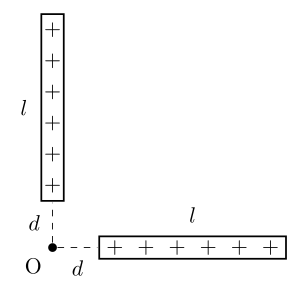
›Reveal solutionSolution
Each rod produces an axial field at O of magnitude kλl/[d(d+l)], directed away from it; the two contributions are mutually perpendicular (one vertical, one horizontal) and equal in magnitude, so the resultant is E02≈406 Vm−1.
Concept and Intuition
For a point lying on the extension of a uniformly charged rod's own axis (i.e. off one end, along the line containing the rod), the field is found by integrating Coulomb's law element-by-element along the rod: E=∫dd+ly2kλdy=kλ(d1−d+l1)=d(d+l)kλl. Here, O sits exactly on the axis of each rod (the vertical rod's axis is the vertical line through O; the horizontal rod's axis is the horizontal line through O), so this formula applies twice — once for each rod — and the two resulting field vectors are perpendicular because the rods themselves are perpendicular. Equal charge, length, and gap d make the two magnitudes identical, so they combine via Pythagoras.
Step-by-Step Solution
- Linear charge density: λ=lq=110−8=10−8 C/m.
- Axial field magnitude from one rod: E0=d(d+l)kλl, with k=9×10⁹, d=0.25 m, l=1 m so d+l=1.25 m.
- E0=0.25×1.259×109×10−8×1=0.312590=288 V/m. …
- AP EAPCET 2025Set eng-2025-05-21-FN1 markMCQQ.The force between two point charges kept with a separation of 9 cm in air is 98 N. If a dielectric slab of constant 4, thickness 6 cm and another dielectric slab of constant 9, thickness 3 cm are introduced between the two charges, then the new force becomes (A) 18 N (B) 36 N (C) 49 N (D) 84 N
›Reveal solutionSolution
This tests the effect of dielectric slabs placed between two point charges on the Coulomb force between them, using the effective-separation method. Answer: 18 N.
Concept and Intuition
When the entire gap between two point charges is filled with a dielectric of constant K, the force reduces by a factor of K (Coulomb's law inside a dielectric medium). When only part of the path is filled by slabs of finite thickness, each slab behaves as though it stretches that portion of the path by a factor K — exactly as an optical medium of refractive index n=K increases the effective (optical) path length of light travelling through it. So the total effective separation becomes the sum of the untouched air gaps plus tK for each slab, and the force follows the inverse-square law using this effective separation.
Step-by-Step Solution
- Original separation d=9 cm, giving F=98 N in air.
- Slab 1: thickness t1=6 cm, constant K1=4, so K1=2; its effective length becomes t1K1=12 cm.
- Slab 2: thickness t2=3 cm, constant K2=9, so K2=3; its effective length becomes t2K2=9 cm.
- Since t1+t2=6+3=9 cm =d, the slabs fill the whole gap (no leftover air gap). …
- AP EAPCET 2025Set eng-2025-05-21-AN1 markMCQQ.Three particles of each charge q are placed at the vertices of an equilateral triangle of side L. The work to be done to decrease the side of the triangle to 2L is (A) 4πε01Lq2 (B) 4πε01L2q2 (C) 4πε01L3q2 (D) 4πε012L3q2
›Reveal solutionSolution
The work needed to squeeze the triangle equals the increase in total electrostatic potential energy of the three like charges, which comes out to 4πε01L3q2.
Concept and Intuition
By the work-energy theorem for conservative electrostatic forces, the external work done to slowly rearrange a system of charges (with no change in kinetic energy) equals the change in the system's total electrostatic potential energy. For like charges (here all charge q, presumably same sign since they repel and require positive work to bring closer), moving them closer together requires positive work because we're pushing against their mutual repulsion.
Step-by-Step Solution
- For a system of point charges, total PE is the sum over all distinct pairs: U=∑4πε01rijqiqj.
- In an equilateral triangle of side L with three equal charges q, there are 3 pairs, each at separation L: Ui=3×4πε01Lq2.
- When the side shrinks to L/2 (still equilateral, so all three pairwise distances are equal to L/2): Uf=3×4πε01L/2q2=4πε01L6q2. …
- AP EAPCET 2025Set ap-2025-05-19-AN1 markMCQQ.Three point charges +10 μC, +20 μC and +40 μC are placed at the vertices of an equilateral triangle of side 1m. The electrostatic potential energy of the system of the charges is (A) 6.3 J (B) 12.6 J (C) 25.2 J (D) 21.6 J
›Reveal solutionSolution
Total electrostatic potential energy of a system of point charges is the sum over every pair; for this equilateral triangle (all sides 1 m) it works out to 12.6 J.
Concept and Intuition
Potential energy of a system of charges is the work needed to assemble them, which is the sum of the pairwise interaction energies rijkqiqj over all distinct pairs. Since the triangle is equilateral, every pairwise distance is the same (1 m), which simplifies the calculation to a single sum of products.
Step-by-Step Solution
- Pairs and their charge products: q1q2=10×20=200, q1q3=10×40=400, q2q3=20×40=800 (all in μC2).
- Sum: 200+400+800=1400 μC2=1400×10−12 C2. …
- AP EAPCET 2025Set ap-2025-05-19-FN1 markMCQQ.If three particles of each charge +q are placed at the three vertices of an equilateral triangle of side 3r, then the net electric field at the centroid of the triangle is (A) 4πε01rq (B) 4πε01r2q (C) 4πε01r23q (D) zero
›Reveal solutionSolution
Three identical charges at the vertices of an equilateral triangle create fields at the centroid that are equal in magnitude and symmetrically arranged at 120∘ to each other — they cancel exactly, giving zero net field.
Concept and Intuition
The centroid of an equilateral triangle is equidistant from all three vertices, so each charge contributes an electric field of the same magnitude at that point. Because the triangle has three-fold rotational symmetry, the three field vectors (each pointing away from its source charge, since the charges are positive) are oriented 120∘ apart from one another. Three equal-magnitude vectors symmetrically spaced by 120∘ always add to zero — this is a standard vector identity (same reasoning as why three equal forces at 120∘ balance).
Step-by-Step Solution
- Side of triangle =3r; centroid-to-vertex distance for an equilateral triangle of side a is 3a.
- So centroid-to-vertex distance =33r=r.
- Each charge contributes field magnitude E=4πε01r2q at the centroid, directed away from that vertex. …
- AP EAPCET 2025Set ap-2025-05-20-AN1 markMCQQ.Three point charges +Q, q and +Q are placed on x-axis at distances 0,2d and d respectively from the origin. If the resultant electrostatic force on the point charge +Q placed at x=0 is zero, then the value of q is (A) +2Q (B) −2Q (C) −4Q (D) +4Q
›Reveal solutionSolution
This tests force balance for three collinear charges; the middle charge must be negative and of magnitude Q/4 to cancel the repulsion from the far +Q.
Concept and Intuition
The charge +Q at the origin feels two forces: a repulsion from the +Q at x=d (pushing it toward −x), and a force from q at x=d/2. For the net force to be zero, the force from q must point in the +x direction — i.e., q must attract the origin charge, meaning q is negative.
Step-by-Step Solution
- Force from +Q at x=d on the origin charge: F2=d2kQ2, directed along −x (repulsive).
- Force from q at x=d/2 on origin charge must be equal in magnitude and directed along +x (attractive), so q < 0.
- Magnitude: F1=(d/2)2kQ∣q∣=d24kQ∣q∣. …
- AP EAPCET 2025Set eng-2025-05-24-FN1 markMCQQ.The sum of two point positive charges separated by a distance of 1.5 m in air is 25μC. If the electrostatic force between the two charges is 0.6 N, then the difference between the two charges is (A) 5μC (B) 8μC (C) 3μC (D) 6μC
›Reveal solutionSolution
This tests using Coulomb's law together with a sum constraint to find two unknown charges. The difference between the charges comes out to 5μC.
Concept and Intuition
Coulomb's law gives the product of two charges from a measured force, while the problem separately gives their sum. Two numbers with a known sum and a known product are exactly the roots of a quadratic equation — this is the standard algebraic trick used whenever 'sum and product' of two charges (or masses, etc.) are both known.
Step-by-Step Solution
- Coulomb's law: F=r2kq1q2, so q1q2=kFr2=9×1090.6×(1.5)2=9×1090.6×2.25=1.5×10⁻¹⁰ C2.
- Convert to μC2: 1.5×10⁻¹⁰ C2=150 (μC)2 (since 1(μC)2=10−12C2).
- Given q1+q2=25μC and q1q2=150(μC)2, form the quadratic x2−25x+150=0. …
🎓Unlock everything free for 14 days
- ✓Full step-by-step solutions
- ✓Concept-first explanations
- ✓Methods, shortcuts & mistakes
- ✓PYQ mapping + timed mock tests
Full access for 14 days. No credit card required.