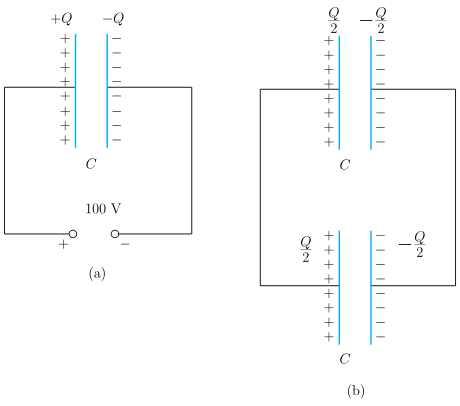
Q.(a) A 900 pF capacitor is charged by 100 V battery [Fig. 2.31(a)]. How much electrostatic energy is stored by the capacitor?
🔒You're viewing a preview — the full solution, concept, methods & PYQ mapping are locked.
🔒 Start your 14-day free trial to unlock the full solution →Concept understanding — Capacitor Energy Storage
Capacitor Energy Storage
The Intuition
Charging a capacitor is like piling sand onto a growing heap. The first grain of charge lands on an empty plate easily. But every later bit of positive charge must be pushed onto a plate that is already positive, and it resists. So more and more work is needed as the plate fills up. All of that work does not disappear — it is stored in the capacitor as electrostatic potential energy, ready to be released later.
Building the Formula
Suppose at some instant during charging the capacitor already holds charge q, so the voltage across it at that moment is v=q/C. Moving one more small charge dq onto the plate costs work:
dW=vdq=Cqdq
Adding up (integrating) all these small contributions as the charge builds from 0 to a final value Q gives the total work done:
W=∫0QCqdq=C1⋅2Q2=2CQ2
This work is exactly the energy U stored in the charged capacitor.
Three Equivalent Forms
Using Q=CV, the same stored energy can be written three ways — pick whichever matches the quantities you know:
U=2CQ2=21QV=21CV2
- Use 2CQ2 when the charge is fixed (capacitor disconnected from the source).
- Use 21CV2 when the voltage is fixed (capacitor stays connected to a battery).
The factor of 21 is essential. A common error is writing U=QV. That would only be true if the full voltage V acted while all the charge moved — but the voltage climbs steadily from 0 to V as the plates fill, so the effective average voltage is V/2, giving U=21QV.
Where the Energy Lives — Energy Density
The energy is stored in the electric field occupying the space between the plates, not on the plates themselves. For a parallel-plate capacitor this leads to a general result: energy stored per unit volume of field is
u=21ε0E2
where E is the field strength. Wherever an electric field exists, energy is stored there, with density proportional to E2.
A Quick Example
A 10 μF capacitor is charged to 100 V. The stored energy is:
U=21CV2=21×(10×10−6)×(100)2=0.05 J
That 0.05 J can be released almost instantly — which is exactly how a camera flash works: charge slowly, discharge fast. …
Concept: Capacitor Energy Storage — U=21CV2=Q2/2C; connecting a charged capacitor to an identical uncharged one conserves total charge but not total energy.
(a) C=900 pF=9×10⁻¹⁰ F, V=100 V:
Ui=21CV2=21(9×10⁻¹⁰)(100)2=4.5×10⁻⁶ J.
(b) Disconnected, the charge Q=CV=9×10⁻⁸ C is fixed. Connected to an identical uncharged 900 pF capacitor (now in parallel, Ceq=1.8×10⁻⁹ F), it splits equally, 4.5×10⁻⁸ C each: …
Energy stored in a charged capacitor is U=21CV2=Q2/2C. Charging 900 pF to 100 V stores Ui=4.5 μJ (part a). Once disconnected from the battery and connected to an identical uncharged 900 pF capacitor, the fixed total charge splits equally between the two (now-parallel) capacitors, and the system's total stored energy drops to exactly half, Uf=2.25 μJ (part b) — the rest is dissipated as heat/spark during the redistribution.
Part (a): energy stored while connected to the battery
C=900 pF=9×10⁻¹⁰ F,V=100 V.
Using U=21CV2:
Ui=21(9×10⁻¹⁰)(100)2=21(9×10⁻¹⁰)(104)=4.5×10⁻⁶ J=4.5 μJ.
The charge on the capacitor at this point is Q=CV=(9×10⁻¹⁰)(100)=9×10⁻⁸ C — this is the charge carried over into part (b).
Part (b): disconnect, then connect to an identical uncharged capacitor
Once the battery is removed, the charge Q=9×10⁻⁸ C on the first capacitor is fixed (nothing left to add or remove charge). Connecting it to a second, identical, uncharged 900 pF capacitor puts the two in parallel, and since there is no external source, the total charge Q must simply redistribute between them.
By symmetry (identical capacitors), the charge splits equally:
Q1=Q2=2Q=4.5×10⁻⁸ C.
The combined (parallel) capacitance is Ceq=C+C=1.8×10⁻⁹ F, and the total stored energy afterward is …
Method: Capacitor Energy Storage — Whether the Capacitor Stays Connected to the Source or Is Isolated
This method applies to any problem comparing a capacitor's stored energy before and after some change (adding a dielectric, connecting to another capacitor, disconnecting from the battery) — the correct formula to use depends on what is held fixed during the change.
Steps
Step 1: Decide what is held constant — voltage or charge
If the capacitor stays connected to a battery throughout, the voltage across it is fixed by the battery; use U=21CV2. If the capacitor is disconnected from every source before the change happens, its charge is fixed (nothing can add or remove charge); use U=2CQ2.
Step 2: Compute the initial energy with the appropriate formula
Use whichever of U=21CV2, U=21QV, or U=Q2/2C matches the quantities actually given at that stage.
Step 3: For a "disconnect, then connect to another capacitor" scenario, apply charge conservation first …
- AP EAPCET 2026Set eng-2026-05-18-FN1 markMCQQ.A parallel plate capacitor of capacitance 12 μF is charged to a potential of 180 V. If the distance between the plates of the capacitor is π3 mm, then the energy density of the electric field between the plates of the capacitor is (A) 25×10−6 Jm−3 (B) 25×10−3 Jm−3 (C) 50×10−6 Jm−3 (D) 50×10−3 Jm−3
›Reveal solutionSolution
Energy density between capacitor plates is u=21ε0E2 with E=V/d; it doesn't actually need the capacitance value. Answer: 50×10−3 Jm−3.
Concept and Intuition
The energy density stored in the electric field of a parallel plate capacitor is a local property of the field strength, u=21ε0E2. It does not depend on the plate area or capacitance directly — only on how strong the field is, which is set by E=V/d. This is a useful distinction from total energy U=21CV2, which does depend on the geometry (through C). Since the question only asks for energy density, the plate area/capacitance is redundant information here.
Step-by-Step Solution
- Convert the plate separation: d=π3 mm=π3×10⁻³ m.
- Electric field: E=dV=3×10⁻³/π180=3×10−3180π=6×104π V/m.
- E2=36×108×π=3.6×10⁹π (V/m)2.
- Energy density: u=21ε0E2=21×8.85×10−12×3.6×109π. =0.5×8.85×3.6×π×10−3=0.5×31.86×3.1416×10−3 ≈0.5×100.1×10−3≈50.0×10⁻³ J/m3. …
- AP EAPCET 2026Set ap-2026-05-19-AN1 markMCQQ.The force acting on plates of a parallel plate capacitor with capacitance C=tε0AK, when connected to a source of constant voltage V is A — Area of parallel plates K — dielectric constant of medium between plates t — distance between plates (A) 21t2ε0KAV2 (B) 2ε0KAV/t2 (C) 21tε0KAV (D) tε0KAV2
›Reveal solutionSolution
The attractive force between capacitor plates at fixed voltage is F=21ε0KAV2/t2, obtained from F=−dU/dt at constant V.
Concept and Intuition
For a capacitor held at constant voltage by a battery, the force between the plates can be found from how the stored energy changes as plate separation t changes, using F=21V2dtdC (the factor of 21 survives because although the battery supplies energy as t changes, exactly half of the battery's work goes into mechanical work and half into the field energy change — the standard result for constant-voltage capacitor systems).
Step-by-Step Solution
- C=tε0AK.
- dtdC=−t2ε0AK (magnitude t2ε0AK).
- Force magnitude: F=21V2dtdC=21t2ε0KAV2. …
- AP EAPCET 2025Set eng-2025-05-22-FN1 markMCQQ.The energy stored in a capacitor is W. To double the charge on the plates of the capacitor, the additional work to be done is (A) W (B) 4W (C) 34W (D) 3W
›Reveal solutionSolution
Capacitor energy goes as Q2, so doubling the charge quadruples the stored energy; the extra work supplied is the difference between the new and old energies, giving 3W.
Concept and Intuition
The energy stored in a charged capacitor is W=2CQ2=21CV2=21QV. Of these forms, W=2CQ2 is most convenient here because the capacitance C is fixed by the capacitor's geometry and does not change as we push more charge onto the plates. Since W∝Q2, energy does not scale linearly with charge — it scales quadratically. This is the key intuitive point: pushing the second increment of charge onto the plates costs more work than the first, because the plates are already at a higher potential opposing the new charge.
Step-by-Step Solution
- Let the original charge be Q, so the original stored energy is W=2CQ2.
- When the charge is doubled to 2Q, the new stored energy is
W′=2C(2Q)2=2C4Q2=4(2CQ2)=4W.
- The additional work required to take the capacitor from charge Q to charge 2Q is the increase in stored energy: …
- AP EAPCET 2025Set ap-2025-05-20-FN1 markMCQQ.If the charge on a capacitor of capacitance 15 μF is 300 μC, then the energy stored in the capacitor is (A) 3 mJ (B) 9 mJ (C) 6 mJ (D) 12 mJ
›Reveal solutionSolution
Using the energy-stored formula U=Q2/2C with the given charge and capacitance gives 3 mJ.
Concept and Intuition
A charged capacitor stores energy in its electric field. This energy can be expressed in three equivalent forms — U=21CV2=21QV=2CQ2 — and since here the charge and capacitance are given directly (not the voltage), the Q2/2C form is the most direct to use.
Step-by-Step Solution
- Given: C=15 μF=15×10−6 F, Q=300 μC=300×10−6 C.
- Energy stored: U=2CQ2=2×15×10−6(300×10−6)2.
- Numerator: (300×10−6)2=9×10⁻⁸.
- Denominator: 2×15×10−6=3×10⁻⁵. …
- AP EAPCET 2025Set eng-2025-05-23-AN1 markMCQQ.One of the two identical capacitors having the same capacitance C, is charged to a potential V1 and the other is charged to a potential V2. If they are connected with their like plates together, then the decrease in the electrostatic potential energy of the combined system is (A) 4C(V12−V22) (B) 4C(V12+V22) (C) 4C(V1−V2)2 (D) 4C(V1+V2)2
›Reveal solutionSolution
This tests energy loss when two identical charged capacitors are connected with like plates together: charge redistributes to a common potential and the loss equals 4C(V1−V2)2, dissipated as heat/radiation during the transient.
Concept and Intuition
When two capacitors are joined plate-to-plate of the same polarity, charge conservation fixes their common final potential to the charge-weighted average — here, since both have the same capacitance C, the common potential is simply the arithmetic mean V=2V1+V2. But energy is not conserved during this sudden redistribution (some is lost to resistive/radiative dissipation in the connecting wires), so the final stored energy is always less than the initial stored energy unless V1=V2.
Step-by-Step Solution
- Initial energy: Ui=21CV12+21CV22=2C(V12+V22).
- Total charge conserved, common potential: V=2CCV1+CV2=2V1+V2. …
- AP EAPCET 2025Set eng-2025-05-24-FN1 markMCQQ.The energy stored in a capacitor of capacitance 10μF when charged to a potential of 6 kV is (A) 100 J (B) 200 J (C) 180 J (D) 160 J
›Reveal solutionSolution
This is a direct application of the capacitor energy formula U=21CV2; the answer is 180 J.
Concept and Intuition
Charging a capacitor stores energy in its electric field, given by U=21CV2 (equivalently 21QV or 2CQ2). Because energy depends on V2, doubling the voltage quadruples the stored energy — this quadratic sensitivity is why high-voltage capacitor banks store so much energy even with modest capacitance.
Step-by-Step Solution
- Given C=10μF=10×10−6F and V=6kV=6000V.
- Apply U=21CV2.
- V2=(6000)2=3.6×10⁷ V2. …
- AP EAPCET 2024Set ap-2024-05-17-AN1 markMCQQ.A 200 volt battery is connected across the series combination of two capacitors 4 μF and 6 μF. The amount of energy stored in this series combination is (A) 38×10−2 J (B) 48×10−2 J (C) 3.8×10⁻² J (D) 4.8×10⁻² J
›Reveal solutionSolution
Two capacitors in series combine to an equivalent 2.4 μF, and the energy stored under 200 V works out to 4.8×10⁻² J.
Concept and Intuition
For capacitors in series, the equivalent capacitance is smaller than either individual value (they share the same charge, not the same voltage), given by Ceq1=C11+C21. Once the equivalent capacitance across the full battery voltage is known, the energy stored in the whole combination is simply U=21CeqV2, since energy storage only cares about the total capacitance seen by the source and the voltage across it.
Step-by-Step Solution
- Equivalent series capacitance: Ceq=C1+C2C1C2=4+64×6=1024=2.4 μF=2.4×10⁻⁶ F.
- Energy stored: U=21CeqV2=21×2.4×10−6×(200)2. …
- AP EAPCET 2023Set ap-2023-05-23-AN1 markMCQQ.A conducting sphere of radius R carrying a charge Q lies concentrically inside an uncharged conducting shell of radius 2R. If they are joined by a metal wire, then the charge flowing to the shell and the amount of heat produced are respectively. (A) 3Q,4πε0RQ2 (B) 32Q,8πε0RQ2 (C) Q,16πε0RQ2 (D) Q,12πε0RQ2
›Reveal solutionSolution
Connecting the inner sphere to the enclosing shell moves the entire charge Q to the shell's outer surface; the heat dissipated equals the electrostatic field energy that used to occupy the region between R and 2R, which works out to 16πε0RQ2.
Concept and Intuition
A charge fully enclosed by a conducting shell and then connected to it by a wire cannot remain on the inner conductor in electrostatic equilibrium — any residual charge there would create a field inside the shell material, which is impossible for a conductor at equilibrium. So all the charge relocates to the outermost surface. The field that used to exist between R and 2R disappears, and the energy once stored in that field is dissipated as heat in the wire (resistive dissipation during the transient charge flow).
Step-by-Step Solution
- Before connection: field exists everywhere from r=R outward (charge Q effectively acts as if concentrated at the center for r>R, since the shell is neutral overall). Field energy Ui=8πε0RQ2 (the standard energy of a point/sphere charge's field down to radius R: U=∫R∞21ε0E24πr2dr=8πε0RQ2). …
- AP EAPCET 2023Set eng-2023-05-16-AN1 markMCQQ.A parallel plate capacitor having capacity C0 is charged to V0. With battery disconnected, if the separation between the plates is doubled then the energy stored in it is E1. Instead if the separation between the plates is doubled, with battery in connection, the energy stored in it is E2. Then the value of E1E2 is (A) 0.5 (B) 1.5 (C) 2 (D) 0.25
›Reveal solutionSolution
With the battery disconnected, charge stays fixed while capacitance halves, doubling the stored energy; with the battery connected, voltage stays fixed while capacitance halves, quartering the energy relative to the original — giving E2/E1=0.25.
Concept and Intuition
When plate separation doubles, capacitance halves (C=ε0A/d). What stays constant depends on whether the battery is connected: disconnected means charge Q is conserved (isolated system); connected means voltage V is fixed by the battery. Energy formulas differ depending on which variable (Q or V) is held fixed, which is exactly why E1 and E2 come out so different.
Step-by-Step Solution
- Initial state: capacitance C0, voltage V0, charge Q0=C0V0, energy =21C0V02.
- Case 1 (battery disconnected): separation doubles, so new capacitance C′=C0/2. Charge is conserved (no path for charge to change): Q=Q0. Energy E1=2C′Q02=2(C0/2)(C0V0)2=C0C02V02=C0V02.
- Case 2 (battery connected): separation doubles, capacitance again C0/2, but now voltage is held fixed at V0 by the battery. …
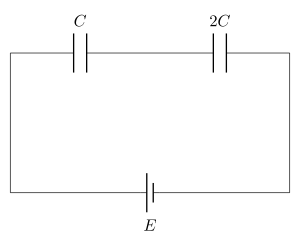
- AP EAPCET 2023Set eng-2023-05-18-AN1 markMCQQ.The given circuit shows two capacitors connected to a battery. After the capacitors are completely charged, the battery is removed and the capacitors are connected with plates of opposite polarity together. Then the charge on 2C and the energy lost in the process are respectively [FIGURE] (a series circuit with a capacitor C and a capacitor 2C connected in series to a battery E) (A) 0, 32CE2 (B) 0, 3CE2 (C) Q, 32CE2 (D) 2Q, 3CE2
›Reveal solutionSolution
This tests series-capacitor charge sharing followed by charge conservation when capacitors are cross-connected with reversed polarity. Both charge on 2C and the energy budget work out to 0 and CE2/3 respectively.
Concept and Intuition
When capacitors are in series with a battery, they carry the same charge magnitude Q (charge conservation along the single conducting loop), even though they have different capacitances and hence different voltages. When the battery is removed and the two capacitors are then reconnected directly to each other with their polarities reversed relative to the original loop (plate of one polarity joined to the opposite-polarity plate of the other), the charges that meet at each junction are equal in magnitude but of opposite sign — they cancel completely, since Q was the same on both.
Step-by-Step Solution
- Series equivalent capacitance: Ceq=C+2CC⋅2C=32C.
- Charge on each capacitor (same in series): Q=CeqE=32CE.
- Voltages: VC=CQ=32E, V2C=2CQ=3E.
- Initial stored energy: Ui=2CQ2+2(2C)Q2=2CQ2+4CQ2=4C3Q2. Substituting Q=32CE: Ui=4C3×94C2E2=3CE2.
- Reconnecting with opposite polarity together: at each junction the charges are +Q from one capacitor and −Q from the other (since the polarities are now reversed relative to each other) — net charge at each node is Q−Q=0. …
- AP EAPCET 2022Set ap-2022-07-11-AN1 markMCQQ.A spherical shell of radius R has a charge Q distributed uniformly over it's surface, then the work done in this process is (A) Q2/4πε0R (B) Q2/8πε0R (C) Q2/16πε0R (D) Q2/32πε0R
›Reveal solutionSolution
This is the classic self-energy of a uniformly charged spherical shell, W=Q2/(8πε0R).
Concept and Intuition
Building up charge on a shell requires bringing successive infinitesimal charges from infinity against the repulsion of charge already placed. Integrating this work over the whole process (equivalently, integrating the field energy density 21ε0E2 over all space outside the shell, where E=kQ/r2 for r>R and E=0 inside) gives the shell's total electrostatic self-energy.
Step-by-Step Solution
- Field outside a uniformly charged shell (charge q already present) is E=r2kq; field energy density u=21ε0E2. …
- AP EAPCET 2022Set eng-2022-07-08-AN1 markMCQQ.A parallel plate capacitor of capacitance 50 pF is charged with 100 V supply. It is then disconnected from the supply and connected to another uncharged 50 pF capacitor. The electrostatic energy lost in this process is (A) 0.125 μJ (B) 0.175 μJ (C) 0.225 μJ (D) 0.275 μJ
›Reveal solutionSolution
A 50 pF capacitor charged to 100 V loses 0.125 μJ (125 nJ) of electrostatic energy when connected across an identical uncharged capacitor.
Concept and Intuition
Charge is conserved when two capacitors are joined, but the total electrostatic energy is not. As charge flows from the charged capacitor into the uncharged one, a transient current passes through the (small but non-zero) resistance of the wires, and part of the stored energy is irreversibly converted to heat. For two equal capacitors, the charged one ends up sharing its charge equally, the common voltage falls to half, and exactly half of the original energy is lost.
Step-by-Step Solution
- Let C=50 pF=50×10−12 F and V=100 V. Charge stored: Q=CV=5×10⁻⁹ C.
- Initial energy: Ui=21CV2=21(50×10−12)(100)2=2.5×10⁻⁷ J=250 nJ.
- After connecting to an identical uncharged capacitor, total capacitance =2C; charge Q is unchanged, so common potential V′=2CQ=100×10−125×10−9=50 V.
- Final energy: Uf=21(2C)V′2=21(100×10−12)(50)2=1.25×10⁻⁷ J=125 nJ.
- Energy lost: ΔU=Ui−Uf=250−125=125 nJ=0.125 μJ. Equivalently, ΔU=21C1+C2C1C2V2=21(25×10−12)(100)2=0.125 μJ.
Common Mistakes …
🎓Unlock everything free for 14 days
- ✓Full step-by-step solutions
- ✓Concept-first explanations
- ✓Methods, shortcuts & mistakes
- ✓PYQ mapping + timed mock tests
Full access for 14 days. No credit card required.