Q.A molecule of a substance has a permanent electric dipole moment of magnitude 10−29 C m. A mole of this substance is polarised (at low temperature) by applying a strong electrostatic field of magnitude 106 V m−1. The direction of the field is suddenly changed by an angle of 60∘. Estimate the heat released by the substance in aligning its dipoles along the new direction of the field. For simplicity, assume 100% polarisation of the sample.
🔒You're viewing a preview — the full solution, concept, methods & PYQ mapping are locked.
🔒 Start your 14-day free trial to unlock the full solution →Concept understanding — Dipole Alignment Energy
Dipole Alignment Energy — From Intuition to Formula
Imagine you have a tiny bar magnet — a compass needle. You know it always turns to point north. But what if you try to hold it pointing east? You feel a torque, a twisting force that wants to rotate it back. If you let go, it snaps to align with the field.
That "snap" releases energy. The energy that was stored in the misaligned configuration is called dipole alignment energy (or potential energy of a dipole in an external field).
The Core Intuition
A dipole (like a compass needle or a polar molecule) has two opposite "poles" — a north and a south, or a positive and a negative charge. When placed in an external field:
- Aligned (parallel to the field): the dipole is in its lowest energy state — like a ball at the bottom of a valley.
- Anti-aligned (opposite to the field): the dipole is in its highest energy state — like a ball balanced at the top of a hill.
- Perpendicular: the energy is somewhere in between.
The energy depends on how much the dipole is twisted away from the field direction. The more you force it to point against the field, the more energy you store — like winding a spring.
The Precise Statement
For an electric dipole with dipole moment p placed in a uniform external electric field E, the potential energy of alignment is:
U=−p⋅E=−pEcosθ
where θ is the angle between p and E.
For a magnetic dipole (like a current loop or a compass needle) with magnetic moment μ in a magnetic field B:
U=−μ⋅B=−μBcosθ
Why the Negative Sign?
This is the part that confuses most students. Let's break it down.
When θ=0∘ (aligned), cosθ=1, so U=−pE. This is the minimum energy — the most stable configuration.
When θ=180∘ (anti-aligned), cosθ=−1, so U=+pE. This is the maximum energy — the least stable.
The negative sign is a convention that makes the aligned state the lowest energy. Think of it this way: the field does positive work to rotate the dipole from anti-aligned to aligned, so the dipole loses potential energy. The formula captures that loss as a negative value relative to the zero-energy reference (which is usually taken at θ=90∘, where U=0).
A common mistake: thinking U=p⋅E (without the minus sign). That would make the aligned state highest energy — physically wrong. The dipole wants to align, so aligned must be lowest energy.
What It Physically Means
The alignment energy tells you:
- How much work an external agent must do to rotate the dipole from aligned to some angle θ.
- How stable the dipole is in a given orientation — the deeper the energy well (larger p or E), the harder to knock it out of alignment.
- The torque on the dipole: τ=−dθdU=−pEsinθ, which matches the familiar τ=p×E.
A Quick Example
A water molecule has a permanent electric dipole moment p=6.2×10⁻³⁰ C⋅m. In an electric field of 106 N/C (a strong laboratory field): …
Concept: Dipole Alignment Energy, U=−pEcosθ. The dipoles start aligned with the old field, i.e. at 60∘ to the new field, then relax to 0∘; the released energy appears as heat.
- Heat per dipole =U60∘−U0∘=(−pEcos60∘)−(−pEcos0∘)=pE(1−21)=21pE.
- For one mole (NA=6.022×10²³): Q=21NApE. …
The dipoles begin aligned with the old field (so 60∘ from the new one) and relax to alignment; the released energy is Q=21NApE=21×6.022×1023×10−29×106≈3.0J.
The physics
A permanent dipole in a field has potential energy U=−p⋅E=−pEcosθ, minimum (−pE) when aligned. When the field direction is suddenly turned by 60∘, the dipoles — still pointing the old way — are now at 60∘ to the new field. As they swing round to align with it, their potential energy drops, and that energy is dissipated as heat.
The dipoles do not start aligned with the new field; they start 60∘ from it (their old alignment direction).
Step 1 — Heat released by one dipole
Ui=−pEcos60∘=−21pE,Uf=−pEcos0∘=−pE.
q=Ui−Uf=−21pE−(−pE)=21pE.
Step 2 — Scale to one mole (100% polarised) …
Method: Heat Released When a Field Reorients a Population of Dipoles
This method applies whenever a strong external field suddenly changes direction and a collection of permanent dipoles — already aligned with the old field direction — relaxes to align with the new one, releasing energy as heat.
Steps
Step 1: Identify the dipole's initial and final angle relative to the new field direction
The dipole is not initially aligned with the new field — it is still pointing along the old field direction, which now makes some angle θ with the new direction (equal to the angle through which the field was rotated). The final angle, once the dipole has settled, is 0∘ (fully aligned).
Step 2: Write the potential energy at each angle using U=−pEcosθ
Ui=−pEcosθ,Uf=−pEcos0∘=−pE
Step 3: The heat released per dipole is the drop in potential energy
qper dipole=Ui−Uf …
- AP EAPCET 2026Set eng-2026-05-14-FN1 markMCQQ.Two electric charges +3.2×10⁻¹⁹ C and −3.2×10⁻¹⁹ C are placed 2.4 Å apart to form an electric dipole. It is placed in uniform electric field of intensity 4×10⁵ V/m. The work done to rotate the electric dipole from the equilibrium position by 180∘ is (A) 3×10⁻²⁵ J (B) 6×10⁻²³ J (C) 12×10−23 J (D) Zero
›Reveal solutionSolution
This tests the potential energy of a dipole in a uniform field, U=−pEcosθ, and the work needed to flip it through 180∘. Answer: 6×10⁻²³ J.
Concept and Intuition
A dipole in a uniform electric field has potential energy U(θ)=−pEcosθ, minimized (stable equilibrium) when the dipole is aligned with the field (θ=0). Rotating it to θ=180∘ (anti-aligned, the position of maximum energy) requires external work equal to the change in potential energy, W=U(180∘)−U(0∘).
Step-by-Step Solution
- Dipole moment: p=q×d=(3.2×10⁻¹⁹ C)(2.4×10⁻¹⁰ m)=7.68×10⁻²⁹ Cm.
- U(θ)=−pEcosθ. At θ=0: U(0)=−pE. At θ=180∘: U(180∘)=−pEcos180∘=+pE.
- Work done W=U(180∘)−U(0∘)=pE−(−pE)=2pE.
- W=2×(7.68×10−29)×(4×105)=2×3.072×10−23=6.144×10⁻²³ J.
- Rounding, W≈6×10⁻²³ J.
Common Mistakes …
- AP EAPCET 2025Set eng-2025-05-22-AN1 markMCQQ.A short bar magnet of magnetic moment 104 JT−1 is free to rotate in a horizontal plane. The work done in rotating the magnet slowly from the direction parallel to a horizontal magnetic field of 4×10⁻⁵ T to a direction 60° to the direction of the field is (A) 0.2 J (B) 2.6 J (C) 0.4 J (D) 6.2 J
›Reveal solutionSolution
This tests the work-energy relation for rotating a magnetic dipole in a uniform field. Using W=mB(cosθ1−cosθ2) gives W=0.2 J.
Concept and Intuition
A bar magnet in a magnetic field behaves like an electric dipole in an electric field: it has potential energy U(θ)=−mBcosθ, which is minimum when aligned with the field (θ=0) and increases as it is rotated away. The external agent rotating the magnet "slowly" (quasi-statically, so kinetic energy stays zero) must supply work exactly equal to the change in this potential energy.
Step-by-Step Solution
- Potential energy of a dipole at angle θ to the field: U(θ)=−mBcosθ.
- Work done by external agent going from θ1 to θ2: W=U(θ2)−U(θ1)=−mBcosθ2−(−mBcosθ1)=mB(cosθ1−cosθ2) …
- AP EAPCET 2025Set eng-2025-05-23-AN1 markMCQQ.The work done in rotating a bar magnet which is initially in the direction of a uniform magnetic field through 45∘ is W. The additional work to be done to rotate the magnet further through 15∘ is (A) 2W (B) 2W (C) W2 (D) 2W
›Reveal solutionSolution
This tests the work-done-in-rotating-a-dipole formula W=MB(cosθ1−cosθ2), applied twice to compare the work over 0∘→45∘ with the extra work over 45∘→60∘ — the ratio simplifies exactly to 1/2.
Concept and Intuition
A bar magnet in a uniform field B has potential energy U(θ)=−MBcosθ, where θ is the angle between its moment and the field. Rotating it from θ1 to θ2 requires work equal to the potential energy change, W=U(θ2)−U(θ1)=MB(cosθ1−cosθ2). Because cosθ is not linear in θ, equal angular steps do not require equal amounts of work — this problem exploits that non-linearity.
Step-by-Step Solution
- Work rotating from 0∘ (aligned with field) to 45∘: W=MB(cos0∘−cos45∘)=MB(1−21).
- Work rotating from 0∘ all the way to 60∘ (i.e. the next 15∘ included): Wtotal=MB(cos0∘−cos60∘)=MB(1−21)=2MB.
- Additional work for the last 15∘: W′=Wtotal−W=MB(21−1+21)=MB(21−21). …
- AP EAPCET 2023Set eng-2023-05-16-AN1 markMCQQ.Two electric dipoles, each of dipole moment 'P' are placed at points A (a,0) and B (−a,0) as shown in the figure. The work done in rotating both the dipoles through 90∘ in clockwise direction is [FIGURE] (a coordinate-axes diagram with a dipole drawn on the positive x-axis at point A and a dipole on the negative x-axis at point B, both aligned along the x-axis) (E = Electric field) (A) PE (B) Zero (C) 2PE (D) 2PE
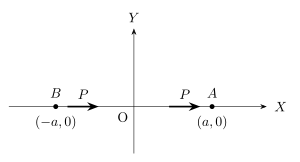
›Reveal solutionSolution
The two dipoles sit oppositely oriented along the axis, so their initial potential energies (−PE and +PE) cancel; after each turns 90∘ both become perpendicular to the field (U=0), so the total energy is unchanged and the net work is zero — option (B).
Concept
The potential energy of a dipole of moment P in a field E is U=−P⋅E=−PEcosθ, where θ is the angle between P and E. The work done by an external agent to reorient a dipole equals the change in this energy, W=ΔU=Uf−Ui. For a system of dipoles the total work is the change in the total energy.
Step 1 — Initial energies.
The two dipoles at A(a,0) and B(−a,0) are aligned along the x-axis but point in opposite senses along it: one lies parallel to the field, the other antiparallel.
UiA=−PEcos0∘=−PE,UiB=−PEcos180∘=+PE
Ui=UiA+UiB=−PE+PE=0
Step 2 — After a 90∘ clockwise rotation. …
- AP EAPCET 2023Set eng-2023-05-18-AN1 markMCQQ.To heat the food containing water, the frequency of the microwaves used in microwave oven is (A) independent of the resonant frequency of water molecules. (B) equal to the resonant frequency of water molecules. (C) 100 times the resonant frequency of water molecules. (D) 1001 times the resonant frequency of water molecules.
›Reveal solutionSolution
A microwave oven works by tuning the wave frequency to the resonant frequency of water molecules so energy transfer to the food (which contains water) is efficient.
Concept and Intuition
Water molecules are polar and have natural rotational resonant frequencies at which they absorb electromagnetic energy most efficiently — much like how a swing absorbs energy best when pushed at its natural frequency. A microwave oven is engineered to emit radiation at (or very near) this resonant frequency of water so that the microwaves are strongly absorbed by the water content of the food, converting the wave's energy into molecular kinetic energy — i.e. heat.
Step-by-Step Solution
- Food is heated by transferring electromagnetic wave energy into kinetic energy of water molecules.
- This transfer is most efficient when the driving (microwave) frequency coincides with the resonant (natural) frequency of the water molecule's rotational motion. …
- AP EAPCET 2022Set ap-2022-07-12-FN1 markMCQQ.A rectangular coil of length 2 cm and width 1.25 cm with 250 turns carries a current of 55 μA and subjected to a magnetic field of strength 0.64 T. Work done for rotating the coil by 180° against the torque is (A) 2.2 μJ (B) 3.5 μJ (C) 4.4 μJ (D) 5.5 μJ
›Reveal solutionSolution
Rotating a current loop by 180° in a magnetic field, starting from stable equilibrium, requires work W=2MB against the restoring torque. Answer: 4.4 μJ.
Concept and Intuition
A current loop in a magnetic field has potential energy U=−MBcosθ, minimum (most negative) when aligned with the field (θ=0) and maximum when anti-aligned (θ=180°). Rotating the loop from stable equilibrium to the opposite orientation therefore requires work equal to the full swing in potential energy, ΔU=MB−(−MB)=2MB.
Step-by-Step Solution
- Loop area: A=2cm×1.25cm=2.5cm2=2.5×10⁻⁴m2.
- Magnetic moment: M=NIA=250×(55×10−6)×(2.5×10−4).
- 250×55×10−6=0.01375; then 0.01375×2.5×10−4=3.4375×10⁻⁶Am2. …
- AP EAPCET 2021Set ap-2021-09-07-FN1 markMCQQ.A magnet of magnetic moment 6 J T−1 is aligned in the direction of magnetic field of 0.3 T. The net work done to bring the magnet normal to the magnetic field is (A) 2 J (B) 1 J (C) 1.8 J (D) 2.4 J
›Reveal solutionSolution
The work needed to rotate a magnetic dipole from being aligned with the field to being perpendicular to it is W=mB(cosθ1−cosθ2)=1.8 J.
Concept and Intuition
A magnetic dipole in a field has potential energy U(θ)=−mBcosθ, which is lowest (most negative) when aligned with the field (θ=0) and rises as the dipole is rotated away from alignment. The work done by an external agent to rotate the dipole from θ1 to θ2 equals the change in potential energy, W=U(θ2)−U(θ1)=−mBcosθ2−(−mBcosθ1)=mB(cosθ1−cosθ2).
Step-by-Step Solution
- Formula: W=mB(cosθ1−cosθ2).
- Initial position: aligned with field, θ1=0°, so cosθ1=1.
- Final position: normal to the field, θ2=90°, so cosθ2=0. …
- AP EAPCET 2021Set eng-2021-08-24-FN1 markMCQQ.A magnet of magnetic moment 2 J.T−1 is aligned in the direction of magnetic field of 0.1 T. What is the net work done to bring the magnet normal to the magnetic field? (A) 0.1 J (B) 0.2 J (C) 1.0 J (D) 2.0 J
›Reveal solutionSolution
Rotating a magnetic dipole from parallel to perpendicular to the field requires work W=mB(cosθi−cosθf); here W=mB=0.2 J.
Concept and Intuition
A magnetic dipole in a field has potential energy U=−mBcosθ. The work done by an external agent to change orientation equals the change in this potential energy, W=ΔU=Uf−Ui.
Step-by-Step Solution
- Initial orientation: aligned with field, θi=0∘, Ui=−mBcos0∘=−mB.
- Final orientation: normal to field, θf=90∘, Uf=−mBcos90∘=0. …
🎓Unlock everything free for 14 days
- ✓Full step-by-step solutions
- ✓Concept-first explanations
- ✓Methods, shortcuts & mistakes
- ✓PYQ mapping + timed mock tests
Full access for 14 days. No credit card required.