Q.Explain quantitatively the order of magnitude difference between the diamagnetic susceptibility of N2 (∼5×10⁻⁹) (at STP) and Cu (∼10−5).
🔒You're viewing a preview — the full solution, concept, methods & PYQ mapping are locked.
🔒 Start your 14-day free trial to unlock the full solution →Concept understanding — Magnetic Materials Magnetization
From a Paperclip to a Magnet: The Intuition
You already know that a magnet can pick up iron nails. But what is actually happening inside that nail when it gets near the magnet? And why does a plastic comb, rubbed on hair, pick up tiny bits of paper — but never iron filings?
The answer lies in magnetization — the process by which a material becomes magnetic.
Think of a piece of iron as a chaotic crowd of tiny compass needles. Each needle is an atomic magnetic moment (a tiny magnet, arising from the spin of electrons). In unmagnetized iron, these needles point in random directions. Their magnetic effects cancel out, so the iron as a whole shows no net magnetism.
Now bring a strong magnet close. Its magnetic field acts like a command: "Line up!" The tiny compass needles inside the iron start rotating, aligning themselves with the external field. The more they align, the stronger the iron's own magnetic field becomes. This alignment is magnetization.
Magnetization is not the same as inducing a current. It is a purely magnetic reorientation of atomic dipoles inside a material.
The Precise Definition
Magnetization (M) is the net magnetic dipole moment per unit volume of a material. It tells you how strongly a material is magnetized — how many tiny atomic magnets are aligned, and in which direction.
If a material has N atoms per unit volume, each with an average magnetic moment μavg, then:
M=Nμavg
The SI unit of M is amperes per metre (A/m). Why? Because a magnetic dipole moment has units of A·m², and dividing by volume (m³) gives A/m.
M=volumetotal magnetic dipole moment
How Magnetization Connects to the Magnetic Field
When a material gets magnetized, it produces its own magnetic field. The total magnetic field B inside the material is the sum of:
- The external applied field H (caused by free currents, like the current in a solenoid)
- The material's response — the magnetization M
The fundamental relation is:
B=μ0(H+M)
where μ0=4π×10−7T⋅m/A is the permeability of free space.
Do not confuse H (magnetic field intensity, or "magnetizing field") with B (magnetic flux density). H is what you apply; M is what the material does; B is the total field you measure.
The Three Kinds of Magnetic Materials
Not all materials respond the same way to an external field. The magnetization M is proportional to H for most materials (at least for small fields):
M=χmH
where χm is the magnetic susceptibility — a dimensionless number that tells you how easily a material magnetizes.
| Material Type | χm | Behaviour | Example |
|---|---|---|---|
| Diamagnetic | Small and negative (≈−10−5) | Weakly repelled by a magnet; M opposes H | Water, copper, bismuth |
| Paramagnetic | Small and positive (≈10−5 to 10−3) | Weakly attracted; M aligns with H | Aluminium, oxygen gas |
| Ferromagnetic | Large and positive (≫1) | Strongly attracted; M can be huge and persists even after H is removed | Iron, nickel, cobalt |
Why this formula?
Magnetic Materials & Magnetization: Why the Key Formulas Hold
Let's build this from the ground up — starting with what magnetization physically means, then deriving the formulas step by step.
1. What is Magnetization (M)?
Magnetization is the net magnetic dipole moment per unit volume of a material.
- Inside a material, atoms act like tiny magnetic dipoles (due to electron spin and orbital motion).
- Without an external field, these dipoles point randomly → net M=0.
- When an external field H is applied, dipoles align partially → net M=0.
Definition:
M=volumenet magnetic dipole moment
Units: A/m (same as H).
2. The Fundamental Relation: B=μ0(H+M)
This is the master equation linking the three magnetic fields:
- B = magnetic flux density (the total field inside the material)
- H = applied magnetic field (due to free currents)
- M = magnetization (response of the material)
- μ0 = permeability of free space (4π×10−7 H/m)
Why this form?
Step 1: In vacuum, there is no material, so M=0. Then:
B=μ0H
Step 2: Inside a material, the dipoles themselves produce an additional field. The total B is the sum of:
- The field due to free currents (μ0H)
- The field due to bound currents (from aligned dipoles), which is μ0M
Hence:
B=μ0H+μ0M=μ0(H+M)
Key insight: M is not an independent field — it's the material's response to H.
3. Magnetic Susceptibility (χm) and Permeability (μ)
For linear, isotropic, homogeneous materials (most common in exams), magnetization is proportional to the applied field:
M=χmH
- χm = magnetic susceptibility (dimensionless)
- χm>0 for paramagnetic materials
- χm<0 for diamagnetic materials
- χm≫1 for ferromagnetic materials (but not linear!)
Derivation of relative permeability μr:
Substitute M=χmH into the master equation:
B=μ0(H+χmH)=μ0(1+χm)H
Define:
μr=1+χm(relative permeability)
μ=μ0μr(absolute permeability)
Thus:
B=μH
Why this matters: It shows that the material simply scales the applied field by a factor μr.
4. Why χm Has Different Signs (Physical Reasoning)
| Material Type | χm | Why? |
|---|---|---|
| Diamagnetic | χm<0 (small, ~10−5) | Applied field induces opposing dipole moments (Lenz's law at atomic level). M opposes H. |
| Paramagnetic | χm>0 (small, ~10−3) | Permanent atomic dipoles align partially with H. Thermal agitation fights alignment. |
The key idea is that diamagnetic susceptibility (χ) depends on the number of atoms per unit volume and the mean square radius of the electron orbits. For a gas at STP, the atomic density is far lower than in a solid metal.
Step 1: Susceptibility formula
For a diamagnetic material, χ=−6mc2Ne2⟨r2⟩, where N is the number of atoms per unit volume and ⟨r2⟩ is the mean square orbital radius.
Step 2: Compare densities
At STP, 1 mole of N2 occupies 22.4 L, so NN2≈22.4×1036.02×1023≈2.7×10¹⁹ atoms/cm3.
For Cu (density ≈9 g/cm3, atomic mass 63.5), NCu≈63.59×6.02×1023≈8.5×10²² atoms/cm3.
Thus NCu/NN2≈3×103.
Step 3: Compare orbital radii …
The huge difference arises because diamagnetic susceptibility depends on the number density of atoms and the size of the electron orbits. In a gas like N₂ at STP, atoms are far apart (low density), while in a solid metal like Cu, atoms are tightly packed (high density). Additionally, copper has more electrons per atom and larger effective orbital radii, giving a much larger induced magnetic moment per atom. The combined effect yields a factor of about 104 — exactly the observed gap.
Why this approach works
Diamagnetism is a universal property: when an external magnetic field is applied, it slightly alters the orbital motion of electrons, inducing a tiny magnetic moment that opposes the field. The size of this induced moment per atom is proportional to the square of the orbital radius and the number of electrons. But the bulk susceptibility χ also depends on how many atoms are packed into a given volume — the number density.
So the order-of-magnitude difference between N₂ gas and solid Cu comes from two separate factors:
- Number density — how many atoms per cubic metre.
- Atomic diamagnetic response — how large the induced moment is per atom.
Let’s quantify each.
Step-by-step calculation
1. Number density at STP vs. in a solid
For an ideal gas at STP (0 °C, 1 atm), one mole occupies 22.4 L = 2.24×10⁻²m3.
Number of molecules per mole is Avogadro’s number NA=6.02×10²³.
So number density of N₂ molecules:
nN2=2.24×10−26.02×1023≈2.69×1025m−3
For copper: density ρ=8.96g/cm3=8960kg/m3, atomic mass M=63.5g/mol=0.0635kg/mol.
Number density of Cu atoms:
nCu=MρNA=0.06358960×6.02×1023≈8.5×1028m−3
Ratio of number densities:
nN2nCu≈2.69×10258.5×1028≈3.2×10³
So just from packing, Cu has about 3000 times more atoms per unit volume than N₂ gas.
This factor alone already accounts for most of the difference — but not all. The remaining factor comes from the atomic diamagnetic response.
2. Atomic diamagnetic susceptibility per atom
The classical Langevin formula for diamagnetic susceptibility per atom (or molecule) is:
χatom=−6meμ0e2∑⟨r2⟩
where ∑⟨r2⟩ is the sum of mean-square orbital radii of all electrons in the atom/molecule.
For a diatomic N₂ molecule, each nitrogen atom has 7 electrons, so 14 electrons total. But the electrons are tightly bound in small orbitals (first-row element). A typical ⟨r2⟩ for a 2p electron in N is about (0.5A˚)2=0.25×10⁻²⁰m2. Summing over all electrons gives roughly:
∑⟨r2⟩N2∼14×0.25×10−20≈3.5×10⁻²⁰m2
For copper (atomic number 29), the inner electrons (up to 3d) have smaller radii, but the outer 4s electron and especially the 3d electrons have larger orbits. A typical ⟨r2⟩ for a 3d electron in Cu is about (1.0A˚)2=1.0×10⁻²⁰m2, and there are 10 such d-electrons. The 4s electron has an even larger orbit, but it contributes less because it’s only one electron. A rough sum:
∑⟨r2⟩Cu∼(core electrons: small)+10×1.0×10−20≈1.0×10⁻¹⁹m2
That’s about 3 times larger than for N₂. …
Method: Estimating Order-of-Magnitude Differences in Diamagnetic Susceptibility
Use this whenever you're asked to explain why the susceptibility of one diamagnetic substance is so much larger or smaller than another's — a gas vs. a solid, or two solids of very different density.
Steps
Step 1: Start from the microscopic (Langevin) formula
The diamagnetic susceptibility of a single atom, and hence the bulk susceptibility, is
χ=nχatom,χatom=−6meμ0e2∑⟨r2⟩,
where n is the number density of atoms/molecules and ∑⟨r2⟩ is the sum of mean-square orbital radii of the electrons in that atom. This tells you χ depends on exactly two things: how densely packed the atoms are, and how large the electron orbits are.
Step 2: Compute the number density of each substance
- For a gas at STP, use the molar volume: n=VmNA, with Vm=22.4 L/mol.
- For a solid, use its mass density and molar mass: n=MρNA.
Take the ratio n2/n1 — for a solid vs. a gas this ratio is typically of order 103, because a solid packs atoms roughly a thousand times more densely than a gas at atmospheric pressure.
Step 3: Compare the orbital size (electron count/radius) per atom …
Showing the 12 most recent of 25 on this concept.
- AP EAPCET 2026Set eng-2026-05-12-AN1 markMCQQ.If χ is the magnetic susceptibility, μ, μ0 and μr are absolute, free space and relative permeabilities respectively, then (A) μ=μr(1+χ) (B) μ=μ0(1+χ) (C) μr=1−χ (D) μ=μ0μr(1−χ)
›Reveal solutionSolution
The standard magnetism relations μr=1+χ and μ=μ0μr combine directly to give μ=μ0(1+χ).
Concept and Intuition
Magnetic susceptibility χ measures how strongly a material magnetizes in response to a field; relative permeability μr measures how much the material's absolute permeability exceeds that of free space. These two descriptions of the same magnetic response are linked by the identity μr=1+χ, and absolute permeability is simply μr scaled by the free-space value μ0.
Step-by-Step Solution
- Definition of relative permeability: μr=μ0μ.
- Standard relation between susceptibility and relative permeability: μr=1+χ.
- Combine: μ0μ=1+χ⟹μ=μ0(1+χ). …
- AP EAPCET 2026Set eng-2026-05-14-FN1 markMCQQ.A material satisfies the relation μ0(H+M)=0, where H and M are magnetic intensity and magnetization, respectively; then the material is (A) Nonmagnetic (B) Paramagnetic (C) Ferromagnetic (D) Diamagnetic
›Reveal solutionSolution
This tests recognizing that B=μ0(H+M)=0 with M=−H corresponds to diamagnetic behaviour (magnetization opposing the field). Answer: Diamagnetic.
Concept and Intuition
Inside any magnetic material, B=μ0(H+M). The given condition forces B=0, meaning the material's own magnetization M exactly cancels the applied field's contribution (M=−H). Materials whose induced magnetization opposes the external field (negative susceptibility, χ<0) are diamagnetic; here that opposition is complete, which is the hallmark (idealised limit) of diamagnetism, distinguishing it from paramagnetic (M aligns with H, χ>0, small positive) and ferromagnetic (M strongly aligns with H, large positive χ) materials.
Step-by-Step Solution
- Start from B=μ0(H+M), the general relation between B, H, and M.
- Given: μ0(H+M)=0⇒H+M=0⇒M=−H.
- Since M is opposite in sign to H (magnetization opposes the applied field), the susceptibility χ=M/H=−1, i.e. negative. …
- AP EAPCET 2026Set eng-2026-05-13-AN1 markMCQQ.A magnetic material placed in a magnetic field of intensity H=1000 Am−1 has magnetization M=2 Am−1. The magnetic susceptibility, and type of material is (A) 2×10⁻³, Diamagnetic (B) 2×10⁻³, paramagnetic (C) 4×10⁻³, Ferromagnetic (D) 2000, Ferromagnetic
›Reveal solutionSolution
Magnetic susceptibility is χ=M/H. A small positive value like 2×10⁻³ identifies the material as paramagnetic (diamagnetic would be small and negative; ferromagnetic would be very large, often ∼102–105).
Concept and Intuition
Susceptibility measures how readily a material magnetizes in response to an applied field. Diamagnetic materials weakly oppose the field (χ small and negative). Paramagnetic materials weakly align with it (χ small and positive, typically 10−5 to 10−3). Ferromagnetic materials show enormous positive χ (hundreds to thousands).
Step-by-Step Solution
- χ=HM=1000 Am−12 Am−1=2×10⁻³. …
- AP EAPCET 2026Set eng-2026-05-15-AN1 markMCQQ.The temperature at which the susceptibility of nickel becomes 0.5 times its susceptibility at a temperature of 460∘C is (Curie temperature of nickel is 360∘C) (A) 560 K (B) 833 K (C) 733 K (D) 760 K
›Reveal solutionSolution
The Curie–Weiss law for a ferromagnet above its Curie point gives χ∝1/(T−TC); solving for the new temperature gives 833 K.
Concept and Intuition
Above the Curie temperature TC, a ferromagnetic material behaves like a paramagnet, and its susceptibility obeys the Curie–Weiss law: χ=T−TCC, where C is the material's Curie constant. Susceptibility keeps falling as temperature rises further above TC.
Step-by-Step Solution
- Convert to Kelvin: TC=360+273=633 K; T1=460+273=733 K.
- χ1=T1−TCC=733−633C=100C.
- We want T2 such that χ2=0.5χ1=200C.
- So T2−TC=200⇒T2=200+633=833 K.
Common Mistakes …
- AP EAPCET 2026Set eng-2026-05-18-FN1 markMCQQ.A bulk magnetic material has volume of 2 m3 and its magnetization is found to be 2 A m−1, then the magnetic moment of the bulk material is (A) 1 Am2 (B) 4 Am2 (C) 2 Am2 (D) 8 Am2
›Reveal solutionSolution
Magnetization is magnetic moment per unit volume: M=m/V, so m=MV. Answer: 4 Am2.
Concept and Intuition
Magnetization M describes how strongly a bulk material is magnetized, defined as the net magnetic dipole moment per unit volume, M=m/V. It's directly analogous to how polarization is dipole moment per unit volume in dielectrics. So the total magnetic moment of the whole sample is simply magnetization times volume.
Step-by-Step Solution
- Definition: M=Vm, so m=M×V.
- Given M=2 Am−1, V=2 m3.
- m=2×2=4 Am2.
Common Mistakes …
- AP EAPCET 2025Set eng-2025-05-23-FN1 markMCQQ.Materials suitable for permanent magnets should have (A) low retentivity and low coercivity (B) low retentivity and high coercivity (C) high retentivity and low coercivity (D) high retentivity and high coercivity
›Reveal solutionSolution
Permanent magnet materials need both high retentivity (to stay strongly magnetized) and high coercivity (to resist demagnetization) — steel is the classic example, unlike soft iron used for electromagnets.
Concept and Intuition
Retentivity is the magnetization a material keeps after the external field is removed; coercivity is the reverse field needed to bring that magnetization to zero. A permanent magnet should hold a strong field indefinitely (high retentivity) and not be easily demagnetized by small stray fields, vibration, or temperature changes (high coercivity). This corresponds to a hysteresis loop that is tall (high Br) and wide (high Hc) — materials like steel and alnico. In contrast, electromagnet cores (soft iron) want high retentivity is not needed; instead they need low retentivity/low coercivity so they can be easily magnetized and demagnetized as the current is switched.
Step-by-Step Solution
- Identify what is needed for a permanent magnet: it must stay magnetized after the magnetizing field is removed → requires high retentivity.
- It must also resist losing its magnetism due to small opposing fields, mechanical shocks, or temperature → requires high coercivity. …
- AP EAPCET 2025Set ap-2025-05-20-AN1 markMCQQ.If the magnetisation of a material is M and the magnetic field in the material is B, then the magnetic intensity is (μ0 - permeability of free space) (A) μ0B (B) μ0B−μ0M (C) μ0BM (D) Bμ0M
›Reveal solutionSolution
A direct rearrangement of the fundamental relation between magnetic field, magnetisation and magnetic intensity inside matter.
Concept and Intuition
Inside a magnetized material, the total magnetic field B has two contributions: the field due to free currents (captured by H) and the field due to the material's own magnetisation M. The relation B=μ0(H+M) ties all three together.
Step-by-Step Solution
- Start from B=μ0(H+M).
- Rearranging: H+M=μ0B.
- H=μ0B−M=μ0B−μ0M. …
- AP EAPCET 2025Set eng-2025-05-24-FN1 markMCQQ.A sample of paramagnetic salt contains 2×1024 atomic dipoles each of dipole moment 1.5×10⁻²³ J T−1. The sample is placed under homogeneous magnetic field of 0.6 T and cooled to a temperature 4.2 K. The degree of magnetic saturation achived is 20%. Then total dipole moment of the sample for a magnetic field of 0.9 T and a temperature of 2.8 K is (A) 4.5 J T−1 (B) 13.5 J T−1 (C) 0.64 J T−1 (D) 7 J T−1
›Reveal solutionSolution
Curie's law (M∝B/T) scales the dipole moment between the two states; the result is 13.5 JT−1.
Concept and Intuition
In a paramagnetic sample well below full saturation, thermal agitation competes with the aligning magnetic field, and Curie's law says the net magnetic dipole moment is proportional to B/T — stronger field aligns more dipoles, higher temperature randomizes them more. The 'degree of saturation' tells us what fraction of the theoretical maximum (all dipoles perfectly aligned) is actually achieved at a given (B,T).
Step-by-Step Solution
- Maximum possible (fully saturated) dipole moment: Msat=Np=(2×1024)(1.5×10⁻²³)=30 J/T.
- At B1=0.6T, T1=4.2K, the sample achieves 20% saturation: M1=0.20×30=6 J/T.
- Curie's law: M∝TB, so M1M2=B1/T1B2/T2=0.6/4.20.9/2.8. …
- AP EAPCET 2025Set eng-2025-05-26-AN1 markMCQQ.A sample of a ferromagnetic iron in the shape of a cube of side 1.0 μm contains 8.7×1028 atoms per cubic metre and the magnetic dipole moment of each iron atom is 9.3×10⁻²⁴ Am2. Then the maximum possible magnetic dipole moment (in Am2) of the sample is nearly (A) 8.1×10⁻¹² (B) 8.1×10⁻¹⁴ (C) 81×10−14 (D) 81×10−16
›Reveal solutionSolution
The maximum possible dipole moment of a ferromagnetic sample occurs when every atomic dipole is perfectly aligned (saturation); here it works out to 81×10−14 A m2.
Concept and Intuition
In a ferromagnetic material, atomic magnetic moments can be aligned in the same direction by an external field (magnetic saturation). The maximum possible dipole moment of the whole sample is simply the number of atoms times each atom's dipole moment, since in that ideal aligned state nothing cancels.
Step-by-Step Solution
- Volume of the cube: V=(1.0×10⁻⁶m)3=1.0×10⁻¹⁸m3.
- Number of atoms in the sample: N=n×V=8.7×1028×1.0×10−18=8.7×10¹⁰.
- Maximum dipole moment: Mmax=Nμ=8.7×1010×9.3×10−24. …
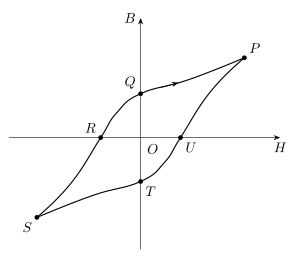
- AP EAPCET 2025Set eng-2025-05-27-FN1 markMCQQ.If the given figure shows the relation between magnetic field (B-along y-axis) and magnetic intensity (H-along x-axis) of a ferromagnetic material, then the point that represents coercivity of the material is [FIGURE] (a B-H hysteresis loop: B on the vertical axis, H on the horizontal axis; the loop passes through P in the upper-right (positive B and H), Q on the positive B-axis where H=0, R on the negative H-axis where B=0 to the left of the origin O, U on the positive H-axis where B=0 to the right of the origin O, T on the negative B-axis where H=0, and S in the lower-left (negative B and H); an arrow on the upper part of the loop shows the traversal direction from S/lower branch up through Q towards P) (A) P (B) Q (C) R (D) S
›Reveal solutionSolution
This tests reading coercivity and retentivity off a hysteresis (B–H) loop; the answer is (C) point R.
Concept and Intuition
On a B–H hysteresis loop, two special sets of points are commonly asked about: retentivity (residual magnetism when H=0, found where the loop crosses the vertical B-axis) and coercivity (the reverse field needed to demagnetise the material completely, i.e. bring B to zero, found where the loop crosses the horizontal H-axis). Coming down from positive saturation (P), the material retains a positive B at H=0 (point Q, retentivity), and needs a negative H to bring B to zero — that crossing point is the coercivity.
Step-by-Step Solution
- Starting from positive saturation at P and decreasing H, the loop crosses the B-axis (at H=0) at point Q — this gives the retentivity (residual field).
- Continuing to decrease H into negative values, B falls to zero at the point where the loop crosses the H-axis on the negative side — this is point R.
- By definition, coercivity is the magnitude of this reverse field required to demagnetise the sample, i.e., it is represented by point R. …
- AP EAPCET 2024Set ap-2024-05-16-AN1 markMCQQ.Relative permeability (μr) of a sample is given by 1<μr<1+ϵ, where ϵ is a small positive number. Then nature of the sample is (A) Diamagnetic material (B) Paramagnetic material (C) Ferro magnetic material (D) Super conducting material
›Reveal solutionSolution
A relative permeability just above 1 is characteristic of paramagnetism; diamagnets sit just below 1, ferromagnets are far above 1, and superconductors have μr=0.
Concept and Intuition
Relative permeability μr=1+χ, where χ is the magnetic susceptibility.
- Diamagnetic substances: χ is small and negative, so μr is slightly less than 1.
- Paramagnetic substances: χ is small and positive, so μr is slightly greater than 1 (a value like 1+ϵ with small ϵ>0).
- Ferromagnetic substances: χ is large and positive (hundreds to thousands), so μr≫1.
- Ideal superconductors: perfect diamagnets, χ=−1, so μr=0 (Meissner effect).
Step-by-Step Solution
- Given: 1<μr<1+ϵ with ϵ small and positive.
- This means μr is only marginally above 1 — a small positive susceptibility.
- Small positive susceptibility with μr close to (but above) 1 is exactly the paramagnetic regime. …
- AP EAPCET 2024Set ap-2024-05-17-FN1 markMCQQ.A super conductor exhibits (A) Ferro magnetism (B) Para magnetism (C) Dia magnetism (D) Ferri magnetism
›Reveal solutionSolution
The Meissner effect makes a superconductor a perfect diamagnet, expelling all internal magnetic field. Answer: (C) Dia magnetism.
Concept and Intuition
Below its critical temperature, a superconductor doesn't merely have zero resistance — it also actively expels any externally applied magnetic field from its interior (the Meissner effect), so that the magnetic field inside is exactly zero. This is the signature of a perfect diamagnet (magnetic susceptibility χ=−1), since diamagnetism is characterized by an induced magnetization that opposes and cancels the applied field.
Step-by-Step Solution
- Recall the defining property of superconductivity below Tc: zero electrical resistance and the Meissner effect (expulsion of magnetic flux from the bulk).
- A material with χ=−1 (magnetic field completely cancelled inside) is, by definition, a perfect diamagnet. …
🎓Unlock everything free for 14 days
- ✓Full step-by-step solutions
- ✓Concept-first explanations
- ✓Methods, shortcuts & mistakes
- ✓PYQ mapping + timed mock tests
Full access for 14 days. No credit card required.