Q.Light from a point source in air falls on a spherical glass surface (n=1.5 and radius of curvature =20 cm). The distance of the light source from the glass surface is 100 cm. At what position the image is formed?
🔒You're viewing a preview — the full solution, concept, methods & PYQ mapping are locked.
🔒 Start your 14-day free trial to unlock the full solution →Concept understanding — Refraction at Spherical Surface
Refraction at a Spherical Surface
Imagine you're looking at a fish in a pond. The fish appears closer to the surface than it actually is. That's refraction — light bends when it moves from water to air. Now take that idea and replace the flat water surface with a curved one, like a glass lens or a drop of water. That's refraction at a spherical surface.
The core intuition
When light hits a flat surface (like a glass slab), it bends once and travels straight. But when the surface is curved — part of a sphere — the angle at which light hits changes depending on where on the surface it strikes. A ray hitting near the centre meets the surface almost head-on; a ray hitting near the edge meets it at a steep slant. This variation in incidence angle is what makes spherical surfaces focus or diverge light.
Think of a spherical surface as a tiny piece of a sphere. The centre of that sphere is called the centre of curvature (C). The distance from the surface to C is the radius of curvature (R). The line joining the centre of the surface (the pole, P) to C is the principal axis.
The precise geometry
We need to track what happens to a ray from an object point O on the principal axis. The ray travels in medium 1 (refractive index n1), hits the spherical surface at point A, and enters medium 2 (refractive index n2). The surface has radius R, with centre C.
The key is Snell's law at point A:
n1sini=n2sinr
But i and r are measured from the normal at A. For a spherical surface, the normal at any point is the line joining that point to C. So the normal is AC.
For small angles (paraxial rays — rays close to the axis), sinθ≈θ in radians. This approximation is the backbone of all standard lens and mirror formulas. It lets us replace Snell's law with:
n1i=n2r
Now look at the geometry. Let the object distance from the pole be u (negative by sign convention — object on left), and the image distance be v (positive if image is on the right, in medium 2). The angle the incident ray makes with the axis is α, the refracted ray makes β, and the normal makes θ with the axis.
From the triangles:
- In △OAC: i=α+θ
- In △AIC: r=θ−β (for a convex surface towards the object)
Substitute into Snell's law:
n1(α+θ)=n2(θ−β)
For small angles, α≈POAP≈−uh (since u is negative), β≈vh, and θ≈Rh.
Plugging these in:
n1(−uh+Rh)=n2(Rh−vh)
Cancel h (non-zero) and rearrange:
vn2−un1=Rn2−n1
This is the refraction at a spherical surface formula. It relates object distance u, image distance v, radii R, and the two refractive indices.
Sign convention (crucial for exams)
Use the Cartesian sign convention (the one used in NCERT and most Indian boards):
- Distances measured from the pole P along the principal axis.
- Positive in the direction of incident light (usually left to right).
- Negative opposite to incident light.
- R is positive if the centre of curvature C is on the right (convex surface towards object), negative if C is on the left (concave surface towards object).
The most common mistake is getting the sign of R wrong. Always check: is the centre of curvature on the same side as the incoming light or the opposite side? If opposite, R is positive.
What the formula tells you
- If n2>n1 (going from rarer to denser), the right side Rn2−n1 is positive for a convex surface. This means v is positive — the image forms on the other side (real image). …
Why this formula?
Great — let’s build the Refraction at a Spherical Surface formula from first principles. The goal is to understand why the relation
vn2−un1=Rn2−n1
holds, where:
- n1 = refractive index of the first medium (where the object lies)
- n2 = refractive index of the second medium (where the image lies)
- u = object distance from the pole (sign convention: negative for real object)
- v = image distance from the pole (sign convention: positive for real image on the opposite side)
- R = radius of curvature of the spherical surface (positive if centre of curvature is on the image side)
1. The core idea: Snell’s law at a curved interface
At any point on the spherical surface, the incident ray and refracted ray obey Snell’s law:
n1sini=n2sinr
For small angles (paraxial approximation — rays close to the principal axis), sinθ≈θ (in radians). So:
n1i=n2r
This linearisation is the key that lets us turn geometry into algebra.
2. Geometry of a single ray
Consider a point object O on the principal axis. A ray from O strikes the spherical surface at point P (height h above the axis). Let:
- C = centre of curvature of the spherical surface
- M = pole of the surface (vertex)
- I = image point formed after refraction
Draw the normal at P — it passes through C (since the surface is spherical). The angles:
- i = angle between incident ray OP and the normal PC
- r = angle between refracted ray PI and the normal PC
3. Relating angles to distances (paraxial approximation)
Because h is small compared to u, v, and R:
- Angle between OP and the axis: α≈uh (with sign)
- Angle between PC (normal) and the axis: θ≈Rh
- Angle between PI and the axis: β≈vh
Now, from the geometry of the triangle formed by the ray, the normal, and the axis:
- Incident angle i = angle between OP and the normal = θ−α (if θ>α)
- Refracted angle r = angle between PI and the normal = θ−β
Check the sign convention carefully — the exact relation depends on whether the ray bends toward or away from the normal. For a convex surface (centre on the image side), the standard result is:
i=α+θandr=θ−β
But the difference that matters is:
i−r=α+β
4. Applying Snell’s law
From n1i=n2r, we can write:
n1i=n2(i−(i−r))or directly:
n1i=n2r⟹n1i−n2r=0
But it’s more useful to express r in terms of i and the geometry:
r=i−(α+β)
Substitute into Snell’s law:
n1i=n2[i−(α+β)]
Simplify:
n1i=n2i−n2(α+β)
(n1−n2)i=−n2(α+β)
Now, i≈α+θ (from geometry). For small angles, α≈h/u, β≈h/v, θ≈h/R.
5. Substituting the small-angle approximations
Let’s do it step by step:
(n1−n2)(α+θ)=−n2(α+β)
Replace α, β, θ:
(n1−n2)(uh+Rh)=−n2(uh+vh)
Cancel h (non-zero):
(n1−n2)(u1+R1)=−n2(u1+v1)
6. Rearranging to the standard form
Expand the left side: …
Concept: Refraction at a single spherical surface.
Reasoning:
- Use the standard formula for refraction at a spherical surface:
vn2−un1=Rn2−n1
where $n_1 = 1$ (air), $n_2 = 1.5$ (glass), $u = -100\ \text{cm}$ (real object, negative sign convention), and $R = +20\ \text{cm}$ (convex surface towards the object).
2. Substitute the values:
v1.5−−1001=201.5−1
$$ \frac{1.5}{v} + \frac{1}{100} = \frac{0.5}{20} = \frac{1}{40} $$ …
Using the refraction formula for a single spherical surface, the image forms 100 cm behind the glass surface, on the opposite side from the object — a real image.
The problem is a classic application of refraction at a single spherical surface. Light travels from air (refractive index n1=1) into glass (n2=1.5). The surface is convex toward the incident light (the source is in air, the glass is on the other side). The radius of curvature R=+20 cm by the sign convention: the centre of curvature lies on the side where light goes (into the glass), so R is positive.
The key formula that governs this is the single spherical surface equation, which relates object distance u, image distance v, the two refractive indices, and the radius of curvature.
vn2−un1=Rn2−n1
Here, n1=1 (air), n2=1.5 (glass), R=+20 cm, and u=−100 cm (object is real, on the incident side, so u is negative by the Cartesian sign convention).
Let’s work through it step by step.
- Set up the equation with signs. The object is real and placed in front of the surface, so u=−100 cm. The surface is convex toward the object, so R=+20 cm. Substitute into the formula:
v1.5−−1001=201.5−1
- Simplify the right-hand side.
200.5=401
- Simplify the left-hand side. The term −−1001 becomes +1001:
v1.5+1001=401
- Isolate v1.5.
v1.5=401−1001
Find a common denominator (200):
401=2005,1001=2002
So:
v1.5=2005−2=2003
- Solve for v.
1.5×3200=v
v=3300=100 cm …
Method: Refraction Formula for a Single Spherical Surface
We use the Gaussian formula for refraction at a spherical surface:
vn2−un1=Rn2−n1
Step-by-step solution
Step 1: Identify the given values
- Refractive index of air, n1=1
- Refractive index of glass, n2=1.5
- Radius of curvature, R=+20 cm (convex surface toward the object in air)
- Object distance from surface, u=−100 cm (negative by sign convention — object is real and on the incident side)
Step 2: Apply the formula
v1.5−−1001=201.5−1
Step 3: Simplify
v1.5+1001=200.5
v1.5+0.01=0.025
Common Mistakes & How to Avoid Them: Refraction at Spherical Surface
Mistake 1: Wrong Sign Convention for R
The error: Students often take R=+20 cm without checking the surface orientation.
In this problem, light travels from air to glass through a convex surface (since the source is in air and the centre of curvature lies on the other side).
Correct approach:
- For a convex surface (centre of curvature on the transmitted side), R is positive.
- Here, R=+20 cm is correct — but only if you verify the direction.
How to avoid:
Always draw a ray diagram. Mark the centre of curvature C. If C lies on the side where light is going after refraction, R>0. If it lies on the incident side, R<0.
Mistake 2: Confusing n1 and n2 in the Formula
The error: Swapping refractive indices in the formula:
vn2−un1=Rn2−n1
Students sometimes write vn1−un2 or misplace n1 and n2.
Correct assignment:
- n1 = refractive index of the incident medium = 1 (air)
- n2 = refractive index of the transmitted medium = 1.5 (glass)
How to avoid:
Write the formula as:
vntransmitted−unincident=Rntransmitted−nincident
Always label n1 and n2 before plugging numbers.
Mistake 3: Forgetting the Sign of u
The error: Using u=+100 cm instead of u=−100 cm.
Correct approach:
By Cartesian sign convention, object distance u is negative when the object is on the incident side (real object).
So u=−100 cm.
How to avoid:
Remember: real object → u is negative. Only virtual objects (rare in basic problems) give positive u.
Mistake 4: Arithmetic Errors in Solving for v
The error: Rushing through the algebra and making sign mistakes.
Correct calculation:
v1.5−(−100)1=201.5−1
v1.5+1001=200.5=401
v1.5=401−1001=2005−2=2003
v=1.5×3200=3300=100 cm
How to avoid:
- Write each step clearly.
- Keep fractions — avoid decimals until the final step. …
- AP EAPCET 2024Set ap-2024-05-17-FN1 markMCQQ.A lens with refractive index 3/2 has a power of +5 diapters in air. If it is completely immersed in water, its power is (in diapters) (Refractive index of water is 4/3) (A) 1.25 (B) 1.3 (C) 1.35 (D) 1.20
›Reveal solutionSolution
Immersing a lens changes its effective refractive index relative to the medium; recompute the lensmaker factor using μlens/μmedium. Answer: (A) 1.25.
Concept and Intuition
A lens's power in the lensmaker's formula depends on the refractive index of the lens relative to its surrounding medium, not its absolute refractive index. When a lens is immersed in a medium other than air, its relative refractive index drops (since the lens and medium are now closer in optical density), which reduces the lens's converging (or diverging) power — this is why lenses appear "weaker" underwater, and is the same reason our eye's lens needs help (goggles/spectacles) to focus underwater.
Step-by-Step Solution
- Lensmaker's equation: P=(μmediumμlens−1)(R11−R21). Let k=R11−R21, a constant fixed by the lens's shape.
- In air (μmedium=1): Pair=(μlens−1)k=(23−1)k=21k.
- Given Pair=5 D, so 21k=5⇒k=10. …
- AP EAPCET 2023Set eng-2023-05-17-AN1 markMCQQ.The radius of curvature of a convex lens is 40 cm, for each surface. Its refractive index is 1.5. Its focal length is (A) 40 cm (B) 20 cm (C) 80 cm (D) 30 cm
›Reveal solutionSolution
Applying the lensmaker's equation to an equiconvex lens with 40 cm radius of curvature on each face and refractive index 1.5 gives a focal length of 40 cm.
Concept and Intuition
The lensmaker's equation connects a thin lens's focal length to its material's refractive index and the curvatures of its two surfaces, using the sign convention that radii are positive if their centre of curvature lies on the outgoing-light side. For an equiconvex lens, both surfaces bulge outward symmetrically, so the first surface's radius is positive and the second's is negative, but both have the same magnitude.
Step-by-Step Solution
- Lensmaker's equation: f1=(n−1)(R11−R21).
- For an equiconvex lens with each face having radius of curvature magnitude 40 cm: R1=+40 cm, R2=−40 cm.
- R11−R21=401−(−401)=401+401=201. …
- AP EAPCET 2022Set ap-2022-07-11-AN1 markMCQQ.An object O is placed in front of two thin coaxial convex lenses A and B of focal lengths 24 cm and 9 cm respectively. The object O is 6 cm to the left of lens A. If the final image is formed at 18 cm to the right of lens B, then the separation between the two lenses is (Consider lens A placed left of lens B) (A) 5 cm (B) 10 cm (C) 8 cm (D) 12 cm
›Reveal solutionSolution
Applying the lens formula twice in sequence — first to lens A, then to lens B — pins down the lens separation as 10 cm.
Concept and Intuition
In a two-lens system, the image formed by the first lens becomes the object for the second. We apply the thin-lens equation to each lens in turn, carrying the intermediate image position (measured from the second lens) as the unknown that fixes the separation d.
Step-by-Step Solution
- Lens A: u1=−6 cm, f1=24 cm. v11=f11+u11=241−61=241−4=−81⇒v1=−8 cm.
- This (virtual) image lies 8 cm to the left of A — i.e., at distance (d+8) to the left of lens B, where d is the lens separation. So for lens B, u2=−(d+8). …
- AP EAPCET 2022Set eng-2022-07-04-AN1 markMCQQ.The radii of curvature of a double convex lens are 4 cm and 8 cm. If the refractive index of the material of the lens is 1.5, the focal length of the lens is nearly (A) 16 cm (B) 12.11 cm (C) 7.33 cm (D) 5.33 cm
›Reveal solutionSolution
Apply the lensmaker's equation with the correct sign convention for a double convex lens to get f=16/3≈5.33 cm.
Concept and Intuition
For a thin lens, f1=(n−1)(R11−R21), where radii are signed according to the direction light travels: a convex surface facing the incoming light is positive, and a convex surface on the far side (as seen from inside the lens, curving away) is negative.
Step-by-Step Solution
- Double convex lens: first surface radius R1=+4 cm (center of curvature on the outgoing side), second surface radius R2=−8 cm (center of curvature on the incoming side). …
- AP EAPCET 2022Set eng-2022-07-06-FN1 markMCQQ.A concave lens and a convex lens are arranged as shown in the figure. The position of the final image [FIGURE] (optical axis with a diverging (concave) lens of f1=−20 cm and a converging (convex) lens of f2=10 cm; an object arrow stands 30 cm to the left of the concave lens; the concave and convex lenses are separated by 5 cm) (A) 17 cm to the left of convex lens (B) 24.2 cm to the right of concave lens (C) 29.2 cm to the right of concave lens (D) 24.2 cm to the left of convex lens
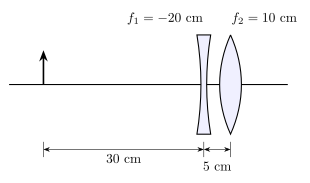
›Reveal solutionSolution
Apply the thin-lens formula twice in sequence — once for the concave lens,
then treat its image as the object for the convex lens — to get the final
real image at 29.2 cm to the right of the concave lens.
Concept and Intuition
For a system of two coaxial thin lenses, the image formed by the first lens
becomes the object for the second lens, regardless of whether that first
image is real or virtual (a virtual image simply means the "object" for the
second lens is on the same side as the incoming light rather than requiring
the rays to have actually converged there). Apply the lens formula
v1−u1=f1 sequentially, being careful to re-measure each
object distance from the second lens's own position.
Step-by-Step Solution
- First lens (concave, f1=−20 cm): object is 30 cm to its left, so u1=−30 cm. v11=f11+u11=−201−301=−603−602=−605=−121. So v1=−12 cm — a virtual image 12 cm to the left of the concave lens (on the same side as the object, as expected for a diverging lens).
- This image becomes the object for the convex lens. The convex lens is 5 cm to the right of the concave lens, so the (virtual) image is 12+5=17 cm to the left of the convex lens: u2=−17 cm.
- Second lens (convex, f2=+10 cm): v21=f21+u21=101−171=17017−10=1707.
- v2=7170≈24.29 cm — positive, so a real image forms 24.2 cm to the right of the convex lens. …
- AP EAPCET 2021Set ap-2021-09-03-FN1 markMCQQ.Two equiconvex lenses, each of refractive index 1.5 and focal length 'f' are kept in contact with each other, and the space in between the lenses is filled with a liquid of refractive index 1.75. The focal length of the combination is ________ (A) 3f (B) 34f (C) 2f (D) 43f
›Reveal solutionSolution
Treating the system as three thin lenses in contact (glass–liquid–glass), the powers add to give an overall focal length of 2f.
Concept and Intuition
When two equiconvex lenses are brought together with a small air gap, the gap itself — bounded by the two convex glass surfaces facing each other — acts like a biconcave lens shape once filled with liquid. So the system is really three thin lenses in contact: glass lens, liquid lens (concave-concave), glass lens, and their powers simply add (thin-lens approximation).
Step-by-Step Solution
- For a single equiconvex lens of radius magnitude R and index 1.5: f1=(1.5−1)(R1−−R1)=0.5×R2=R1, so R=f.
- The liquid lens occupies the gap between the two facing convex surfaces — since these bulge away from the gap, the gap itself has the shape of a biconcave lens with both radii equal in magnitude to R=f (one surface's centre of curvature on each side), giving radii −R and +R in the sign convention.
- Power of the liquid lens: fliquid1=(1.75−1)(−R1−R1)=0.75×(−R2)=−R1.5=−f1.5. …
- AP EAPCET 2021Set eng-2021-08-24-FN1 markMCQQ.The radius of curvature of the face of planoconvex lens is 12 cm and its refractive index is 1.5. Then the focal length of the lens is: (A) 26 cm (B) 22 cm (C) 24 cm (D) 20 cm
›Reveal solutionSolution
This tests the lensmaker's formula for a planoconvex lens; the flat face contributes nothing to the power. f=24 cm.
Concept and Intuition
A planoconvex lens has one curved refracting surface and one flat surface. Since a flat surface has infinite radius of curvature, it doesn't bend light on its own — all the focusing power of the lens comes from the single curved surface. This lets us use the lensmaker's equation with one radius set to ∞.
Step-by-Step Solution
- Lensmaker's equation: f1=(n−1)(R11−R21).
- For the planoconvex lens, take the curved face as R1=+12 cm (convex toward incoming light) and the flat face as R2=∞. …
🎓Unlock everything free for 14 days
- ✓Full step-by-step solutions
- ✓Concept-first explanations
- ✓Methods, shortcuts & mistakes
- ✓PYQ mapping + timed mock tests
Full access for 14 days. No credit card required.