Physics · Ch 11 — Thermodynamics
Thermal Equilibrium
Thermal Equilibrium
What Does "Thermal Equilibrium" Mean?
The idea of equilibrium is central to thermodynamics. A system is said to be in thermal equilibrium when its macroscopic properties — temperature, pressure, volume — do not change with time, and there is no net flow of heat across its boundary. But this definition hides a deeper, more fundamental idea: the Zeroth Law of Thermodynamics.
The textbook introduces thermal equilibrium not by a single definition, but by building it from the ground up, starting with the concept of temperature itself.
The Zeroth Law of Thermodynamics
Before we can say two bodies are in thermal equilibrium, we need a way to compare their "hotness" or "coldness" — that is, their temperature. The Zeroth Law provides the logical foundation for temperature measurement.
Zeroth Law of Thermodynamics: If two bodies A and B are each in thermal equilibrium with a third body C, then A and B are in thermal equilibrium with each other.
This statement seems obvious, but it is not a logical consequence of anything else — it is an empirical fact, and it is the reason we can use a thermometer. The third body C is the thermometer. When you place a thermometer in contact with a cup of coffee, the thermometer's mercury (or alcohol) expands or contracts until it reaches thermal equilibrium with the coffee. The thermometer now reads the coffee's temperature. If you then place the same thermometer in contact with a glass of milk, and it reaches equilibrium at the same reading, the Zeroth Law tells you that the coffee and the milk are in thermal equilibrium with each other — they are at the same temperature.
Without the Zeroth Law, you could not be sure that two objects at the same thermometer reading are actually at the same temperature. The law guarantees that temperature is a well-defined, transitive property.
Defining Thermal Equilibrium Properly
With the Zeroth Law in hand, we can now define thermal equilibrium precisely.
A system is in thermal equilibrium if:
- Its macroscopic variables (pressure , volume , temperature , etc.) are constant in time.
- There is no net heat transfer between any two parts of the system, or between the system and its surroundings.
But condition (2) is really a consequence of condition (1) when the system is isolated. The key point is that thermal equilibrium is a state — a specific set of values for the state variables — that the system settles into when left undisturbed for a long time.
Thermal equilibrium is not the same as mechanical equilibrium (where net forces are zero) or chemical equilibrium (where composition is constant). A gas can be in thermal equilibrium but not in mechanical equilibrium if, say, a piston is free to move. Thermodynamics often considers systems that are in all forms of equilibrium simultaneously — this is called thermodynamic equilibrium.
The Concept of Temperature
Temperature is the property that determines whether two bodies in thermal contact will be in thermal equilibrium. If two bodies have the same temperature, they are in thermal equilibrium. If they have different temperatures, heat will flow from the hotter to the colder body until their temperatures equalize.
The Zeroth Law allows us to assign a numerical value to temperature. We choose a thermometric property — a physical quantity that changes measurably with temperature, such as:
- The length of a mercury column in a capillary tube.
- The electrical resistance of a platinum wire.
- The pressure of a fixed volume of gas.
- The volume of a fixed mass of gas at constant pressure.
We then define a temperature scale by choosing a reference point (like the triple point of water, 273.16 K) and assuming a linear relationship between the thermometric property and temperature.
where is the thermometric property at the unknown temperature , is its value at the reference temperature , and the relationship is assumed linear.
The most fundamental temperature scale is the ideal gas temperature scale, which uses the pressure of a gas at constant volume (or the volume at constant pressure) as the thermometric property. As the gas pressure approaches zero, all gases behave ideally, and the scale becomes independent of the gas used — this is the Kelvin scale.
Key Properties of Thermal Equilibrium (as listed in the textbook)
The textbook lists three essential properties that follow from the Zeroth Law and the definition of thermal equilibrium. Each one is proved or justified in the text.
Property (I): Transitivity of Thermal Equilibrium
If body A is in thermal equilibrium with body B, and body B is in thermal equilibrium with body C, then body A is in thermal equilibrium with body C.
This is a direct restatement of the Zeroth Law. It is the property that makes temperature a well-defined quantity. Without transitivity, you could have A in equilibrium with B, B in equilibrium with C, but A not in equilibrium with C — which would mean that "same temperature" is not a transitive relation, and you could not define a single temperature scale.
›Proof
Proof (from the Zeroth Law):
Let body C be a thermometer. If A is in thermal equilibrium with C, then the thermometer reads the same value when in contact with A as it does when in contact with B (since B is also in equilibrium with C). By the Zeroth Law, A and B must therefore be in thermal equilibrium with each other. This argument can be repeated for any pair of bodies that are each in equilibrium with the same third body. Hence, thermal equilibrium is transitive.
Property (II): Existence of a Temperature Function
For every thermodynamic system in equilibrium, there exists a scalar quantity called temperature, such that equality of temperature is a necessary and sufficient condition for thermal equilibrium.
This property is the definition of temperature. It says that temperature is not just a number we assign arbitrarily — it is a physical property that determines whether two systems will be in thermal equilibrium. If two systems have the same temperature, they are in thermal equilibrium. If they have different temperatures, they are not.
This property does not say that temperature is the only factor determining equilibrium. Two systems at the same temperature but with different pressures or volumes can still be in thermal equilibrium — the condition is only about heat flow, not about mechanical or chemical equilibrium.
Property (III): Temperature is a State Variable
The temperature of a system in thermal equilibrium is a function of its state variables (like pressure and volume) and is independent of the path taken to reach that state.
This means that for a given equilibrium state (say, a specific and for a fixed amount of gas), the temperature is uniquely determined. You cannot have two different equilibrium states with the same and but different temperatures. This is what allows us to write equations of state, like the ideal gas law .
›Proof
Proof (conceptual):
Suppose a system can be in two different equilibrium states, A and B, that have the same pressure and volume but different temperatures. Place a thermometer in contact with the system in state A. It reads . Now change the system to state B without changing or — but if and are fixed, the system's state is completely determined (for a given amount of substance). Therefore, state B cannot have different and from state A — they are the same state. Hence, temperature must be a single-valued function of and (and amount of substance). This is the basis for the equation of state.
The Equation of State
The textbook introduces the equation of state as the mathematical relationship between the state variables of a system in thermal equilibrium. For a fixed amount of a pure substance, the most common form is:
This is a general statement. For an ideal gas, the specific form is:
where is the number of moles and is the universal gas constant.
For real gases, more complex equations exist (van der Waals equation, etc.), but the principle is the same: in thermal equilibrium, , , and are not independent — they are linked by a definite relation.
The equation of state is an empirical law — it comes from experiment, not from pure theory. For an ideal gas, it combines Boyle's law ( at constant ), Charles's law ( at constant ), and Avogadro's law (equal volumes of gases at same and contain equal numbers of molecules). …
Drawn by us to help you understand the concept clearly, and verified to make sure it's accurate. For exams, practice from your NCERT textbook's own diagram.
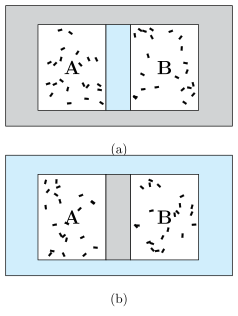
Figure 11.1 is a side-by-side comparison of two experimental arrangements. Both panels show a rectangular box divided into two chambers, labelled A and B, each filled with gas molecules. The only difference between the two panels is the nature of the wall that separates the chambers.
In panel (a), the dividing wall is drawn as a thin, light-coloured barrier. This is the adiabatic wall — an insulator that completely blocks the flow of heat. No thermal energy can cross from A to B or from B to A, no matter how different their temperatures are. The box itself has a grey frame, reinforcing the idea that the entire system is isolated from the surroundings.
In panel (b), the dividing wall is drawn as a grey, solid-looking barrier. This is the diathermic wall — a conductor that allows heat to flow freely between A and B. The box now has a blue frame, which signals that the system is not thermally isolated from the environment (though the text does not specify whether the outer walls are adiabatic or diathermic; the key point is the inner wall). If A is hotter than B, heat will flow through the diathermic wall until both chambers reach the same temperature.
The physical idea is the foundation of the Zeroth Law of Thermodynamics. Two systems separated by an adiabatic wall are thermally independent — they can be at different temperatures indefinitely. But when that wall is replaced by a diathermic one, the systems interact thermally and eventually settle into thermal equilibrium, meaning they have the same temperature. The figure makes this distinction visual: the adiabatic wall preserves a temperature difference; the diathermic wall erases it.
The Zeroth Law states: If system A is in thermal equilibrium with system C, and system B is also in thermal equilibrium with C, then A and B are in thermal equilibrium with each other. This law justifies the use of a thermometer (system C) to compare the temperatures of A and B.
The textbook uses this figure to introduce the concept of temperature as the property that determines whether heat will flow when a diathermic wall is inserted. No formula is derived directly from the figure itself, but the figure sets up the need for a quantitative measure of "hotness." That measure is temperature, and the key relation that follows from the Zeroth Law is the definition of thermal equilibrium:
…