Q.In the following pairs of halogen compounds, which would undergo reaction faster?
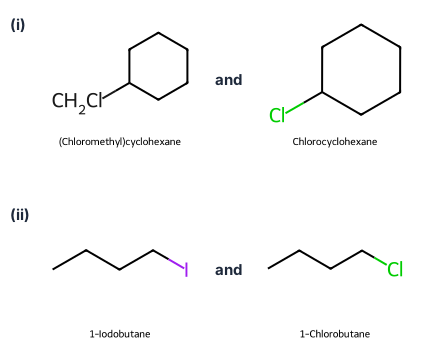
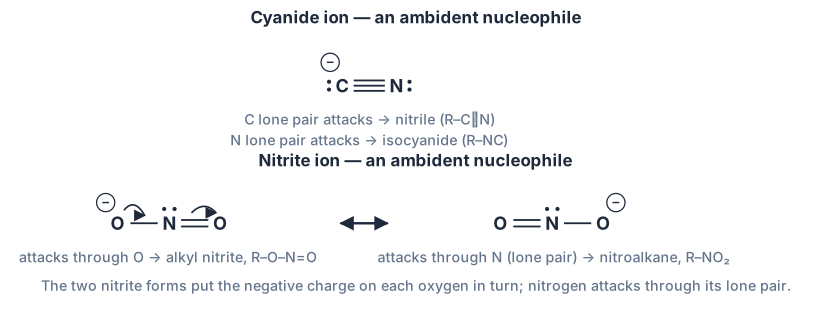
The key idea is that reactivity depends on steric hindrance at the electrophilic carbon and on the leaving group ability. For (i), (chloromethyl)cyclohexane reacts faster because its primary carbon is less hindered than the secondary carbon in chlorocyclohexane. For (ii), 1-iodobutane reacts faster because iodide is a better leaving group than chloride. The faster compounds are ** (i) (chloromethyl)cyclohexane** and ** (ii) 1-iodobutane**.
Concept and Intuition
The reaction is a one-step, bimolecular nucleophilic substitution. The nucleophile attacks the carbon from the back, pushing the leaving group out in a single concerted motion. Two factors dominate the rate:
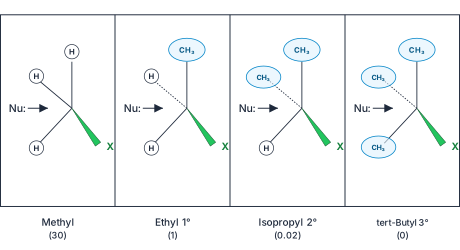
- Steric hindrance — The carbon being attacked must be as open as possible. Primary carbons are fastest, secondary are slower, and tertiary carbons barely react via because bulky groups block the backside approach.
- Leaving group ability — A good leaving group must be stable as an anion after departure. Weaker bases (more stable anions) are better leaving groups. Iodide () is a much better leaving group than chloride () because iodine is larger, more polarizable, and its conjugate acid () is stronger than .
With this in mind, we compare each pair.
Step-by-step reasoning
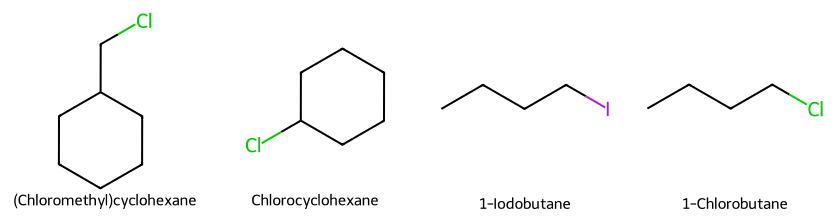
Pair (i): (Chloromethyl)cyclohexane vs. chlorocyclohexane
-
Identify the electrophilic carbon
In (chloromethyl)cyclohexane (), the chlorine is attached to a group — that carbon is primary (bonded to one other carbon and two hydrogens).
In chlorocyclohexane (), the chlorine is attached directly to the cyclohexane ring — that carbon is secondary (bonded to two other carbons and one hydrogen).
-
Compare steric hindrance
The primary carbon in (chloromethyl)cyclohexane has only one bulky neighbour (the cyclohexane ring) and two small hydrogens. The backside is wide open for nucleophilic attack.
The secondary carbon in chlorocyclohexane is flanked by two ring carbons, creating significant steric crowding. The cyclohexane ring itself also blocks approach from certain angles.
-
Apply the rate rule
For reactions, the rate order by substrate type is:
Since (chloromethyl)cyclohexane is primary and chlorocyclohexane is secondary, the primary compound reacts much faster.
A common mistake is to think that the cyclohexane ring in (chloromethyl)cyclohexane makes it more hindered. But the chlorine is on a separate group, so the reactive carbon is still primary and relatively unhindered. The ring is one carbon away, not directly attached to the reaction centre.
Pair (ii): 1-Iodobutane vs. 1-chlorobutane
-
Identify the substrate type
Both compounds have the same carbon skeleton: a straight-chain butane with the halogen on the terminal carbon. Both are primary alkyl halides. Steric hindrance is identical — the only difference is the halogen.
-
Compare leaving group ability
The leaving group ability is inversely related to the basicity of the anion.
- is the conjugate base of , a very strong acid (). Iodide is a very weak base and very stable as an anion due to its large size and high polarizability.
- is the conjugate base of , also a strong acid (), but chloride is a stronger base than iodide. In the transition state, the bond to the leaving group is partially broken. A better leaving group stabilises this transition state more, lowering the activation energy.
-
Apply the leaving group trend
The general order of leaving group ability for halides in reactions is:
Therefore, 1-iodobutane reacts faster than 1-chlorobutane.
A quick way to remember: larger halide ions are better leaving groups because they are more polarizable and their negative charge is more delocalised. Iodine is the largest stable halogen, so iodide is the best leaving group among the common halides.
Final Answer
- (Chloromethyl)cyclohexane reacts faster;
- 1-Iodobutane reacts faster.
Unlock everything free for 14 days
- Full step-by-step solutions
- Concept-first explanations
- Methods, shortcuts & mistakes
- PYQ mapping + timed mock tests
Full access for 14 days. No credit card required.