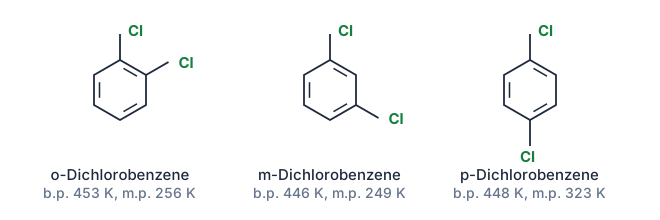
Q.p-Dichlorobenzene has higher m.p. than those of o- and m-isomers. Discuss.
You're viewing a preview — the full solution, concept, methods & PYQ mapping are locked.
Start your 14-day free trial to unlock the full solution →
The unusually high melting point of p-dichlorobenzene arises from its perfect molecular symmetry, which allows it to pack more efficiently in the crystal lattice, requiring more energy (higher temperature) to overcome the stronger intermolecular forces.
Why Symmetry Dictates Melting Point
Melting point is not just about the strength of intermolecular forces — it is about how effectively those forces can act across the entire crystal. A molecule that packs neatly into a lattice will have many more stabilizing contacts per molecule than one that fits awkwardly. For substituted benzenes, symmetry is the key to packing efficiency.
All three dichlorobenzene isomers have the same molecular weight and the same functional groups. Their dipole moments differ: the ortho isomer has a significant dipole (~2.5 D), the meta isomer a moderate one (~1.5 D), and the para isomer has zero dipole moment. You might expect the polar isomers to have higher melting points due to dipole-dipole interactions — but the data shows the opposite. The non-polar para isomer melts at ~53 °C (326 K), while ortho melts at –17 °C and meta at –24 °C. Something else dominates.
That something is crystal packing.
Step-by-Step Reasoning
-
Identify the key structural difference.
In p-dichlorobenzene, the two chlorine atoms are directly opposite each other. The molecule is perfectly linear and highly symmetric (it belongs to the point group). In contrast, o-dichlorobenzene has the chlorines adjacent (crowded, bent shape), and m-dichlorobenzene has them at 120° (asymmetric, bent shape). Neither ortho nor meta isomer has a centre of symmetry or a mirror plane that makes the molecule "fit" into a lattice as neatly.
-
Connect symmetry to packing efficiency.
A symmetric molecule like p-dichlorobenzene can stack like bricks — each molecule fits snugly against its neighbours, maximizing van der Waals contacts. The crystal lattice is more ordered and compact. More intermolecular contacts per molecule means more total van der Waals energy holding the crystal together. To melt the crystal, you must supply enough thermal energy to break all these contacts simultaneously. That requires a higher temperature.
-
Contrast with the unsymmetric isomers.
The ortho and meta isomers have irregular shapes. They cannot pack as tightly; there are gaps and mismatches in the lattice. Fewer stabilizing contacts per molecule means the crystal is held together more weakly. Less thermal energy is needed to disrupt the lattice, so the melting point is much lower — in fact, both are liquids at room temperature.
-
Consider the role of dipole moments — a common trap. …
Unlock everything free for 14 days
- Full step-by-step solutions
- Concept-first explanations
- Methods, shortcuts & mistakes
- PYQ mapping + timed mock tests
Full access for 14 days. No credit card required.