Physics · Ch 4 — Moving Charges and Magnetism
Magnetic Field, Lorentz Force
Magnetic Field, Lorentz Force
The Lorentz Force: Uniting Electric and Magnetic Effects
When a charged particle moves through a region containing both an electric field and a magnetic field , the total force acting on it is the sum of the electric force and the magnetic force. This combined force is called the Lorentz force, named after H.A. Lorentz.
The total force on a charge moving with velocity at a point where the electric field is and the magnetic field is is given by:
This can be split into two parts:
- Electric force:
- Magnetic force:
Key Features of the Magnetic Force
The magnetic part, , has several unique properties that distinguish it from the electric force:
-
Dependence on charge, velocity, and field: The magnetic force depends on the charge , the velocity , and the magnetic field . A negative charge experiences a force in the opposite direction to that on a positive charge.
-
Direction is perpendicular: Because it involves a cross product (), the magnetic force always acts in a direction perpendicular to both the velocity and the magnetic field . Its direction is given by the right-hand rule (or screw rule) for cross products.
-
Zero force for parallel motion: If the velocity is parallel or anti-parallel to the magnetic field , the cross product is zero. Therefore, the magnetic force is zero when a charge moves along the field lines.
-
Zero force on a stationary charge: If the charge is not moving (), the magnetic force is zero. Only a moving charge experiences a magnetic force.
Magnitude of the Magnetic Force
The magnitude of the magnetic force is given by:
where:
- is the magnitude of the charge.
- is the speed of the charge.
- is the magnitude of the magnetic field.
- is the angle between the velocity vector and the magnetic field vector .
The force is maximum when (charge moves perpendicular to the field) and zero when or (charge moves parallel or anti-parallel to the field).
Defining the Unit of Magnetic Field: The Tesla
The expression for the magnetic force is used to define the SI unit of magnetic field, the tesla (T). …
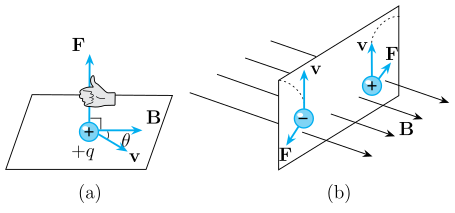
Drawn by us to help you understand the concept clearly, and verified to make sure it's accurate. For exams, practice from your NCERT textbook's own diagram.
What Figure 4.2 Shows
The figure has two parts, (a) and (b), both illustrating the magnetic force on a moving charged particle.
Part (a) shows a perspective view of a horizontal plane. At the front-left of this plane is a positive charge . A stylised right hand is drawn on the plane near the charge. Three vectors emerge from the charge:
- Velocity points to the lower-right, making an angle with the horizontal direction. The angle is marked between and the magnetic field.
- Magnetic field points horizontally to the right.
- Magnetic force points straight upward (bold), perpendicular to both and .
The right hand is used to show the direction of for a positive charge: if you point your fingers along and curl them toward , your thumb gives the direction of .
Part (b) shows a vertical plane. Here, velocity points straight upward. A positive charge experiences a magnetic force in one direction (say, to the left), while a negative charge experiences the opposite force (to the right). The magnetic field is horizontal (into or out of the page, depending on the drawing). This panel emphasises that the sign of the charge reverses the force direction.
Physical Idea Taught
The figure teaches the Lorentz magnetic force — the force on a moving charge in a magnetic field. Key features:
- The force depends on the charge , velocity , and magnetic field .
- It is given by the cross product , so the force is perpendicular to both and .
- The magnitude is , where is the angle between and . If is parallel or antiparallel to ( or ), the force is zero.
- For a negative charge, the force direction is opposite to that for a positive charge (as shown in part (b)).
- Only moving charges experience this force; stationary charges feel no magnetic force.
Key Formula
The textbook develops the Lorentz force expression:
For the magnetic part alone: …