Question of 53
Q.Answer any four of the following questions: (2x4=8)
a) What are the characteristic features of Euglenoids?
b) Which of the plant group is called amphibians of plant kingdom and why?
c) What is 'cell theory'? Who proposed this theory?
d) What is the significance of meiosis?
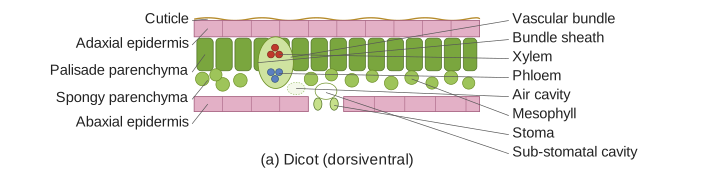
e) Draw a labelled diagram of a dorsiventral leaf (internal structure)
Assam AhsecAHSEC Higher Secondary (HS) 1st Year Examination 2026Subjective· 8mImportance★★★★★
0% · 0/53 Questions
You're viewing a preview — the full solution, concept, methods & PYQ mapping are locked.
Start your 14-day free trial to unlock the full solution →Concise answers to the five short parts (any four required for full marks).
- Characteristic features of Euglenoids: They are mostly freshwater flagellate protists. Instead of a cell wall they have a protein-rich flexible layer called the pellicle. They bear two flagella (one long, one short). In presence of sunlight they are photosynthetic (autotrophic); in darkness they become heterotrophic, feeding on smaller organisms — i.e. they are mixotrophic. Example: Euglena.
- Amphibians of the plant kingdom: Bryophytes (e.g. mosses, liverworts). They are called so because, though they live in moist terrestrial habitats, they require water for sexual reproduction — the flagellated male gametes (antherozoids) must swim through a film of water to reach the egg.
- Cell theory: All living organisms are composed of cells and products of cells, and all cells arise from pre-existing cells. It was proposed by Matthias Schleiden (a botanist) and Theodore Schwann (a zoologist), and later extended by Rudolf Virchow ('Omnis cellula-e cellula').
- Significance of meiosis: It reduces the diploid chromosome number to haploid in gametes/spores, thereby keeping the chromosome number constant from generation to generation in sexually reproducing organisms. Crossing over and independent assortment during meiosis produce genetic variation, the raw material for evolution. …
Unlock everything free for 14 days
- Full step-by-step solutions
- Concept-first explanations
- Methods, shortcuts & mistakes
- PYQ mapping + timed mock tests
Full access for 14 days. No credit card required.