Seed Structure: The Blueprint of a New Plant
Think of a seed as a survival pod. A plant's entire next generation is packed into a tiny, dormant package that can wait out winter, drought, or any bad season, then burst into life when conditions are right. The seed is not a baby plant — it's a baby plant plus its packed lunch, all wrapped in a protective coat.
Every seed has three essential parts: a seed coat (the protective wrapper), an embryo (the tiny future plant), and a food supply (either stored inside the embryo itself or in a separate tissue called endosperm). The way these parts are arranged differs between the two major groups of flowering plants: dicots and monocots.
The Embryo Axis: The Plant's Spine
At the heart of every seed lies the embryo axis — the miniature stem-root system of the future plant. It has two ends:
- Radicle — the embryonic root, which will grow downward into the soil.
- Plumule — the embryonic shoot, which will grow upward toward the light.
Attached to this axis are the cotyledons (seed leaves). These are the first leaves the plant produces, but they often never see sunlight — their job is to absorb or store food for the germinating seedling.
Dicot Seed Structure
Take a bean seed — a classic dicot. Split it open and you see two large, fleshy halves. Those halves are the cotyledons. They are thick because they are the food supply. The endosperm was absorbed during seed development, and its nutrients were transferred into the cotyledons. So a dicot seed like bean or pea has no endosperm at maturity — the cotyledons themselves serve as storage.
Between the two cotyledons, tucked at one end, lies the embryo axis. The radicle points toward the micropyle (a tiny pore in the seed coat through which water enters during germination). The plumule sits between the cotyledons, protected.
In some dicots (like castor), the endosperm remains at maturity. The cotyledons are thin and papery — they absorb food from the endosperm during germination rather than storing it themselves.
Monocot Seed Structure
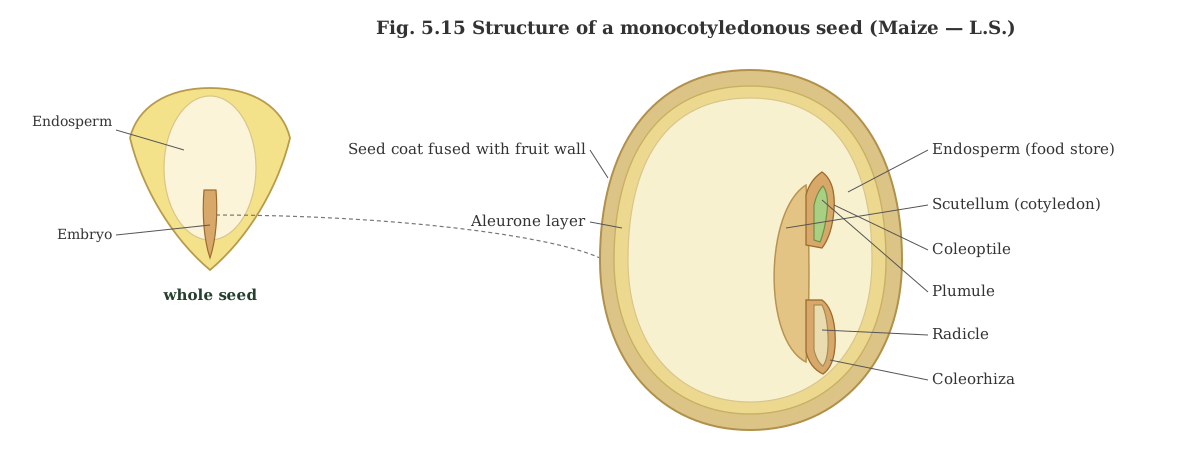
Now look at a maize grain (corn). It's not a true seed botanically — it's a fruit called a caryopsis, where the seed coat is fused to the fruit wall — but for practical purposes, we treat it as a seed.
The key difference: monocot seeds have one cotyledon, called the scutellum. It is thin and shield-shaped, pressed against the endosperm. The scutellum does not store food; it acts as a transfer organ, digesting the endosperm and passing nutrients to the growing embryo.
The endosperm in a monocot seed is large and persistent — it makes up most of the seed's bulk. In maize, you can see two distinct regions: the starchy white endosperm (food) and the small, yellowish embryo tucked at one side.
The embryo axis in monocots has the same parts — radicle and plumule — but they are covered by protective sheaths: the coleorhiza covers the radicle, and the coleoptile covers the plumule. These sheaths protect the delicate growing points as they push through soil.
Dicot vs Monocot Seed — The Core Difference …