Question of 32
Q.Write a short note on the structure of a dicot seed.
Jammu Kashmir JkboseJammu and Kashmir Board of School Education (Class 11) 2025Subjective· 3mImportance★★★★★
0% · 0/32 Questions
You're viewing a preview — the full solution, concept, methods & PYQ mapping are locked.
Start your 14-day free trial to unlock the full solution →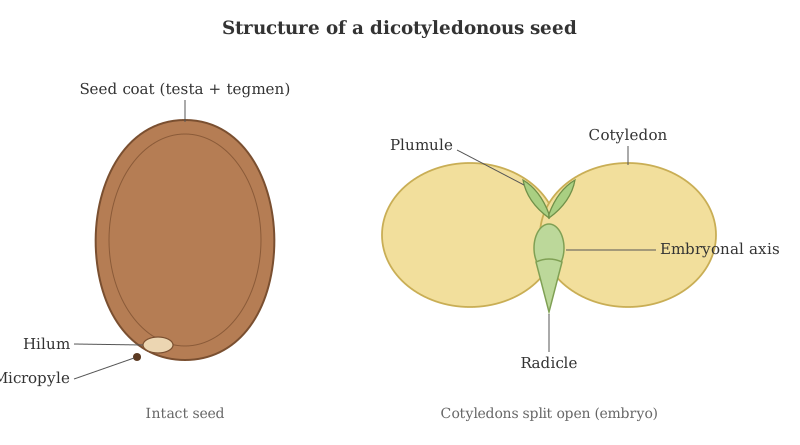
A dicot seed has a protective seed coat, a hilum and micropyle, and an embryo with two cotyledons, a plumule and a radicle; it may or may not have endosperm.
The structure of a typical dicot seed (e.g. gram, pea, bean) is as follows:
- Seed coat: the outer protective covering, differentiated into an outer, thicker layer called the testa and an inner, thinner layer called the tegmen.
- Hilum: a small, scar-like structure on the seed coat marking the point where the seed was earlier attached to the fruit wall (pedicel/funicle).
- Micropyle: a small pore located just above the hilum, through which water is absorbed during germination (it is also the point of entry of the pollen tube during fertilisation).
- Embryo: found within the seed coat, consisting of:
- an embryonal axis,
- two cotyledons (seed leaves), which are often fleshy and store food in non-endospermic seeds,
- the plumule — the portion of the embryonal axis above the level of cotyledon attachment, which develops into the shoot system; also called the epicotyl,
- the radicle — the portion below the level of cotyledon attachment, which develops into the root system; also called the hypocotyl. …
Unlock everything free for 14 days
- Full step-by-step solutions
- Concept-first explanations
- Methods, shortcuts & mistakes
- PYQ mapping + timed mock tests
Full access for 14 days. No credit card required.