Q.Find the centre of mass of three particles at the vertices of an equilateral triangle. The masses of the particles are 100 g, 150 g, and 200 g respectively. Each side of the equilateral triangle is 0.5 m long.
You're viewing a preview — the full solution, concept, methods & PYQ mapping are locked.
Start your 14-day free trial to unlock the full solution →The center of mass is the weighted average of the positions of the particles. By setting up a coordinate system for the equilateral triangle and applying the center of mass formula, we find the coordinates of the center of mass to be .
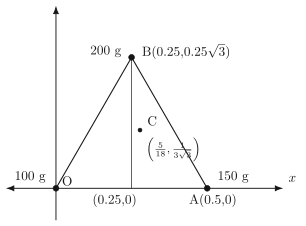
The figure shows an equilateral triangle with its three vertices labelled O, A, and B. Vertex O is placed at the origin of the - coordinate plane. Vertex A lies on the -axis at . Vertex B is at , which is the third corner of an equilateral triangle of side length units. A median is drawn from vertex B to the opposite side OA. The centre of mass of the three-particle system is marked inside the triangle at the coordinates . The and axes are shown, with the origin at O.
The physical idea is straightforward: when you have discrete masses at known positions, the centre of mass is the weighted average of their positions. Each mass pulls the balance point toward itself in proportion to its mass. In this example, three particles of masses , , and sit at the vertices. The 200 g mass at B is the heaviest, so the centre of mass lies closer to B than to the lighter vertices — notice that the CM coordinates are not at the triangle’s geometric centre (the centroid), but shifted toward B.
The textbook develops the definition of centre of mass for a system of particles. For the -coordinate:
and similarly for the -coordinate:
Here is the mass of the -th particle and are its coordinates. The denominator is the total mass .
Applying these formulas to the figure: total mass . The -coordinate of the CM is
The -coordinate is
When all masses are equal, the centre of mass coincides with the centroid of the triangle. Here the masses are unequal, so the CM is pulled toward the heaviest particle. You can think of it as the balance point if you placed the triangle on a pin — it would tip until the CM is directly above the support.
A common mistake is to confuse the centre of mass with the geometric centroid. The centroid depends only on shape, not on how mass is distributed. The centre of mass depends on both shape and mass distribution. In this figure, the centroid of the triangle would be at , which is different from the CM at .
The median drawn from B to side OA is a visual aid — it shows that the CM lies along this median, but not at its midpoint. The CM divides the median in the ratio of the masses at the ends, a property that generalises to any system of two particles.
The center of mass of a system of particles is a crucial concept in physics, representing the average position of all the mass in the system. Imagine trying to balance an object on a single point; that point would be its center of mass. For a system of discrete particles, it's essentially a weighted average of their individual positions, where the 'weight' for each particle is its mass. This means that particles with greater mass have a stronger influence on the location of the center of mass.
To find the center of mass, we first need to define a coordinate system. This allows us to assign specific coordinates to each particle. The choice of coordinate system does not affect the physical location of the center of mass, but a smart choice can simplify the calculations significantly.
Here's how we can approach this problem:
-
Set up the Coordinate System and Particle Positions:
Let the side length of the equilateral triangle be m. We'll place one vertex of the triangle at the origin to simplify calculations.
Let the three particles have masses g, g, and g.
-
Particle 1 ( g): Place it at the origin.
-
Particle 2 ( g): Place it along the positive x-axis.
-
Particle 3 ( g): The third vertex of an equilateral triangle with one vertex at and another at will be at .
TipChoosing one vertex at the origin and another on an axis simplifies the coordinates of those two points, reducing the number of non-zero terms in the center of mass calculation. …
-
Unlock everything free for 14 days
- Full step-by-step solutions
- Concept-first explanations
- Methods, shortcuts & mistakes
- PYQ mapping + timed mock tests
Full access for 14 days. No credit card required.