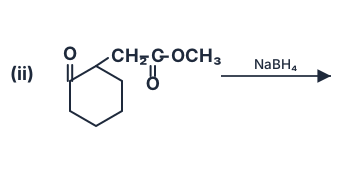
Q.Write structures of the products of the following reactions:
🔒You're viewing a preview — the full solution, concept, methods & PYQ mapping are locked.
🔒 Start your 14-day free trial to unlock the full solution →Concept understanding — Electrophilic Addition Reactions
Electrophilic Aromatic Substitution – The First Meeting
Imagine you have a benzene ring — that perfect, flat hexagon of six carbons with alternating double bonds. It's stable, almost stubbornly so. You want to attach something new to it, say a bromine atom or a nitro group. But benzene doesn't react like an alkene. It doesn't just add across a double bond. Instead, it does something more elegant: it kicks out a hydrogen and keeps its aromatic ring intact.
That's the heart of Electrophilic Aromatic Substitution (EAS).
The Intuition: Why "Substitution" and Not "Addition"?
Benzene's stability comes from its delocalised π electrons — a cloud above and below the ring. This cloud is electron-rich, so it attracts electrophiles (electron-loving species). But if an electrophile simply added to a double bond, the ring would break its aromaticity, losing that huge stabilisation. That would be energetically costly.
So benzene does something smarter: it lets the electrophile attack, temporarily breaks aromaticity to form a high-energy intermediate (the arenium ion), and then loses a proton to restore the aromatic ring. The net result? A hydrogen is replaced by the electrophile. The ring is back to its stable, aromatic self.
The key trade-off: temporary loss of aromaticity is acceptable because the final product regains it. Addition reactions would permanently destroy aromaticity — benzene avoids that.
The Precise Statement
Electrophilic Aromatic Substitution is a reaction in which an electrophile (E+) replaces a hydrogen atom on an aromatic ring, proceeding through a sigma complex (arenium ion) intermediate, and restoring aromaticity after deprotonation.
The general equation:
Ar−H+EX+Ar−E+HX+
where Ar represents an aromatic ring.
The Mechanism in Three Steps
-
Generation of the electrophile – Many EAS reactions need a catalyst to create a strong enough E+. For example, bromination uses FeBrX3 to polarise BrX2 into BrX+.
-
Attack by the aromatic ring – The π electrons of benzene attack the electrophile, forming a sigma complex (also called the arenium ion or Wheland intermediate). This intermediate is non-aromatic — it has four π electrons delocalised over five carbons, and one sp3 carbon bearing the electrophile and a hydrogen.
Benzene+E+⟶Sigma complex (non-aromatic)
- Deprotonation – A base (often the counterion of the catalyst, like FeBrX4X−) removes the proton from the sp3 carbon. The pair of electrons from the C–H bond flows back into the ring, restoring the aromatic sextet.
Sigma complex+Base⟶Product+HX+
The sigma complex is not aromatic. It's a high-energy intermediate. Students often mistakenly think it's still aromatic — it isn't. That's why the step is fast and the complex is short-lived.
Why This Matters for Exams
EAS is the gateway to understanding how to put groups onto benzene rings. The rate-determining step is usually the formation of the sigma complex (step 2). The regiochemistry (where the electrophile goes) depends on whether the ring already has a substituent — that's the topic of activating/deactivating groups and ortho/para vs. meta directors. …
Why this formula?
Electrophilic Addition Reactions: Why the Mechanism Works
Electrophilic addition is a cornerstone of alkene and alkyne chemistry. Instead of memorising the "arrow pushing," let's understand why the reaction proceeds the way it does — driven by electron density, stability, and charge.
1. The Core Idea: Why Alkenes React This Way
Alkenes have a π-bond — a cloud of electrons above and below the plane of the σ-bond. This π-electron cloud is:
- Electron-rich (nucleophilic)
- Exposed (not shielded by σ-bonds like in alkanes)
An electrophile (electron-lover) is attracted to this high electron density. The reaction is electrophilic addition because the electrophile attacks first.
Key principle: The π-bond acts as a Lewis base (electron donor). The electrophile is a Lewis acid (electron acceptor).
2. The General Mechanism (Two-Step)
Step 1: Formation of a Carbocation (or Bridged Intermediate)
The electrophile (E⁺) attacks the π-bond. The π-electrons form a new σ-bond to E⁺, leaving the other carbon with a positive charge — a carbocation.
C=C+EX+⟶CX+−C−E
Why does this happen?
The π-bond is weaker than a σ-bond (~260 kJ/mol vs ~350 kJ/mol). Breaking the π-bond to form a σ-bond is energetically favourable because the new σ-bond is stronger. The carbocation is a high-energy intermediate, but it's stabilised by:
- Hyperconjugation (alkyl groups donate electron density)
- Inductive effect (alkyl groups push electrons toward the positive carbon)
Step 2: Nucleophilic Attack
A nucleophile (Nu⁻) attacks the carbocation, forming a second σ-bond.
CX+−C−E+NuX−⟶C−Nu−C−E
Why does this happen?
The carbocation is electron-deficient (positive charge). The nucleophile is electron-rich. Opposite charges attract — this is electrostatic and orbital overlap driven.
3. The Key "Formula" — Markovnikov's Rule
Statement: In the addition of HX to an unsymmetrical alkene, the hydrogen attaches to the carbon with more hydrogens already, and the X attaches to the carbon with fewer hydrogens.
Why does this rule hold? (The reasoning)
Consider propene: CHX3−CH=CHX2 + HBr.
- Possible carbocations:
- Primary carbocation: CHX3−CHX+−CHX2Br (less stable)
- Secondary carbocation: CHX3−CHBr−CHX2X+ (more stable)
The more substituted carbocation (secondary > primary) is more stable due to:
- Hyperconjugation: More alkyl groups = more C–H σ-bonds that can donate electron density into the empty p-orbital of the carbocation.
- Inductive effect: Alkyl groups are electron-donating, stabilising the positive charge.
Result: The reaction proceeds via the more stable carbocation, leading to Markovnikov addition.
Markovnikov's rule is not a law — it's a consequence of carbocation stability.
4. The "Anti-Markovnikov" Exception (Why It Happens)
With HBr in the presence of peroxides (ROOR), the addition is anti-Markovnikov — Br goes to the less substituted carbon.
Why? The mechanism changes from ionic to free-radical.
- Peroxide decomposes to radicals: ROOR2RO⋅
- RO• abstracts H from HBr: RO⋅+HBrROH+Br⋅
- Br• adds to the alkene — at the less substituted carbon (because the radical formed is more stable — tertiary > secondary > primary).
- The new radical abstracts H from another HBr, regenerating Br•. …
Acid-catalysed water addition to propene follows Markovnikov's rule; NaBH4 reduces aldehydes and ketones to alcohols but leaves an ester untouched. …
(i) is Markovnikov hydration of an alkene; (ii) and (iii) are NaBH4 reductions. NaBH4 is a mild hydride donor that reduces the carbonyl of an aldehyde or ketone to an alcohol but is not strong enough to reduce an ester.
Concept and steps
- In acid-catalysed hydration, H+ adds to give the more stable (more substituted) carbocation, so -OH ends up on the more substituted carbon (Markovnikov). Propene gives a secondary carbocation on C-2, so the product is propan-2-ol, CH3-CH(OH)-CH3.
- NaBH4 delivers hydride to the electrophilic carbonyl carbon. The molecule has two carbonyls: a ring ketone (C=O) and an ester (-CO-OCH3). NaBH4 reduces only the ketone, converting the ring C=O into -CH(OH)- (a secondary alcohol), while the ester group survives. The product is a cyclohexane ring bearing -OH on the former carbonyl carbon and -CH2-CO-OCH3 on the adjacent carbon, i.e. methyl (2-hydroxycyclohexyl)acetate. …
Method: Chemoselectivity-Prediction Method for Hydration and Hydride-Reduction Reactions
Core Concept
Predicting the product of an addition or reduction reaction requires first identifying WHICH functional group(s) the reagent can react with, then applying the correct regiochemical/selectivity rule to that group while leaving unreactive functional groups untouched.
Steps
- Identify every functional group present in the substrate (alkene, ketone, aldehyde, ester, etc.).
- Identify what the given reagent is capable of reacting with: dilute acid + H2O reacts with C=C (hydration); NaBH4 is a mild hydride donor that reduces aldehydes and ketones but is NOT strong enough to reduce esters, carboxylic acids, or amides.
- For an addition to an unsymmetrical alkene under acid catalysis, apply Markovnikov's rule: protonate to form the more stable (more substituted) carbocation, then let water attack that same carbon, so -OH lands on the more substituted carbon.
- For a substrate with multiple carbonyls, identify which specific carbonyl(s) the reagent can reduce (aldehyde/ketone) versus which it must leave alone (ester), and reduce only the reactive one(s).
- Write the final structure showing the changed group(s) explicitly and confirm all unreactive groups are drawn unchanged.
Applying this:
(i) CH3-CH=CH2 + H2O/H+: protonation gives the secondary carbocation at C-2; water attacks there -> propan-2-ol, CH3-CH(OH)-CH3. …
- AHSEC Higher Secondary (HS) Final Examination 2018Set ANNUAL3 marksQ.Answer either(a) or (b):(a)(i) Give a method of preparation of 3° alcohol. [1](ii) State the mechanism of the reaction: CH3CH=CH2 + H2O --(H+)--> (equilibrium) CH3-CH(OH)-CH3. [2]
›Reveal solutionSolution
(Part a.) Grignard reagent + ketone → 3° alcohol; and acid-catalysed hydration of propene is a Markovnikov addition via a 2° carbocation.
- Method of preparation of a tertiary (3°) alcohol: Reaction of a Grignard reagent with a ketone gives a tertiary alcohol after hydrolysis. Example: CH3MgBr + (CH3)2C=O → (CH3)3C–OMgBr, then + H2O/H⁺ → (CH3)3C–OH (2-methylpropan-2-ol) + Mg(OH)Br. The carbonyl carbon of the ketone (already bonded to two carbons) gains a third carbon from the Grignard reagent, giving a carbon bearing three alkyl groups and –OH — a 3° alcohol.
- Mechanism of acid-catalysed hydration: CH3CH=CH2 + H2O --(H⁺)--> CH3CH(OH)CH3: Step 1 (protonation): H⁺ (from the acid) adds to the double bond following Markovnikov's rule, generating the more stable secondary carbocation: CH3CH=CH2 + H⁺ → CH3–CH⁺–CH3. Step 2 (nucleophilic attack): a water molecule attacks the carbocation using a lone pair on oxygen: CH3–CH⁺–CH3 + H2O → CH3–CH(–O⁺H2)–CH3 (protonated alcohol). Step 3 (deprotonation): loss of H⁺ (regenerating the catalyst) gives the neutral alcohol: …
🎓Unlock everything free for 14 days
- ✓Full step-by-step solutions
- ✓Concept-first explanations
- ✓Methods, shortcuts & mistakes
- ✓PYQ mapping + timed mock tests
Full access for 14 days. No credit card required.