Q.Predict the products of the following reactions:
🔒You're viewing a preview — the full solution, concept, methods & PYQ mapping are locked.
🔒 Start your 14-day free trial to unlock the full solution →Concept understanding — Oxidation Reactions
Alcohol Oxidation: The Intuition First
Imagine you have a molecule of ethanol — the alcohol in your hand sanitizer or a drink. It has a carbon atom bonded to an –OH group. Now picture that –OH group as a "handle" that can be transformed. Oxidation, in organic chemistry, doesn't always mean adding oxygen — it often means removing hydrogen from a carbon that already has a bond to oxygen. For alcohols, oxidation is like "stripping away" hydrogen atoms from the carbon that holds the –OH, turning the alcohol into a more oxidized functional group.
Think of it this way: a primary alcohol (R–CH₂–OH) has two hydrogens on the carbon with the –OH. If you remove one hydrogen and the hydrogen from the –OH, you get an aldehyde (R–CHO). Remove both hydrogens (and the –OH hydrogen), and you get a carboxylic acid (R–COOH). A secondary alcohol (R–CHOH–R') has only one hydrogen on that carbon — remove it, and you get a ketone (R–CO–R'). A tertiary alcohol has no hydrogen on that carbon — so it cannot be oxidized without breaking the carbon skeleton.
That's the core intuition: oxidation of an alcohol is about removing hydrogens from the carbon bearing the –OH group. The more hydrogens you can remove, the more oxidized the product.
The Precise Statement
Alcohol oxidation is the process in which an alcohol loses hydrogen atoms (dehydrogenation) from the carbon bonded to the –OH group, increasing the number of C–O bonds (or decreasing C–H bonds). The outcome depends on the class of the alcohol:
| Alcohol Class | Structure | Product after oxidation | Reagent example |
|---|---|---|---|
| Primary (1°) | R–CH₂–OH | Aldehyde (R–CHO) then Carboxylic acid (R–COOH) | PCC (stops at aldehyde); K₂Cr₂O₇/H⁺ (goes to acid) |
| Secondary (2°) | R–CHOH–R' | Ketone (R–CO–R') | K₂Cr₂O₇/H⁺, CrO₃, etc. |
| Tertiary (3°) | R₃C–OH | No reaction (under normal conditions) | — |
A common mistake: students think "oxidation" always adds oxygen. For alcohols, it's removal of hydrogen from the carbon with the –OH. The oxygen from the –OH stays — it's the hydrogens that leave.
Why Does Tertiary Alcohol Not Oxidize?
Look at the carbon with the –OH in a tertiary alcohol: it has three carbon groups attached and no hydrogen. To form a C=O bond, you'd need to remove a hydrogen from that carbon — but there is none. The only way to oxidize a tertiary alcohol is to break a C–C bond (strong and difficult), which is not typical oxidation. So in standard organic chemistry, tertiary alcohols are inert to mild oxidizing agents.
A Real-World Analogy
Think of the alcohol carbon as a "parking spot" with a certain number of hydrogen "cars." Primary alcohol has two cars parked. Oxidation is like towing away one car (→ aldehyde) or both cars (→ carboxylic acid). Secondary alcohol has one car — tow it away, and you get a ketone. Tertiary alcohol has zero cars — nothing to tow, so no reaction.
Key Reagents to Remember (for exams)
- PCC (pyridinium chlorochromate): oxidizes 1° alcohols to aldehydes only — stops there.
- K₂Cr₂O₇ / H₂SO₄ (Jones reagent): oxidizes 1° alcohols all the way to carboxylic acids; 2° alcohols to ketones.
- KMnO₄: similar to dichromate, but stronger — can over-oxidize. …
Why this formula?
Oxidation Reactions: Why the Key Principles Hold
Oxidation reactions are fundamental to chemistry, and understanding why they work the way they do is essential for mastering Indian board exams (Class 11, 12, JEE, NEET). Let's break down the core ideas from first principles.
1. The Core Definition: What Does "Oxidation" Really Mean?
Historically, oxidation meant "adding oxygen." But that's too narrow. The modern, exam-correct definition is:
Oxidation is the loss of electrons by a species.
This is the electronic concept (given by the ionic theory). The why behind this definition comes from the behavior of atoms during chemical reactions.
Why do atoms lose electrons?
Atoms seek stability. They achieve this by having a full outer electron shell (octet, duplet, or pseudo-inert gas configuration).
- Metals (like Na, Mg, Fe) have few valence electrons (1, 2, or 3). It's energetically easier for them to lose these electrons than to gain 5, 6, or 7.
- Non-metals (like O, Cl, F) have many valence electrons (5, 6, or 7). It's energetically easier for them to gain electrons.
So, when a metal reacts with a non-metal, the metal loses electrons (gets oxidized), and the non-metal gains electrons (gets reduced).
Example:
2Na+Cl2→2NaCl
- Na loses 1 electron: Na→Na++e− (Oxidation)
- Cl gains 1 electron: Cl2+2e−→2Cl− (Reduction)
Key takeaway: Oxidation and reduction always happen together (Redox reactions). You cannot have one without the other.
2. The Key Formula(e): Oxidation Number Rules
The oxidation number (O.N.) is a bookkeeping tool. It's not a real charge (except in ionic compounds), but it helps track electron flow.
Why do we assign oxidation numbers?
Because in covalent compounds (like CH4 or H2O), electrons are shared, not transferred. We need a way to pretend they are transferred to see which atom "owns" the electrons more.
The Rules (and why they exist)
| Rule | Statement | Why this rule? |
|---|---|---|
| 1 | O.N. of an element in its free state = 0 | No electron transfer has occurred. |
| 2 | O.N. of a monatomic ion = its charge | The atom has actually lost/gained that many electrons. |
| 3 | O.N. of H = +1 (except in metal hydrides where it's -1) | H is less electronegative than O, F, Cl, but more electronegative than metals. |
| 4 | O.N. of O = -2 (except in peroxides where it's -1, superoxides -1/2, and with F where it's +2) | O is highly electronegative (3.44 on Pauling scale). It "pulls" electrons toward itself. |
| 5 | Sum of O.N. in a neutral compound = 0 | The compound has no net charge. |
| 6 | Sum of O.N. in a polyatomic ion = charge of the ion | The ion's overall charge must be accounted for. |
The Derivation of a Key Formula: Finding O.N. of an Unknown Element
Suppose you need to find the O.N. of S in H2SO4.
Step 1: Write known O.N.s:
- H: +1 (rule 3)
- O: -2 (rule 4)
- S: let it be x (unknown)
Step 2: Apply rule 5 (neutral compound sum = 0):
2(+1)+x+4(−2)=0
Step 3: Solve:
2+x−8=0
x−6=0
x=+6
Why this works: The oxidation number is a mathematical consequence of the electronegativity hierarchy. Oxygen is more electronegative than sulfur, so it "takes" the electrons. Hydrogen is less electronegative than sulfur, so it "gives" electrons to sulfur. The net result is that sulfur appears to have lost 6 electrons.
3. The Key Formula(e): Balancing Redox Equations
Two methods are exam-critical: Oxidation Number Method and Ion-Electron Method (Half-Reaction Method).
Why do we need these methods?
Because in a redox reaction, the total number of electrons lost (oxidation) must equal the total number of electrons gained (reduction). This is the Law of Conservation of Charge.
The Ion-Electron Method (for acidic medium) — Step-by-step why
Example: Balance MnO4−+Fe2+→Mn2++Fe3+ (acidic)
Step 1: Write half-reactions.
-
Oxidation: Fe2+→Fe3++e−
Why? Fe loses 1 electron (O.N. goes from +2 to +3).
-
Reduction: MnO4−→Mn2+
Why? Mn gains electrons (O.N. goes from +7 to +2).
Step 2: Balance atoms other than H and O.
- Mn is already balanced (1 on each side).
Step 3: Balance O by adding H2O.
- Left: 4 O atoms. Right: 0 O atoms.
- Add 4 H2O to the right:
MnO4−→Mn2++4H2O
Step 4: Balance H by adding H+ (because acidic medium).
- Right: 8 H atoms (from 4 H2O). Left: 0 H atoms.
- Add 8 H+ to the left:
8H++MnO4−→Mn2++4H2O
Step 5: Balance charge by adding electrons.
- Left: 8(+1)+(−1)=+7 charge.
- Right: +2 charge.
- To make left = right, add 5 electrons to the left:
8H++MnO4−+5e−→Mn2++4H2O
Step 6: Multiply half-reactions to equalize electrons.
- Oxidation: Fe2+→Fe3++e− (×5)
- Reduction: 8H++MnO4−+5e−→Mn2++4H2O (×1)
Step 7: Add them:
5Fe2++8H++MnO4−→5Fe3++Mn2++4H2O
Why this works: Every step is driven by conservation laws:
- Mass balance: Same number of each atom on both sides.
- Charge balance: Net charge on left = net charge on right.
- Electron balance: Electrons lost = electrons gained.
4. The Key Formula(e): Electrochemical Series and Cell Potential
For a galvanic cell (voltaic cell), the cell potential Ecell∘ is:
Ecell∘=Ecathode∘−Eanode∘
Why this formula? …
Concept: Nucleophilic Addition–Elimination with Ammonia Derivatives – Aldehydes and ketones react with ammonia derivatives (H2N−Z) in weakly acidic medium: the nitrogen lone pair adds to the carbonyl carbon, and a molecule of water is then eliminated, leaving a carbon–nitrogen double bond (C=N−Z).
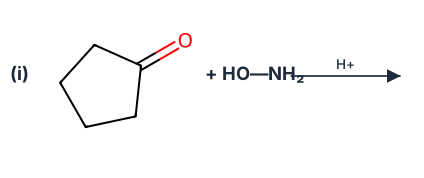
(i) Cyclopentanone + hydroxylamine (HO−NH2), H+ — here Z=OH, so the carbonyl becomes C=N−OH: the oxime of cyclopentanone.
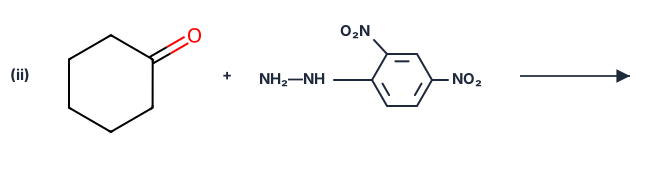
(ii) Cyclohexanone + 2,4-dinitrophenylhydrazine — Z=NH−C6H3(NO2)2, giving the 2,4-DNP-hydrazone (the yellow-orange derivative used in the 2,4-DNP test).
(iii) R−CH=CH−CHO + semicarbazide (NH2−CO−NH−NH2), H+ — only the terminal −NH2 of the hydrazine end condenses (the −NH2 next to C=O is deactivated by amide resonance): the product is the semicarbazone. The C=C double bond is untouched. …
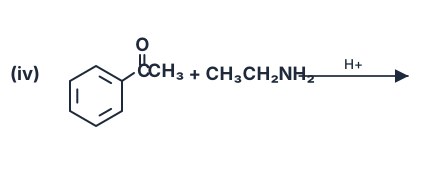
All four reactions are nucleophilic addition–elimination of an ammonia derivative H2N−Z on a carbonyl compound: the products are (i) cyclopentanone oxime, (ii) cyclohexanone 2,4-dinitrophenylhydrazone, (iii) the semicarbazone of the α,β-unsaturated aldehyde, and (iv) the N-ethylimine (Schiff base) of acetophenone — each with a molecule of water eliminated.
The carbonyl group of an aldehyde or ketone is attacked by the lone pair of the nitrogen of an ammonia derivative (H2N−Z). The initially formed addition product (a carbinolamine, >C(OH)−NH−Z) rapidly loses water in the weakly acidic medium, leaving the condensation product >C=N−Z. The optimum pH matters: the acid protonates the carbonyl oxygen (activating the carbonyl), but too much acid would protonate the amine nucleophile itself.
(i) Cyclopentanone + HO−NH2 (hydroxylamine), H+
Hydroxylamine's nitrogen adds to the ring carbonyl carbon; dehydration then gives the oxime: the ring C=O becomes C=N−OH.
cyclopentanone+HO−NH2H+cyclopentanone oxime+H2O
(ii) Cyclohexanone + 2,4-dinitrophenylhydrazine
The terminal −NH2 of the hydrazine adds to the carbonyl; loss of water gives the 2,4-dinitrophenylhydrazone, ring C=N−NH−C6H3(NO2)2. 2,4-DNP-derivatives are yellow, orange or red crystalline solids — this is exactly the reaction behind the classical 2,4-DNP (Brady's) test for the carbonyl group.
(iii) R−CH=CH−CHO + semicarbazide, H+ …
The One Recipe Behind All Four Parts
Every part is the same two-step pattern — recognise it once and all four answers follow:
- Identify the carbonyl compound and the ammonia derivative H2N−Z. The nucleophile is always the nitrogen bearing two hydrogens.
- Condense and eliminate water. Replace the carbonyl C=O with C=N−Z and write + H2O.
| Part | Carbonyl compound | H2N−Z | Z | Product type |
|---|---|---|---|---|
| (i) | Cyclopentanone | HO−NH2 | −OH | Oxime |
| (ii) | Cyclohexanone | 2,4-DNP-hydrazine | −NH−C6H3(NO2)2 | 2,4-DNP-hydrazone |
| (iii) | R−CH=CH−CHO | semicarbazide | −NH−CO−NH2 | Semicarbazone |
| (iv) | Acetophenone | CH3CH2NH2 | −CH2CH3 | Imine (Schiff base) |
Watch-outs …
- AHSEC Higher Secondary (HS) Final Examination 2024Set ANNUAL3 marksQ.Complete the following reactions (any three):(a) benzene-1,2-dicarboxylic acid (phthalic acid) + SOCl2/Heat →(b) C6H5CHO + NH2CONHNH2 →(c) CH3COCH2COOC2H5 --(i) NaBH4(ii) H+-->(d) cyclohexanol (C6H11OH) + CrO3 →
›Reveal solutionSolution
(a) SOCl2 converts a –COOH to –COCl. (b) An aldehyde condenses with semicarbazide to form a semicarbazone. (c) NaBH4 selectively reduces the ketone carbonyl of a β-keto ester, leaving the ester intact. (d) CrO3 oxidises a secondary alcohol to a ketone.
(a) Phthalic acid + SOCl2/Heat:
Both –COOH groups of benzene-1,2-dicarboxylic acid are converted to acid chloride (–COCl) groups by thionyl chloride, with loss of SO2 and HCl gas:
C6H4(COOH)2 + 2SOCl2 --(Δ)--> C6H4(COCl)2 + 2SO2 + 2HCl
Product: benzene-1,2-dicarbonyl dichloride (phthaloyl chloride).
(b) Benzaldehyde + Semicarbazide (NH2CONHNH2):
The carbonyl of benzaldehyde condenses with the terminal –NH2 of semicarbazide (a classic carbonyl-derivative-forming reaction), with loss of water:
C6H5CHO + H2N–NH–CO–NH2 --> C6H5CH=N–NH–CO–NH2 + H2O
Product: benzaldehyde semicarbazone.
(c) Ethyl acetoacetate + (i) NaBH4 (ii) H+:
NaBH4 is a mild, selective reducing agent that reduces ketone/aldehyde C=O groups but does not touch ester groups under these conditions. In ethyl acetoacetate, CH3–CO–CH2–COOC2H5, only the ketone carbonyl is reduced to a secondary alcohol; the ester group survives unchanged: …
- AHSEC Higher Secondary (HS) Final Examination 2018Set ANNUAL3 marksQ.Write chemical reactions to affect the following transformations: (any three)(i) Butan-1-ol to butanoic acid.(ii) Cyclohexene to hexane-1,6-dioic acid.(iii) Butanal to butanoic acid.(iv) Ethanoic acid to ethanoic anhydride.
›Reveal solutionSolution
(Answering any three.) Butan-1-ol and butanal are oxidised to butanoic acid; cyclohexene is oxidatively cleaved to adipic acid; ethanoic acid is dehydrated to its anhydride.
- Butan-1-ol → butanoic acid: Oxidation of the primary alcohol with a strong oxidising agent (acidified KMnO4 or K2Cr2O7): CH3CH2CH2CH2OH --(KMnO4/H⁺)--> CH3CH2CH2COOH (butanoic acid).
- Cyclohexene → hexane-1,6-dioic acid (adipic acid): Oxidative cleavage of the C=C ring with hot, concentrated acidified KMnO4 opens the ring to a straight-chain dicarboxylic acid: Cyclohexene --(hot conc. KMnO4/H⁺)--> HOOC–CH2CH2CH2CH2–COOH (hexane-1,6-dioic acid).
- Butanal → butanoic acid: Mild oxidation of the aldehyde (e.g. Tollens' reagent, or [O]) gives the acid: CH3CH2CH2CHO --([O])--> CH3CH2CH2COOH (butanoic acid). …
🎓Unlock everything free for 14 days
- ✓Full step-by-step solutions
- ✓Concept-first explanations
- ✓Methods, shortcuts & mistakes
- ✓PYQ mapping + timed mock tests
Full access for 14 days. No credit card required.