Q.Which one of the following compounds is more reactive towards SN2 reaction and why ?
CH3CH(Cl)CH2CH3 or CH3CH2CH2Cl
🔒You're viewing a preview — the full solution, concept, methods & PYQ mapping are locked.
🔒 Start your 14-day free trial to unlock the full solution →Concept understanding — SN1 and SN2 Mechanism
The Core Idea: Two Ways to Swap a Group
Imagine you have a molecule with a leaving group (like a halogen) attached to a carbon. You want to replace that leaving group with a nucleophile (something that loves positive charge). There are two fundamentally different ways this can happen — like two different ways to replace a lightbulb.
SN2 is like unscrewing the old bulb and screwing in the new one in one smooth motion. SN1 is like first pulling the old bulb out completely, leaving an empty socket, and then putting the new bulb in.
That empty socket — the carbocation — is the key difference.
SN2: One Step, Backside Attack
The name says it all: Substitution, Nucleophilic, Bimolecular. "Bimolecular" means two molecules (the nucleophile and the substrate) are involved in the rate-determining step.
The Mechanism
The nucleophile attacks the carbon from the backside — directly opposite the leaving group. As the nucleophile approaches, the leaving group starts to leave. At the transition state, the nucleophile is partially bonded and the leaving group is partially detached. Then the leaving group departs completely, and the nucleophile is fully bonded.
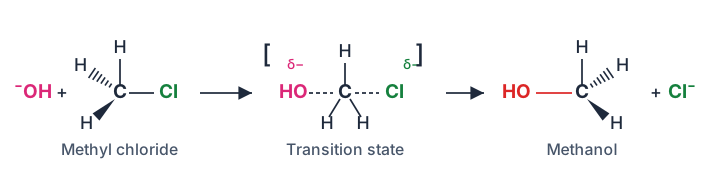
All of this happens in one step — no intermediate.
The Stereochemistry: Inversion
Because the nucleophile attacks from the back, the configuration at the carbon inverts — like an umbrella turning inside out in a strong wind. If you start with an R configuration, you get S (and vice versa). This is called Walden inversion.
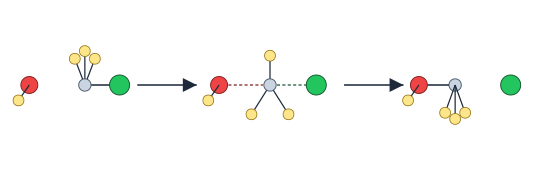
What Favours SN2?
- Primary carbon (least steric hindrance — the backside is wide open)
- Strong nucleophile (needs to push its way in)
- Good leaving group (but not too good — it needs to wait for the nucleophile)
- Polar aprotic solvent (doesn't solvate the nucleophile too tightly)
SN2 is impossible on tertiary carbons — the three bulky groups block the backside completely. The nucleophile simply cannot get close enough.
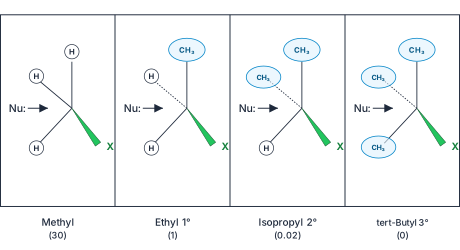
SN1: Two Steps, Carbocation Intermediate
Substitution, Nucleophilic, Unimolecular. "Unimolecular" means only one molecule (the substrate) is involved in the rate-determining step.
The Mechanism
Step 1 (slow, rate-determining): The leaving group leaves on its own, forming a carbocation (a carbon with only six electrons — positively charged and very unstable).
Step 2 (fast): The nucleophile attacks the carbocation. Since the carbocation is flat (trigonal planar), the nucleophile can attack from either side with equal probability.
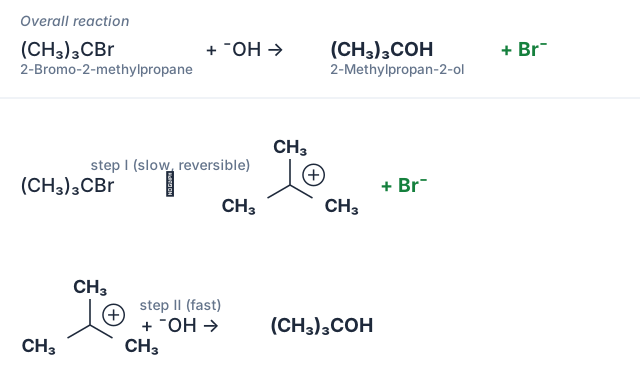
The Stereochemistry: Racemisation
Because the nucleophile can attack from either face of the flat carbocation, you get a racemic mixture — equal amounts of R and S. If the starting material is optically pure, the product will be optically inactive.
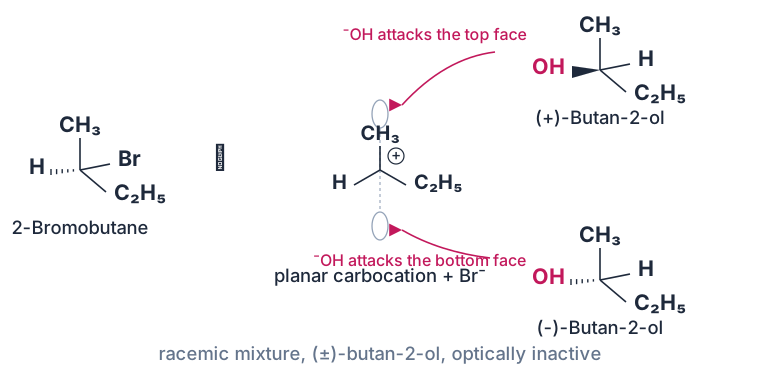
In practice, you often get slightly more inversion than retention (about 60:40) because the leaving group can partially block one face as it departs. But the key idea is loss of stereochemistry.
What Favours SN1?
- Tertiary carbon (the carbocation is stabilised by three alkyl groups — hyperconjugation and inductive effect)
- Weak nucleophile (doesn't need to force its way in — the carbocation is desperate for electrons)
- Excellent leaving group (must be able to leave on its own)
- Polar protic solvent (stabilises the carbocation and the leaving group)
SN1 is impossible on primary carbons — a primary carbocation is so unstable it effectively doesn't exist. The leaving group would never leave on its own.
The Big Comparison Table …
SN2 rate is governed by steric crowding at the carbon bearing the halogen: a primary (less hindered) carbon reacts faster than a secondary one. …
CH3CH2CH2Cl (primary) beats CH3CH(Cl)CH2CH3 (secondary) in SN2 because a primary carbon has less steric hindrance to backside nucleophilic attack.
Concept. The SN2 mechanism (CBSE Class-12 haloalkanes-and-haloarenes) is a one-step, concerted attack of the nucleophile from the side opposite the leaving group.
…
- AHSEC Higher Secondary (HS) Final Examination 2024Set ANNUAL1 markQ.In the following pairs of halogen compounds, which would undergo SN2 reaction faster?(a) (chloromethyl)cyclohexane [cyclohexyl-CH2Cl] and chlorocyclohexane [cyclohexyl-Cl].(b) two straight-chain (unbranched) primary alkyl halides with the same carbon skeleton, differing only in the terminal halogen — one terminating in iodine (–I) and the other in chlorine (–Cl).
›Reveal solutionSolution
(a) (Chloromethyl)cyclohexane (primary C–Cl) is faster than chlorocyclohexane (hindered ring C–Cl). (b) With identical straight-chain skeletons, the C–I compound is faster than the C–Cl compound because iodide is a better leaving group.
(a) (Chloromethyl)cyclohexane vs chlorocyclohexane:
In (chloromethyl)cyclohexane the C–Cl bond sits on an exocyclic –CH2Cl (primary) carbon, one carbon away from the ring, so the nucleophile has easy backside access. In chlorocyclohexane the Cl is on a ring carbon flanked on both sides by the ring (an effectively secondary, hindered centre). Since SN2 slows sharply with steric crowding (CH3 > 1° > 2° > 3°), the primary (chloromethyl)cyclohexane reacts faster.
(b) Straight-chain iodo- vs chloro-alkane: …
- AHSEC Higher Secondary (HS) Final Examination 2022Set ANNUAL1 markQ.Write the chemical reaction for the following transformation (any two): Benzyl chloride to benzyl alcohol. (1+1=2)
›Reveal solutionSolution
Benzyl chloride is hydrolysed by aqueous alkali (nucleophilic substitution, easy because the benzylic carbocation/transition state is resonance-stabilised) to give benzyl alcohol.
Benzyl chloride (C6H5CH2Cl) is a reactive halide because the C-Cl bond is at a BENZYLIC position — ionisation (or nucleophilic attack) at this carbon is assisted by resonance stabilisation of the resulting benzylic cation/transition state with the adjacent aromatic ring. Treating it with aqueous sodium …
🎓Unlock everything free for 14 days
- ✓Full step-by-step solutions
- ✓Concept-first explanations
- ✓Methods, shortcuts & mistakes
- ✓PYQ mapping + timed mock tests
Full access for 14 days. No credit card required.