Q.Write IUPAC names of the following:
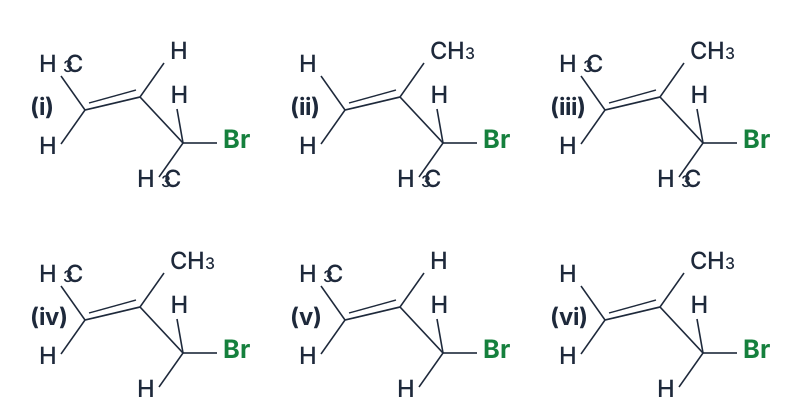
🔒You're viewing a preview — the full solution, concept, methods & PYQ mapping are locked.
🔒 Start your 14-day free trial to unlock the full solution →Concept understanding — Structural Isomerism
Structural Isomerism: The First Meeting
Imagine you have a box of identical Lego bricks — four red, ten blue, and six yellow. You build two different models: a car and a house. Both use exactly the same number of each colour brick, but the structures are completely different. That is the core idea of isomerism: same atoms, different arrangement.
In chemistry, molecules are not just a list of atoms. How those atoms are connected matters enormously. Two molecules can have the exact same molecular formula (same number of each atom) but be connected in different ways. Those are structural isomers (also called constitutional isomers).
The Precise Statement
Structural isomers are compounds that have the same molecular formula but different connectivity of atoms — that is, different structural formulas.
The key word is connectivity. Which atom is bonded to which? If you change that, you get a different substance with different physical and chemical properties.
A Concrete Example: C₄H₁₀
Take butane, C₄H₁₀. There are exactly two ways to connect four carbon atoms and ten hydrogen atoms:
- n-Butane — a straight chain: C–C–C–C
- Isobutane (2-methylpropane) — a branched chain: a central carbon bonded to three methyl groups
Both have formula C₄H₁₀. But n-butane boils at –0.5 °C, while isobutane boils at –11.7 °C. Same atoms, different connectivity → different substance.
Structural isomers are not the same molecule. They are distinct compounds that happen to share a molecular formula. You cannot rotate or flip one to get the other — you must break and reform bonds.
The Three Main Types
Structural isomerism comes in three flavours:
| Type | What changes | Example (C₃H₆O) |
|---|---|---|
| Chain isomerism | The carbon skeleton (straight vs. branched) | Butane vs. isobutane |
| Position isomerism | The location of a functional group or substituent | Propan-1-ol vs. propan-2-ol (OH on carbon 1 vs. carbon 2) |
| Functional group isomerism | The atoms are rearranged into a different functional group | Propanal (aldehyde) vs. propanone (ketone) — both C₃H₆O |
Do not confuse structural isomers with stereoisomers. Stereoisomers have the same connectivity but differ in spatial arrangement (like left and right hands). That is a completely different chapter. For now: structural isomers = different bond connections.
Why This Matters …
Why this formula?
Structural Isomerism: Why the Key Ideas Hold
Structural isomerism arises when molecules share the same molecular formula but differ in the connectivity of atoms. There is no single "formula" for structural isomerism — instead, the key is understanding why different arrangements are possible.
The Core Principle: Connectivity ≠ Composition
A molecular formula tells you how many of each atom are present, but not how they are joined. Structural isomers exist because atoms can form bonds in multiple distinct sequences while satisfying valency rules.
Why This Happens: The Valency Constraint
Each atom has a fixed bonding capacity (valency):
- Carbon: 4 bonds
- Hydrogen: 1 bond
- Oxygen: 2 bonds
- Nitrogen: 3 bonds
Example: For C4H10, the formula satisfies 4(4)+10(1)=26 valence electrons. But the carbon atoms can be arranged as:
- A straight chain: CH3−CH2−CH2−CH3 (n-butane)
- A branched chain: CH3−CH(CH3)−CH3 (isobutane)
Both satisfy valency, but the connectivity differs.
The "Formula" for Counting Isomers: Why It's Not Simple
There is no closed-form formula to count structural isomers for a given molecular formula. The number grows rapidly and depends on:
- Carbon skeleton branching possibilities
- Functional group positions
- Ring formation possibilities
Why No Simple Formula Exists
The problem is combinatorial — the number of possible trees (acyclic graphs) with n carbon atoms grows exponentially. For example:
- C4H10: 2 structural isomers
- C5H12: 3 structural isomers
- C6H14: 5 structural isomers
- C10H22: 75 structural isomers
The pattern follows Cayley's formula for trees, but even that counts only carbon skeletons — not functional group positions.
Key Reasoning: The Branching Principle
The fundamental reason structural isomers exist is that carbon chains can branch. Consider C5H12:
- Straight chain: C−C−C−C−C (n-pentane)
- One branch: C−C−C(C)−C (isopentane) — the branch can be at position 2 or 3, but these are identical due to symmetry
- Two branches: C−C(C)(C)−C (neopentane) — a quaternary carbon
Why position matters: The branch location changes the carbon's environment, altering physical and chemical properties.
The Functional Group Position Rule
For compounds with functional groups (e.g., alcohols CnH2n+2O), the position of the -OH group creates isomers:
- CH3CH2CH2OH (propan-1-ol) — OH at end
- CH3CH(OH)CH3 (propan-2-ol) — OH in middle …
Concept: Structural Isomerism — these are all bromoalkenes; the key is to number the chain so that the double bond gets the lowest locant, then the bromine (or, if both directions tie on the double bond, whichever direction gives the substituents the lower locants).
Step 1: Identify the longest carbon chain that includes the double bond — check carefully whether a methyl group on the double-bond carbon is really part of the chain or just a branch.
Step 2: Number from the end nearer the double bond (if there is a tie, number from the end that gives the lower locant to the bromine).
Step 3: Assign locants to the double bond and the bromine substituent.
Step 4: Write the name as: (locant)-bromo-(locant)-methyl-(locant)-ene, as applicable.
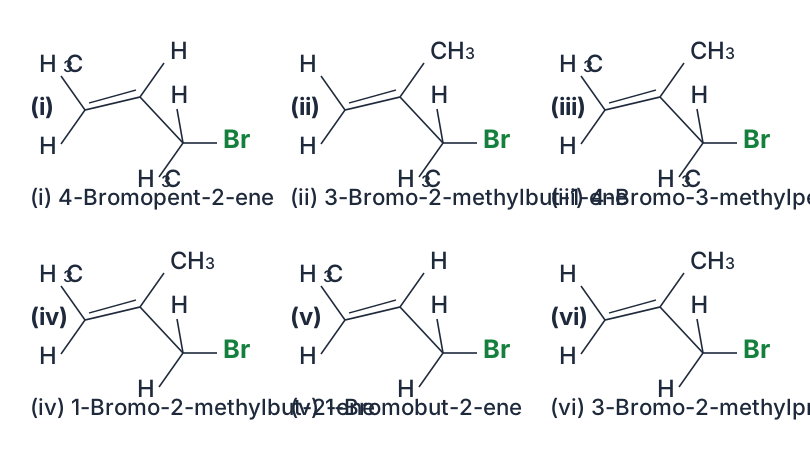
- CH3CH=CHCH(Br)CH3 Chain: 5 carbons, double bond between C2–C3, Br on C4. Name: 4-bromopent-2-ene
- CH2=C(CH3)CH(Br)CH3 Chain: 4 carbons, double bond between C1–C2, methyl on C2, Br on C3. Name: 3-bromo-2-methylbut-1-ene
- CH3CH=C(CH3)CH(Br)CH3 Chain: 5 carbons, double bond between C2–C3, methyl on C3, Br on C4. Name: 4-bromo-3-methylpent-2-ene
- CH3CH=C(CH3)CH2Br …
Number the parent chain to give the double bond the LOWEST locant first; if both directions tie on that, the direction giving the lower locant SET to the substituents wins. Names: (i) 4-bromopent-2-ene,
(ii) 3-bromo-2-methylbut-1-ene,
(iii) 4-bromo-3-methylpent-2-ene,
(iv) 1-bromo-2-methylbut-2-ene,
(v) 1-bromobut-2-ene,
(vi) 3-bromo-2-methylprop-1-ene.
(i) CH3CH=CHCH(Br)CH3
Numbering from the left gives the double bond locant 2; from the right it would be locant 3. Left wins outright (2 < 3, no tie). Br sits on C4: 4-bromopent-2-ene.
(ii) CH2=C(CH3)CH(Br)CH3
The double bond is terminal, so it is always locant 1 from that end — no other numbering is possible. Methyl on C2, bromo on C3, alphabetical order (bromo before methyl): 3-bromo-2-methylbut-1-ene.
(iii) CH3CH=C(CH3)CH(Br)CH3
Numbering from the left gives the double bond locant 2; from the right it would be locant 3. Left wins outright. Methyl on C3, bromo on C4: 4-bromo-3-methylpent-2-ene.
(iv) CH3CH=C(CH3)CH2Br
Both numbering directions give the double bond the SAME locant (2) — a genuine tie, since this is only a 4-carbon chain. When the suffix locant ties, the win goes to whichever direction gives the LOWER locant SET to the substituents. Numbering from the CH2Br end: Br@C1, methyl@C2 — set {1,2}. Numbering from the CH3 end (as in the naive "closer to the double bond" reading): methyl@C3, Br@C4 — set {3,4}. {1,2} is lower, so Br takes C1: 1-bromo-2-methylbut-2-ene. …
Method: IUPAC Naming of Alkenes with Substituents
Method Name: Longest Chain + Lowest Locant + Priority Functional Group method.
Steps:
-
Identify the principal functional group — here, the alkene (C=C) is the priority group (suffix -ene). Bromine is a substituent (prefix bromo-).
-
Select the longest carbon chain that includes the double bond. Number the chain from the end nearest the double bond so that the C=C gets the lowest possible locant. If both directions give the double bond the SAME locant (a genuine tie on a short chain), the direction is then decided by whichever gives the lower locant set to the substituents.
-
Number the substituents (bromo, methyl, etc.) according to their positions on the numbered chain.
-
Write the name as:
- Locant(s) for substituents (alphabetical order) + substituent names
- Locant of double bond + -ene
- Parent alkane name (replace -ane with -ene)
Solutions:
(i) CH3CH=CHCH(Br)CH3
- Longest chain with C=C: 5 carbons → pentene
- Number from left (nearest double bond): C=C at position 2
- Bromine at carbon 4
- Name: 4-bromopent-2-ene
(ii) CH2=C(CH3)CH(Br)CH3
- Longest chain: 4 carbons → butene
- Double bond at position 1 (number from left)
- Methyl at carbon 2, bromine at carbon 3
- Name: 3-bromo-2-methylbut-1-ene
(iii) CH3CH=C(CH3)CH(Br)CH3
- Longest chain: 5 carbons → pentene
- Double bond at position 2
- Methyl at carbon 3, bromine at carbon 4
- Name: 4-bromo-3-methylpent-2-ene
(iv) CH3CH=C(CH3)CH2Br
- Longest chain: 4 carbons → butene (the methyl is a branch, not part of the main chain — this molecule is shorter than (iii), which has an extra CH(Br)CH3 at the end)
- Both numbering directions give the double bond the SAME locant (2) — a genuine tie on this 4-carbon chain. Numbering from the CH2Br end gives the substituents the lower locant set (bromo@1, methyl@2) versus numbering from the other end (methyl@3, bromo@4), so the CH2Br end is C1.
- Bromine at carbon 1, methyl at carbon 2, double bond at position 2
- Name: 1-bromo-2-methylbut-2-ene
(v) CH3CH=CHCH2Br
- Longest chain: 4 carbons → butene …
This is a classic trap in Structural Isomerism and IUPAC Nomenclature. Students often lose marks here not because they don’t know the rules, but because they rush or misread the structure.
Below are the most common mistakes and how to avoid each, with the correct IUPAC names for all six compounds.
Mistake #1: Choosing the wrong parent chain (longest carbon chain)
Why it happens:
Students see a double bond or a bromine and instinctively pick a chain that includes them, but they miscount carbons when a methyl branch is present — usually by folding the branch into the main chain and counting one carbon too many.
Example from the list:
For (iv) CH3CH=C(CH3)CH2Br and (vi) CH2=C(CH3)CH2Br, the methyl group sitting on the double-bond carbon is a branch, not a chain carbon — it is easy to mistakenly fold it into the main chain and count one carbon too many.
- (iv)'s longest chain is only 4 carbons (a butene), not 5 — the chain dead-ends at the CH2Br carbon, and the methyl is a substituent.
- (vi)'s longest chain is only 3 carbons (a propene), not 4, for the same reason.
How to avoid:
- Always number the carbons in the condensed formula before naming, and check whether a group drawn off to the side is really a continuation of the chain or a dead-end branch.
- The parent chain must be the longest continuous carbon chain that includes the double bond (for alkenes) — a one-carbon branch off the double-bond carbon almost never extends the chain.
Correct parent chain for (iv): but-2-ene (4 carbons). Correct parent chain for (vi): prop-1-ene (3 carbons).
Mistake #2: Wrong numbering direction (lowest locants for double bond)
Why it happens:
Students number from the end closest to the first substituent (bromine), forgetting that the double bond gets priority in numbering.
Example from the list:
For (i) CH3CH=CHCH(Br)CH3
- If you number from the Br side (right to left): double bond at C-3, Br at C-2.
- If you number from the other end (left to right): double bond at C-2, Br at C-4.
- The double bond locant is lower from the left (2 < 3), so the left-to-right numbering wins outright, even though it gives bromine the higher-looking number (4).
How to avoid:
- Rule: For alkenes, the double bond gets the lowest possible locant — even if it means a substituent gets a higher number.
- Always number from the end that gives the double bond the smaller number, and only fall back on the substituent locants as a tiebreaker if both directions give the double bond the SAME number.
Correct for (i):
4-bromopent-2-ene (double bond at C-2, bromine at C-4).
Mistake #3: Forgetting to specify the position of the double bond in the name
Why it happens:
Students write “pentene” without a number, or put the number in the wrong place.
How to avoid:
- The locant for the double bond is placed just before the “-ene” suffix (e.g., pent-2-ene).
- For IUPAC, the number is written as a hyphenated prefix:
pent-2-eneor2-pentene(both accepted, butpent-2-eneis more modern).
Mistake #4: Mixing up similar-looking structures
Why it happens: …
- AHSEC Higher Secondary (HS) 1st Year Examination 2026Set ANNUAL1 markMCQQ.Which of the following conformation of n-butane is the most stable?(a) eclipsed(b) gauche(c) staggered(d) skew boat
›Reveal solutionSolution
The staggered (anti) conformation of n-butane has minimum strain and is the most stable.
n-Butane can adopt eclipsed, gauche, staggered (anti) and skew-boat-like arrangements as it rotates about the C2-C3 bond.
- Eclipsed forms have high torsional and steric strain (least stable).
- Gauche (staggered but methyls 60 degrees apart) has some steric strain. …
- AHSEC Higher Secondary (HS) Final Examination 2023Set ANNUAL1 markQ.Among the isomeric alkanes of molecular formula C5H12, identify the one that on photochemical chlorination yields a single monochloride.
›Reveal solutionSolution
Only the fully symmetric isomer of C5H12 — neopentane — has all its hydrogens equivalent, so it alone gives a single monochlorination product.
There are three structural isomers of C5H12:
- n-Pentane (CH3CH2CH2CH2CH3): has 3 chemically distinct sets of hydrogens (C1/C5 equivalent by symmetry, C2/C4 equivalent, and C3) → gives 3 different monochlorinated products.
- Isopentane / 2-methylbutane ((CH3)2CHCH2CH3): has 4 distinct sets of hydrogens → gives 4 different monochlorinated products.
- Neopentane / 2,2-dimethylpropane ((CH3)4C): the central carbon is bonded to four identical methyl groups, so all 12 hydrogens are completely equivalent by symmetry. …
🎓Unlock everything free for 14 days
- ✓Full step-by-step solutions
- ✓Concept-first explanations
- ✓Methods, shortcuts & mistakes
- ✓PYQ mapping + timed mock tests
Full access for 14 days. No credit card required.