Q.Predict all the alkenes that would be formed by dehydrohalogenation of the following halides with sodium ethoxide in ethanol and identify the major alkene:
You're viewing a preview — the full solution, concept, methods & PYQ mapping are locked.
Start your 14-day free trial to unlock the full solution →Zaitsev's rule: the major alkene is the most substituted (most stable) one. (i) 1-bromo-1-methylcyclohexane gives 1-methylcyclohexene (major, Zaitsev) and methylenecyclohexane (minor, exocyclic).
(ii) 2-chloro-2-methylbutane's major alkene is 2-methylbut-2-ene (trisubstituted, beating the disubstituted alternative).
(iii) 2,2,3-trimethyl-3-bromopentane's major alkene is 3,4,4-trimethylpent-2-ene (trisubstituted, beating a disubstituted alternative).
(i) 1-Bromo-1-methylcyclohexane
The bromine-bearing ring carbon (C1) has three β-carbons that carry hydrogens: the two ring carbons C2 and C6 (equivalent by the ring's symmetry) and the methyl group on C1 itself.
- Removing a β-hydrogen from C2 or C6 gives the same alkene either way: 1-methylcyclohexene, with a trisubstituted, endocyclic double bond.
- Removing a β-hydrogen from the C1 methyl gives methylenecyclohexane, with a disubstituted, exocyclic double bond.
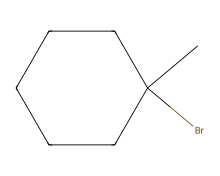
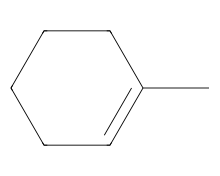
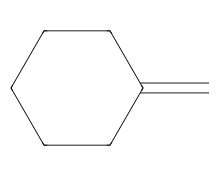
Zaitsev's rule favours the more substituted (and more stable, endocyclic) alkene: 1-methylcyclohexene is the major product; methylenecyclohexane is the minor one.
(ii) 2-Chloro-2-methylbutane
. The chlorine-bearing carbon (C2) has two β-carbons with hydrogens: the C1 methyl and the C3 methylene.
- Eliminating from C1 gives 2-methylbut-1-ene: the new terminal carbon has 0 alkyl neighbours, the other alkene carbon has 2 (the branch methyl and the C3–C4 chain) — disubstituted overall.
- Eliminating from C3 gives 2-methylbut-2-ene: one alkene carbon has 2 alkyl neighbours (the C1 methyl and the branch methyl), the other has 1 (the C4 methyl) — trisubstituted overall.
Zaitsev's rule favours the more substituted alkene: 2-methylbut-2-ene (trisubstituted) is the major product.
(iii) 2,2,3-Trimethyl-3-bromopentane …
Unlock everything free for 14 days
- Full step-by-step solutions
- Concept-first explanations
- Methods, shortcuts & mistakes
- PYQ mapping + timed mock tests
Full access for 14 days. No credit card required.