Q.Find the area of the region bounded by the line y=3x+2, the x-axis and the ordinates x=−1 and x=1
Assam AhsecTextbookSubjective· 3mImportance★★★★★
21% · 7/34 Questions
✓ Free question
Concept understanding — Area Under Curve
Area Under a Curve
How do you measure the area of a region whose top edge is curved rather than a straight line? For rectangles and triangles we have formulas, but a shape bounded above by y=f(x) has no simple side lengths to plug in. The definite integral is the tool built exactly for this.
The core idea: area as a limit of strips
Take the region under y=f(x) (with f(x)≥0), above the x-axis, between x=a and x=b. Slice it into many thin vertical strips. A strip at position x with tiny width dx is almost a rectangle of height f(x), so its area is about f(x)dx. Add up all the strips and let their width shrink to zero: the sum becomes the definite integral
Area=∫abf(x)dx.
This is why the integral is the area — it is the exact total of infinitely many infinitesimally thin rectangles.
How to compute it
Find an antiderivative F(x) (so F′(x)=f(x)) and evaluate at the two limits — the Fundamental Theorem of Calculus:
∫abf(x)dx=F(b)−F(a).
For example, the area under y=x2 from 0 to 1 is [3x3]01=31.
Cases you must handle carefully
Watch out
The integral gives signed area. Where the curve dips below the x-axis, f(x)<0 and ∫fdx comes out negative. For the geometric (positive) area of such a stretch, integrate the absolute value or take the magnitude of that piece: Area=∫ab∣f(x)∣dx.
If a curve crosses the x-axis inside [a,b], split the integral at each crossing and add the sizes of the parts.
Area with respect to the y-axis
When the region is bounded by a curve x=g(y) and the y-axis between y=c and y=d, slice horizontally instead:
Area=∫cdg(y)dy.
Tip
Always sketch the region first. The sketch tells you the correct limits, whether the curve dips below the axis, and whether it is cleaner to integrate in x or in y.
The single big idea: any area with a curved boundary is the sum of infinitely many thin strips, and that sum is precisely a definite integral.
Students searching "Area Under Curve formula and examples" or "Application of Integrals class 12 important questions" will find this the core idea tested throughout NCERT's Application of Integrals chapter, a mainstay of the CBSE Class 12 Maths syllabus and JEE Main/Advanced. Mastering the sign convention for regions below the x-axis is one of the most frequently asked concepts in board and competitive exam papers alike.
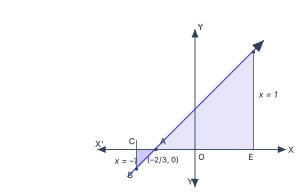
Figure 8.9
The key idea is that the area between a curve and the x-axis is the integral of ∣y∣ between the given limits, because area below the axis counts as positive.
Step 1: Find where the line crosses the x-axis.
Set y=0: 3x+2=0⇒x=−32. This lies between x=−1 and x=1, so the region has parts above and below the axis.
Step 2: Split the integral at x=−32.
For x∈[−1,−32], y≤0, so area = −∫−1−2/3(3x+2)dx.
For x∈[−32,1], y≥0, so area = ∫−2/31(3x+2)dx.
Step 3: Evaluate.
First integral: −[23x2+2x]−1−2/3=−((23⋅94−34)−(23−2))=−((32−34)−(−21))=−(−32+21)=61.
Second integral: [23x2+2x]−2/31=(23+2)−(32−34)=27−(−32)=27+32=625.
Step 4: Total area = 61+625=626=313.
✓Final answer
The area is 313 square units.
Figure 8.9
The area is the sum of two definite integrals because part of the curve lies below the x‑axis. The required area is 313 square units.
We are finding the area between the curve y=3x+2, the x‑axis, and the vertical lines x=−1 and x=1. The key point: area is always positive. If the curve dips below the x‑axis, the definite integral gives a negative value for that portion, so we must split the region and take absolute values.
The line y=3x+2 crosses the x‑axis where 3x+2=0, i.e. at x=−32. Between x=−1 and x=−32, the line is below the axis; between x=−32 and x=1, it is above. So the total area is the sum of the absolute areas of these two parts.
Find the x‑intercept
Set y=0:
3x+2=0⇒x=−32.
This is the point where the sign of y changes.
Area below the axis (from x=−1 to x=−32)
Here y is negative, so the definite integral gives a negative number. The area is the absolute value:
Lower limit (we already computed this as −32 above).
So the integral is:
27−(−32)=27+32=621+64=625.
Total area
Add the two parts:
Total area=61+625=626=313.
Watch out
A common mistake is to directly integrate from −1 to 1 without splitting. That gives ∫−11(3x+2)dx=4, which is wrong because it cancels the negative area. Always check where the curve crosses the axis.
Tip
You can also think of area as ∫−11∣3x+2∣dx. Splitting at x=−2/3 is the clean way to handle the absolute value.
✓Final answer
The area of the region is 313 square units.
Method: Area of a line that crosses the x-axis inside the interval
Use this for the area bounded by a line y=mx+c, the x-axis, and two ordinates, when the line crosses the axis between the limits so part of the region is below the axis.
Steps
Step 1: Find the x-intercept.
Solve mx+c=0 to get x=−mc. If this lies inside [a,b], the region has both a below-axis and an above-axis part.
Step 2: Split at the intercept and take magnitudes.
Area=∫ax0(mx+c)dx+∫x0b(mx+c)dx
where x0=−c/m. On the below-axis piece the integral is negative, so take its absolute value.
Step 3: Evaluate each piece and add the positive amounts.
Integrating straight from a to b without splitting lets the negative (below-axis) part cancel the positive part, understating the true area — always test whether the line changes sign first.
Common Mistakes
Mistake 1: Integrating straight from −1 to 1 without splitting.
Why it's wrong: the line y=3x+2 is below the axis on [−1,−32], so ∫−11(3x+2)dx=4 lets the negative part cancel and understates the true area. Correct approach: split at the intercept x=−32 and add magnitudes, 61+625=313.
Mistake 2: Missing the x-intercept inside the interval.
Why it's wrong: not solving 3x+2=0 hides that the curve changes sign at x=−32. Correct approach: always find where the line meets the axis and check whether it lies between the limits before integrating.
Same / Similar Concept — real previous-year questions on the same or a closely similar concept, not this exact question.
AHSEC Higher Secondary (HS) Final Examination 2025Set ANNUAL4 marks
Q.Find the area lying in the first quadrant and bounded by the circle x2+y2=1 and the lines x=0 and x=1.
OR
Find the area of the region bounded by the line y=3x+2, the x-axis and ordinate x=1.
›Reveal solutionSolution
Main: the region is a quarter of the unit circle, area π/4. OR: the region is a triangle between the line's x-intercept and x=1, area 25/6.
Main: The circle x2+y2=1 has radius 1. In the first quadrant, between x=0 and x=1 (the full radius), the region under the circle is exactly one quarter of the circle.
Area=∫011−x2dx=[2x1−x2+21sin−1x]01
=(0+21⋅2π)−(0+0)=4π
(This matches the quarter-circle area formula 4πr2=4π for r=1.)
OR: The line y=3x+2 meets the x-axis where y=0: 3x+2=0⟹x=−32. The region bounded by the line, the x-axis, and the ordinate x=1 is the triangle from x=−32 (where the line touches the axis) to x=1, where y≥0 throughout.