Q.Solve the following linear programming problem graphically: Maximise Z=4x+y subject to the constraints: x+y≤50, 3x+y≤90, x≥0, y≥0.
Concept understanding — Linear Programming Graphical Method
The Graphical Method for Linear Programming
When a linear programming problem has just two decision variables, x and y, you can solve it by drawing a picture. This is the graphical method, and it is the technique the CBSE Class-12 course expects you to use.
The idea
Each constraint is a linear inequality such as 2x+3y≤100. On the xy-plane its boundary is a straight line, and the inequality picks one side of that line (a half-plane). The points that satisfy all the constraints at once form a single region — the feasible region. Your job is to find the point inside this region that makes the objective function Z=ax+by largest or smallest.
The step-by-step procedure
- Draw each constraint line. Replace every inequality by an equation and plot the line, usually by finding where it meets the axes.
- Shade the correct side. Test a simple point (often the origin (0,0)) in the inequality. If it holds, the origin's side is the wanted half-plane; if not, take the other side. Always include the non-negativity conditions x≥0, y≥0, which keep you in the first quadrant.
- Identify the feasible region. It is the overlap of all the shaded half-planes — the region satisfying every constraint together.
- Find the corner (vertex) points. These are the points where the boundary lines cross. Read them off the graph or solve the two relevant lines simultaneously.
- Evaluate Z at every corner and pick the largest value (for a maximum) or the smallest (for a minimum).
The whole method rests on the Corner-Point Theorem: if an optimum exists, it occurs at a vertex of the feasible region. So you never test interior points — only the corners.
Bounded vs unbounded
If the feasible region is a closed polygon (bounded), both the maximum and minimum are guaranteed and are found among the corners. If the region stretches to infinity (unbounded), a maximum or minimum may fail to exist — you then check whether Z can be pushed indefinitely large or small in the open direction before concluding.
The bottom line
Graph the constraints, find the feasible region, list its corner points, and compare Z=ax+by at each. The best corner is your optimal solution — a clean, visual route to the answer for any two-variable LP problem.
The graphical method for solving linear programming problems is the entire method taught in the NCERT Class 12 Linear Programming chapter, and "linear programming graphical method examples class 12" is one of the most searched topics ahead of CBSE board exams. This corner-point approach is also occasionally tested in JEE Main and select state CET papers involving optimization.
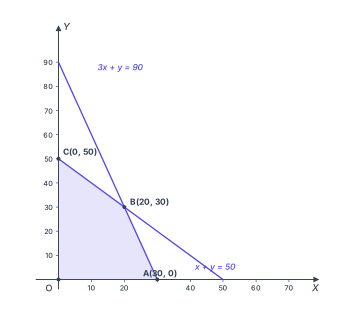
Concept: Linear Programming Graphical Method – The feasible region is the intersection of all constraints; the maximum of Z occurs at a corner point of this region.
Steps:
-
Plot constraints
x+y=50 passes through (50,0) and (0,50).
3x+y=90 passes through (30,0) and (0,90).
Non-negativity restricts to the first quadrant.
-
Find corner points
Intersection of x+y=50 and 3x+y=90: subtract to get 2x=40⇒x=20, then y=30.
Other corners: (0,0), (30,0), (0,50).
-
Evaluate Z=4x+y
- (0,0): Z=0
- (30,0): Z=120
- (0,50): Z=50
- (20,30): Z=4(20)+30=110
The maximum value is 120 at (30,0).
The maximum value is 120 at (30,0).
The problem is a two-variable linear program solved by the graphical method. The feasible region is bounded by the constraints, and the maximum of Z=4x+y occurs at a corner point. The optimal solution is x=30, y=0, giving Z=120.
We have a linear programming problem with two decision variables, x and y, and a linear objective function Z=4x+y to be maximised. The constraints are all linear inequalities. The graphical method works here because with only two variables, each inequality describes a half-plane in the xy-plane. The intersection of all these half-planes is the feasible region — the set of all points that satisfy every constraint. The fundamental theorem of linear programming tells us that if an optimal solution exists, it will be found at one of the corner points (vertices) of this feasible region. So our job is to draw the region, find its vertices, and evaluate Z at each vertex.
Let’s go step by step.
-
Plot each constraint as a line.
First, treat each inequality as an equation.
- x+y=50: This line passes through (50,0) and (0,50).
- 3x+y=90: This passes through (30,0) and (0,90).
- x=0 is the y-axis.
- y=0 is the x-axis.
The inequalities x≥0, y≥0 restrict us to the first quadrant.
-
Determine which side of each line is feasible.
For x+y≤50, test the origin (0,0): 0+0≤50 is true, so the half-plane containing the origin is feasible.
For 3x+y≤90, test (0,0): 0≤90 is true, so again the origin side is feasible.
So the feasible region is the intersection of the two half-planes below both lines, in the first quadrant.
-
Find the corner points of the feasible region.
The region is a polygon bounded by the axes and the two lines. The vertices are:
- (0,0) — intersection of x=0 and y=0.
- (0,50) — intersection of x=0 and x+y=50. But check if it satisfies 3x+y≤90: 3(0)+50=50≤90, yes.
- (30,0) — intersection of y=0 and 3x+y=90. Check x+y≤50: 30+0=30≤50, yes.
- The intersection of the two lines x+y=50 and 3x+y=90. Solve: subtract the first from the second: (3x+y)−(x+y)=90−50 gives 2x=40, so x=20. Then y=50−x=30. So the point is (20,30). Check both constraints: 20+30=50 (tight), 3(20)+30=60+30=90 (tight). This is inside the first quadrant.
So the vertices are: A(0,0), B(0,50), C(20,30), D(30,0).
Always check that each candidate vertex actually satisfies all constraints — sometimes the intersection of two lines falls outside the feasible region because a third constraint cuts it off. Here all four are valid.
-
Evaluate Z=4x+y at each vertex.
Vertex x y Z=4x+y A 0 0 0 B 0 50 0+50=50 C 20 30 80+30=110 D 30 0 120+0=120 The largest value is 120 at D(30,0).
A common mistake is to assume the maximum occurs where the two constraint lines intersect (here (20,30)). But the objective function 4x+y has a steeper slope in the x-direction, so pushing x as high as possible — all the way to x=30 on the 3x+y=90 line — yields a higher value, even though y becomes zero. Always check all vertices.
- Interpret the result. The maximum value of Z is 120, achieved at x=30, y=0. This means that under the given constraints, the best strategy is to use all resources to produce x (30 units) and none of y.
The maximum value is 120, attained at x=30, y=0.
Method: Corner-Point (Graphical) Method for a Maximum
This is the standard technique for maximising a linear objective Z=ax+by of two variables under linear constraints, and it is the only optimisation method in the Class-12 syllabus (no simplex/algebra needed).
Steps
Step 1: Convert each inequality to a line and plot it.
For a constraint px+qy≤r, draw px+qy=r using its intercepts (pr,0) and (0,qr). Do this for every constraint, and keep x≥0, y≥0 (first quadrant).
Step 2: Shade the correct half-plane for each constraint.
Substitute a test point (the origin is easiest when the line does not pass through it). If the inequality holds there, keep the origin's side; otherwise keep the other side. The feasible region is the intersection of all the kept half-planes.
Step 3: Find every corner (vertex) of the feasible region.
A vertex is where two boundary lines meet. Solve those two equations simultaneously (e.g. subtract one from another to eliminate a variable), and confirm the point satisfies all the other constraints before accepting it.
Step 4: Evaluate Z=ax+by at each corner and pick the largest.
Zmax=maxcorners(ax+by)
The vertex giving the biggest value is the optimal solution.
Why the answer need not be at the "inner" intersection: the maximum lands on whichever corner is farthest in the direction the objective grows. If Z increases faster in x than in y, a corner on an axis can beat the intersection of two slanted lines — so you must always test every vertex, never guess.
Common Mistakes
Mistake 1: Assuming the maximum is at the intersection of the two slanted lines (20,30).
Why it's wrong: for Z=4x+y the objective grows much faster in x, so the true maximum is at (30,0) where Z=120, beating Z=110 at (20,30). Correct approach: evaluate Z at every vertex and compare — never assume the "inner" corner wins.
Mistake 2: Forgetting the axis-intercept corners (0,50) and (30,0).
Why it's wrong: the feasible polygon includes vertices on the axes, and the optimum here is one of them. Missing a corner can hide the real maximum. Correct approach: list all vertices, including the ones where a constraint meets an axis.
Mistake 3: Shading the wrong side of a ≤ line.
Why it's wrong: x+y≤50 and 3x+y≤90 both keep the origin side; shading outward would give an empty or wrong region. Correct approach: test (0,0) in each inequality — if it holds, keep the origin's side.
Mistake 4: Reporting only Z=120 without stating where it occurs.
Why it's wrong: a graphical LP answer must give both the optimal value and the point (30,0). Correct approach: always state "maximum Z=120 at (30,0)".
- AHSEC Higher Secondary (HS) Final Examination 2026Set ANNUAL6 marksQ.Solve the following linear programming problem graphically : Minimize Z=10(x−7y+190) subject to the constraints x+y≤8, x≤5, y≤5, x+y≥4, x≥0, y≥0.
›Reveal solutionSolution
Main: min Z=1550 at (0,5). OR: Z=−50x+20y is unbounded below on the feasible region, so no minimum exists.
Main part. Constraints: x+y≤8, x≤5, y≤5, x+y≥4, x,y≥0. This is a bounded region with corner points (0,4),(0,5),(3,5),(5,3),(5,0),(4,0). Evaluate Z=10(x−7y+190):
- (0,4): 10(0−28+190)=1620
- (0,5): 10(0−35+190)=1550
- (3,5): 10(3−35+190)=1580
- (5,3): 10(5−21+190)=1740
- (5,0): 10(5−0+190)=1950
- (4,0): 10(4−0+190)=1940
The minimum is Z=1550 at (0,5).
OR part. Minimize Z=−50x+20y subject to 2x−y≥−5, 3x+y≥3, 2x−3y≤12, x,y≥0. Corner points are (0,3),(0,5),(1,0),(6,0), with Z=60,100,−50,−300 respectively; the smallest corner value is −300 at (6,0). But the feasible region is unbounded (it extends without bound as x increases). Testing the open half-plane −50x+20y<−300: along the edge 2x−3y=12, writing x=6+23y gives Z=−50(6+23y)+20y=−300−55y, which decreases without limit as y→∞ while all constraints stay satisfied. Hence −300 is not a minimum, and Z has no minimum value.
✓Final answerMain: minimum Z=1550 at (0,5). (OR: Z=−50x+20y has no minimum value, since the feasible region is unbounded and Z is unbounded below.)
- AHSEC Higher Secondary (HS) Final Examination 2025Set ANNUAL6 marksQ.Solve graphically the following linear programming problem: Maximize and minimize Z=3x+5y subject to the constraints 2x+3y≤36, x+y≤15, y≥3, x≥0. OR Determine graphically the minimum value of the objective function Z=3x+9y subject to the constraints x+3y≤60, x+y≥10, x≤y, x≥0, y≥0.
›Reveal solutionSolution
Main: plot the constraints, find corner points of the feasible region, evaluate Z at each — max and min occur at corner points (corner-point theorem). OR: same method for a different feasible region and objective.
Main: Maximize/minimize Z=3x+5y subject to 2x+3y≤36, x+y≤15, y≥3, x≥0 (with y≥0 implicit).
Find the corner points of the feasible region by intersecting boundary lines:
- x=0 and y=3: (0,3)
- x=0 and 2x+3y=36: y=12, point (0,12)
- y=3 and x+y=15: x=12, point (12,3) [note: y=3 meeting 2x+3y=36 gives x=13.5, but that violates x+y≤15, so it is not a feasible vertex]
- x+y=15 and 2x+3y=36: substituting x=15−y gives 2(15−y)+3y=36⟹y=6,x=9, point (9,6)
Feasible region vertices: (0,3),(0,12),(9,6),(12,3).
Evaluate Z=3x+5y at each:
- (0,3): Z=15
- (0,12): Z=60
- (9,6): Z=27+30=57
- (12,3): Z=36+15=51
By the corner-point theorem, the maximum and minimum of Z over the feasible region occur at vertices: maximum Z=60 at (0,12), minimum Z=15 at (0,3).
OR: Minimize Z=3x+9y subject to x+3y≤60, x+y≥10, x≤y, x≥0,y≥0.
Corner points of the feasible region:
- x+y=10 and x=y: x=y=5, point (5,5)
- x+y=10 and x=0: point (0,10)
- x+3y=60 and x=0: point (0,20)
- x+3y=60 and x=y: 4x=60⟹x=y=15, point (15,15)
Evaluate Z=3x+9y:
- (0,10): Z=90
- (5,5): Z=15+45=60
- (15,15): Z=45+135=180
- (0,20): Z=180
The minimum value is Z=60 at (5,5), which is the vertex closest to the origin-side boundary x+y=10 meeting x=y; every other feasible vertex gives a strictly larger Z, and the region between vertices along each edge varies monotonically since Z is linear, so the vertex minimum is the true minimum.
✓Final answerMain: maximum Z=60 at (0,12), minimum Z=15 at (0,3). OR: minimum Z=60 at (5,5).
- AHSEC Higher Secondary (HS) Final Examination 2024Set ANNUAL6 marksQ.Solve graphically the following linear programming problem: Maximize and minimize Z=x+2y subject to x+2y≥100, 2x−y≤0, 2x+y≤200, x,y≥0. OR A merchant plans to sell two types of personal computers—a desktop model and a portable model that will cost Rs. 25,000 and Rs. 40,000 respectively. He estimates that the total monthly demand of computers will not exceed 250 units. Determine the number of units of each type of computers which the merchant should stock to get maximum profit if he does not want to invest more than Rs. 70 lakhs and if his profit on the desktop model is Rs. 4,500 and on portable model is Rs. 5,000.
›Reveal solutionSolution
Graph the constraints, find the feasible-region corner points, and evaluate the objective at each; the OR part is a max-profit LPP solved the same way.
Main question: Constraints: x+2y≥100, 2x−y≤0 (i.e. y≥2x), 2x+y≤200, x,y≥0.
Find the corner points of the feasible region by pairwise intersection of the boundary lines (keeping only points satisfying all constraints):
- x+2y=100 meets the y-axis (x=0) at (0,50) — check: y≥2x (50≥0 ✓), 2x+y=50≤200 ✓.
- x+2y=100 meets y=2x: substituting, x+4x=100⇒x=20,y=40, point (20,40).
- y=2x meets 2x+y=200: 2x+2x=200⇒x=50,y=100, point (50,100).
- 2x+y=200 meets the y-axis at (0,200) — check: x+2y=400≥100 ✓, y≥2x (200≥0 ✓).
(The point (100,0), where x+2y=100 meets the x-axis, is rejected since it violates y≥2x.)
So the feasible region is the quadrilateral with vertices (0,50),(20,40),(50,100),(0,200).
Evaluate Z=x+2y:
Point Z=x+2y (0,50) 100 (20,40) 100 (50,100) 250 (0,200) 400 Since (0,50) and (20,40) both lie on the line x+2y=100 and give the same Z=100, the minimum Z=100 is attained at every point of the segment joining them (multiple optimal solutions). The maximum Z=400 occurs uniquely at (0,200).
OR: Let x = number of desktops, y = number of portables.
Budget: 25000x+40000y≤70,00,000⇒5x+8y≤1400 (dividing by 5000).
Demand: x+y≤250. Also x,y≥0.
Maximize profit P=4500x+5000y.
Corner points:
- (0,0)
- (250,0) (demand line meets x-axis; budget 5(250)=1250≤1400, feasible)
- Intersection of 5x+8y=1400 and x+y=250: substitute x=250−y: 5(250−y)+8y=1400⇒1250+3y=1400⇒y=50,x=200, giving (200,50)
- (0,175) (budget line meets y-axis: 8y=1400⇒y=175; demand check 175≤250 ✓)
Evaluate P=4500x+5000y:
Point Profit (0,0) 0 (250,0) 11,25,000 (200,50) 11,50,000 (0,175) 8,75,000 Maximum profit = Rs. 11,50,000, attained at (200,50) — i.e. 200 desktop models and 50 portable models.
✓Final answerMain: minimum Z=100 (segment from (0,50) to (20,40)); maximum Z=400 at (0,200). OR: stock 200 desktops and 50 portables for a maximum profit of Rs. 11,50,000.
- AHSEC Higher Secondary (HS) Final Examination 2023Set ANNUAL6 marksQ.Solve graphically the following linear programming problem. Maximize and minimize Z=−x+2y subject to the constraints x≥2, x+y≥5, x+2y≥6, y≥0. OR A manufacturer makes two types of toys A and B. Three machines are needed for this purpose and the time (in minutes) required for each toy on the machines is given below: Machine I / II / III — Toy A: 12, 18, 6; Toy B: 6, 0, 9. Each machine is available for a maximum of 6 hours per day. If the profit on each toy of type A is Rs. 7.50 and that on each toy of type B is Rs. 5, show that 15 toys of type A and 30 toys of type B should be manufactured in a day to get maximum profit.
›Reveal solutionSolution
Plot the corner points of the unbounded feasible region and test, via the half-plane method, whether Z is bounded in either direction — here it is unbounded both ways.
Constraints: x≥2, x+y≥5, x+2y≥6, y≥0. Since all inequalities are "≥" (plus y≥0), the feasible region lies above/right of these boundary lines and is unbounded.
Corner points (intersections of the boundary lines, checked for feasibility):
- x=2 and x+y=5: gives (2,3). (Check x+2y=2+6=8≥6 ✓.)
- x+y=5 and x+2y=6: subtracting gives y=1, x=4, i.e. (4,1). (Check x≥2 ✓.)
- x+2y=6 and y=0: gives (6,0). (Check x+y=6≥5 ✓, x≥2 ✓.)
The region is bounded by these three segments but extends unboundedly: upward along x=2 (for y≥3) and rightward along y=0 (for x≥6).
Evaluate Z=−x+2y at the corners:
Z(2,3)=−2+6=4,Z(4,1)=−4+2=−2,Z(6,0)=−6+0=−6.
Testing for a maximum: Consider the open half-plane −x+2y>4. The point (2,100) lies in the feasible region (satisfies x≥2, x+y=102≥5, x+2y=202≥6, y≥0) and gives Z=−2+200=198>4. Since this half-plane intersects the feasible region, Z can be made arbitrarily large along x=2 as y→∞ — so Z has no maximum value.
Testing for a minimum: Consider the open half-plane −x+2y<−6. The point (100,0) is feasible (satisfies all constraints) and gives Z=−100<−6. Since this half-plane also intersects the feasible region, Z can be made arbitrarily small (large negative) along y=0 as x→∞ — so Z has no minimum value either.
Hence, over this unbounded feasible region, Z=−x+2y is unbounded in both directions: neither a maximum nor a minimum exists.
OR: Toys A,B; machine-minute constraints (converting 6 hours =360 minutes each):
I: 12x+6y≤360⇒2x+y≤60,II: 18x≤360⇒x≤20,III: 6x+9y≤360⇒2x+3y≤120,x,y≥0.
Maximize Z=7.5x+5y.
Corner points of the feasible region: (0,0), (20,0), (20,20) [intersection of x=20 and 2x+y=60], (15,30) [intersection of 2x+y=60 and 2x+3y=120], (0,40) [intersection of 2x+3y=120 and x=0].
Z(0,0)=0,Z(20,0)=150,Z(20,20)=7.5(20)+5(20)=250,Z(15,30)=7.5(15)+5(30)=112.5+150=262.5,Z(0,40)=200.
The maximum is Z=262.5, attained at (15,30) — confirming that 15 toys of type A and 30 toys of type B give the maximum profit of Rs. 262.50 per day.
✓Final answerZ=−x+2y has neither a maximum nor a minimum (unbounded region, unbounded objective both ways). (OR) Max profit Rs. 262.50 at 15 type-A + 30 type-B toys, confirmed.
- AHSEC Higher Secondary (HS) Final Examination 2022Set ANNUAL6 marksQ.Minimize Z=3x+5y subject to x+3y≥3, x+y≥2, x,y≥0. OR Minimise and Maximise Z=5x+10y subject to x+2y≤120, x+y≥60, x−2y≥0, x,y≥0.
›Reveal solutionSolution
Evaluating Z=3x+5y at the feasible region's corner points gives the minimum 7 at (3/2,1/2). (OR: the classic two-constraint LPP has minimum 300 at (60,0) and maximum 600 along the whole edge from (120,0) to (60,30).)
Minimize Z=3x+5y subject to x+3y≥3, x+y≥2, x,y≥0
Find the corner points of the feasible region (intersection of the boundary lines with each other and the axes, keeping only feasible points):
- On y=0: need x≥3 (from x+3y≥3) and x≥2 (from x+y≥2) — the binding one is x=3, giving corner (3,0).
- On x=0: need y≥1 and y≥2 — binding is y=2, giving corner (0,2).
- Intersection of x+3y=3 and x+y=2: subtracting, 2y=1⇒y=21, then x=23 — corner (23,21).
The feasible region is unbounded, with corners (3,0), (23,21), (0,2) (and extending outward).
Evaluate Z=3x+5y:
Z(3,0)=9,Z(23,21)=29+25=7,Z(0,2)=10.
Since both coefficients of Z are positive and the region extends only outward (away from the origin), Z cannot go below the smallest corner value; the open half-plane 3x+5y<7 has no point in common with the feasible region. So the minimum is Z=7 at (23,21).
OR: Minimise and Maximise Z=5x+10y subject to x+2y≤120, x+y≥60, x−2y≥0, x,y≥0
Finding all feasible corner points (checking each pairwise intersection against all constraints):
- x+2y=120 and x=2y: y=30,x=60 — (60,30), feasible.
- x+2y=120 and y=0: (120,0), feasible.
- x+y=60 and x=2y: y=20,x=40 — (40,20), feasible.
- x+y=60 and y=0: (60,0), feasible.
(Points like (0,60) or (0,0) fail the x≥2y or x+y≥60 constraint and are not corners of the feasible region.)
Evaluate Z=5x+10y:
Z(60,0)=300,Z(120,0)=600,Z(60,30)=300+300=600,Z(40,20)=200+200=400.
Minimum Z=300 at (60,0).
Maximum Z=600, attained at both (120,0) and (60,30) — since these both lie on the line x+2y=120 and Z=5x+10y=5(x+2y) is constant (=600) all along that edge, the maximum is attained at every point of the line segment joining (120,0) and (60,30) (multiple optimal solutions).
✓Final answerMinimum Z=7 at (3/2,1/2). [OR: Minimum Z=300 at (60,0); Maximum Z=600 at every point on the segment joining (120,0) and (60,30).]
- AHSEC Higher Secondary (HS) Final Examination 2020Set ANNUAL6 marksQ.Solve graphically the following linear programming problem: Maximize or Minimize Z=x+2y subject to constraints x+2y≥100, 2x−y≤0, 2x+y≤200, x≥0, y≥0. OR Maximize Z=1000x+600y subject to constraints x+y≤200, x≥20, y≥4x, x≥0, y≥0.
›Reveal solutionSolution
Plot the feasible region from the constraints, find its corner points, then evaluate the objective function at each corner.
Max/Min Z=x+2y s.t. x+2y≥100, 2x−y≤0, 2x+y≤200, x,y≥0
Rewrite 2x−y≤0 as y≥2x.
Corner points (solving pairs of boundary lines and checking they satisfy all constraints):
- x+2y=100 and y=2x: x+4x=100⇒x=20,y=40 → (20,40)
- y=2x and 2x+y=200: 2x+2x=200⇒x=50,y=100 → (50,100)
- x=0 with x+2y=100: y=50 → (0,50) (since at x=0, need y≥50 from constraint 1)
- x=0 with 2x+y=200: y=200 → (0,200) (upper bound at x=0)
These four points (0,50),(20,40),(50,100),(0,200) form the (bounded) feasible region.
Evaluate Z=x+2y:
- (0,50): Z=100
- (20,40): Z=100
- (50,100): Z=250
- (0,200): Z=400
Minimum Z=100 (attained all along the edge joining (0,50) and (20,40), since that edge lies exactly on x+2y=100). Maximum Z=400 at (0,200).
OR: Maximize Z=1000x+600y s.t. x+y≤200, x≥20, y≥4x, x,y≥0
At x=20: y≥80 and y≤180, giving corners (20,80) and (20,180).
y=4x meets x+y=200: x+4x=200⇒x=40,y=160 → (40,160).
Feasible region is the triangle with vertices (20,80),(20,180),(40,160).
Evaluate Z=1000x+600y:
- (20,80): Z=20000+48000=68000
- (20,180): Z=20000+108000=128000
- (40,160): Z=40000+96000=136000
Maximum Z=136000 at x=40,y=160.
✓Final answerMin Z=100 (edge (0,50)–(20,40)); Max Z=400 at (0,200). (OR: Max Z=136000 at (40,160).)
- AHSEC Higher Secondary (HS) Final Examination 2019Set ANNUAL6 marksQ.Solve the linear programming problem graphically. Maximize z=20x+15y, subject to the conditions 2x+y≤200, x+y≤150 and x≥0, y≥0. OR Maximize and minimize z=5x+2y, subject to the conditions x−2y≤2, 3x+2y≤12, −3x+2y≤3 and x≥0, y≥0.
›Reveal solutionSolution
In each LPP, plot the constraint lines, find the vertices of the feasible region, and evaluate the objective at each vertex — the optimum occurs at a vertex (corner-point method).
Main question. Maximize z=20x+15y subject to 2x+y≤200, x+y≤150, x,y≥0.
Find the corner points of the feasible region.
- Intersection of 2x+y=200 and x+y=150: subtracting, x=50, so y=100. Point (50,100).
- y=0: 2x+y=200⇒x=100 (binding, since x+y≤150 allows x up to 150, so 200-line is tighter) — vertex (100,0).
- x=0: x+y=150⇒y=150 (binding, since 2x+y≤200 allows y up to 200) — vertex (0,150).
- Origin (0,0).
Evaluate z=20x+15y:
Vertex z (0,0) 0 (100,0) 2000 (50,100) 1000+1500=2500 (0,150) 2250 Maximum is z=2500 at (50,100).
OR question. Maximize and minimize z=5x+2y subject to x−2y≤2, 3x+2y≤12, −3x+2y≤3, x,y≥0.
Find the vertices.
- x=0: constraints give y≤6 (from 3x+2y≤12) and y≤1.5 (from −3x+2y≤3); tightest is y≤1.5 — vertex (0,1.5); also (0,0).
- y=0: constraints give x≤2 (from x−2y≤2) and x≤4 (from 3x+2y≤12); tightest is x≤2 — vertex (2,0).
- Intersection of x−2y=2 and 3x+2y=12: adding, 4x=14⇒x=3.5, y=2x−2=0.75. Vertex (3.5, 0.75) — check −3(3.5)+2(0.75)=−9≤3 ✓ feasible.
- Intersection of 3x+2y=12 and −3x+2y=3: adding, 4y=15⇒y=3.75, 3x=12−7.5=4.5⇒x=1.5. Vertex (1.5, 3.75) — check x−2y=1.5−7.5=−6≤2 ✓ feasible.
So the feasible region has vertices (0,0), (2,0), (3.5,0.75), (1.5,3.75), (0,1.5).
Evaluate z=5x+2y:
Vertex z (0,0) 0 (2,0) 10 (3.5,0.75) 17.5+1.5=19 (1.5,3.75) 7.5+7.5=15 (0,1.5) 3 Maximum z=19 at (3.5, 0.75)=(27,43); minimum z=0 at (0,0).
✓Final answerMain part: max z=2500 at (50,100). OR part: max z=19 at (27,43), min z=0 at (0,0).
- AHSEC Higher Secondary (HS) Final Examination 2018Set ANNUAL6 marksQ.Solve the Linear Programming Problem graphically: Maximize and Minimize z=6x+3y subject to 4x+y≥80, x+5y≥115, 3x+2y≤150, x≥0,y≥0.
›Reveal solutionSolution
The feasible region is a triangle with corners (2,72),(15,20),(40,15); evaluating z=6x+3y gives min 150 and max 285.
Maximize/minimize z=6x+3y subject to 4x+y≥80, x+5y≥115, 3x+2y≤150, x,y≥0.
Find the corner points by intersecting the boundary lines:
- 4x+y=80 and x+5y=115: solving gives (15,20).
- 4x+y=80 and 3x+2y=150: solving gives (2,72).
- x+5y=115 and 3x+2y=150: solving gives (40,15).
Each of these satisfies all constraints, so the feasible region is the triangle with vertices (2,72), (15,20), (40,15).
Evaluate z=6x+3y at each corner:
- (2,72):z=12+216=228
- (15,20):z=90+60=150
- (40,15):z=240+45=285
So the minimum is 150 at (15,20) and the maximum is 285 at (40,15).
✓Final answerMinimum z=150 at (15,20); Maximum z=285 at (40,15).
OR (alternative question): Max/min z=800x+1200y s.t. 3x+4y≤60, x+3y≤30, x,y≥0.
Corners: (0,0),(20,0),(0,10) and the intersection of 3x+4y=60, x+3y=30, which is (12,6). Values: z(0,0)=0, z(20,0)=16000, z(0,10)=12000, z(12,6)=9600+7200=16800. So minimum z=0 at (0,0) and maximum z=16800 at (12,6).
🎓Unlock everything free for 14 days
- ✓Full step-by-step solutions
- ✓Concept-first explanations
- ✓Methods, shortcuts & mistakes
- ✓PYQ mapping + timed mock tests
Full access for 14 days. No credit card required.