Photoelectric Effect: Why the Key Formulas Hold
The photoelectric effect is a cornerstone of quantum physics. It showed that light behaves as particles (photons) , not just waves. Let's build the reasoning step-by-step.
1. The Core Idea: Energy Conservation
When a photon hits a metal surface, it transfers all its energy to a single electron inside the metal.
- The photon's energy is E=hf, where h is Planck's constant and f is the frequency of light.
- The electron needs a minimum energy to escape the metal — this is called the work function, ϕ.
Why only one electron?
Einstein proposed that light is quantized into discrete packets (photons). A single photon cannot split its energy among multiple electrons — it interacts with one electron at a time.
2. The Photoelectric Equation
If the photon's energy is greater than the work function, the excess energy becomes the electron's kinetic energy after escape:
hf=ϕ+Kmax
Where:
- hf = energy of incident photon
- ϕ = work function (minimum energy to remove electron)
- Kmax = maximum kinetic energy of ejected electron
Why "maximum" kinetic energy?
- Electrons inside the metal have different binding energies.
- Some electrons are near the surface (loosely bound) → get maximum K.
- Others are deeper → lose energy in collisions before escaping → lower K.
3. The Stopping Potential Connection
We measure Kmax using a stopping potential Vs:
Kmax=eVs
Where e is the electron charge. This is because:
- An electric field opposing the electron's motion does work eVs to stop it.
- At the stopping potential, the electron's kinetic energy is exactly balanced by the electric potential energy.
Combining:
hf=ϕ+eVs
This is the Einstein photoelectric equation in its most testable form.
4. Why the Threshold Frequency Exists
From the equation:
hf=ϕ+eVs
If f is too low, hf<ϕ. Then:
- The photon cannot supply enough energy to overcome the work function.
- No electron is ejected, regardless of light intensity.
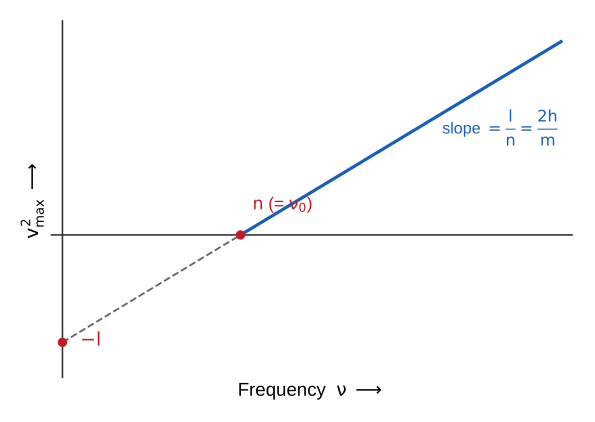
The threshold frequency f0 is when Kmax=0:
hf0=ϕ⇒f0=hϕ
Why intensity doesn't matter for ejection?
- Intensity = number of photons per second.
- Each photon still has energy hf. If hf<ϕ, even a billion photons won't eject an electron — each photon is individually too weak.
5. Why Kinetic Energy Depends on Frequency, Not Intensity
From Kmax=hf−ϕ:
- Frequency f directly determines Kmax.
- Intensity only affects the number of electrons ejected (more photons → more electrons), not their individual energy.
This was the key experimental contradiction with classical wave theory:
- Classical: Higher intensity = bigger wave amplitude = more energy to electrons.
- Reality: Higher frequency = more energy per electron; intensity only changes current.
6. Summary of Key Relationships …