Q.What is nephron ? Describe the structure of a nephron with a diagram.
🔒You're viewing a preview — the full solution, concept, methods & PYQ mapping are locked.
🔒 Start your 14-day free trial to unlock the full solution →Concept understanding — Nephron Structure
The Kidney's Tiny Filtration Plant
Think of your kidneys as the body's water treatment facility. Every day, they process about 180 litres of fluid — roughly the volume of a bathtub — and turn it into just 1–2 litres of urine. How does such a small organ handle that much work? It divides the job among millions of identical, microscopic units.
Each unit is called a nephron. There are about one million nephrons in each kidney. They are the smallest functional units — meaning each one can do everything the kidney does: filter blood, reabsorb useful substances, and excrete waste.
A nephron is the structural and functional unit of the kidney. Each nephron independently produces urine from blood plasma.
The Two-Part Architecture
A nephron has two main sections, and understanding this split is the key to everything.
Part 1: The Renal Corpuscle — this is where filtration happens. It consists of a tuft of capillaries called the glomerulus tucked inside a cup-shaped Bowman's capsule. Blood pressure forces fluid (but not cells or large proteins) out of the glomerulus and into the capsule. That fluid is now called the filtrate — it's basically blood plasma without the proteins.
Part 2: The Renal Tubule — this is a long, winding tube that modifies the filtrate into urine. It has four distinct segments, each with a specific job:
| Segment | What happens there |
|---|---|
| Proximal Convoluted Tubule (PCT) | Reabsorbs most of the good stuff — glucose, amino acids, ions, and about 65% of the water. |
| Loop of Henle | Creates a concentration gradient in the kidney medulla. Descending limb loses water; ascending limb pumps out salt. |
| Distal Convoluted Tubule (DCT) | Fine-tunes salt and pH balance under hormonal control. |
| Collecting Duct | Final water reabsorption (controlled by ADH). The duct is shared by many nephrons. |
The PCT and DCT are in the cortex (outer region) of the kidney. The loop of Henle dips into the medulla (inner region). This spatial arrangement is essential for concentrating urine.
How It All Connects
Trace the path of one drop of filtrate:
- Blood enters the glomerulus under high pressure. Fluid is squeezed into Bowman's capsule.
- Filtrate flows into the PCT, where most nutrients and water are reclaimed back into the blood.
- It then enters the loop of Henle — a hairpin turn that goes deep into the medulla and back. Here, the filtrate becomes concentrated.
- Next is the DCT, where hormones like aldosterone fine-tune sodium and potassium levels.
- Finally, the filtrate enters the collecting duct, which passes back through the medulla. More water is reabsorbed if the body is dehydrated. What remains is urine.
To remember the order: Bowman's → PCT → Loop → DCT → Collecting duct. A common mnemonic: "Big Pink Lions Don't Cry" — Bowman's, Proximal, Loop, Distal, Collecting.
Why This Structure Matters …
The nephron is the microscopic urine-forming unit of the kidney, made of a malpighian body and a long renal tubule. …
A nephron is the functional unit of the kidney; it has a malpighian body (glomerulus + Bowman's capsule) and a renal tubule (PCT, loop of Henle, DCT) leading to a collecting duct.
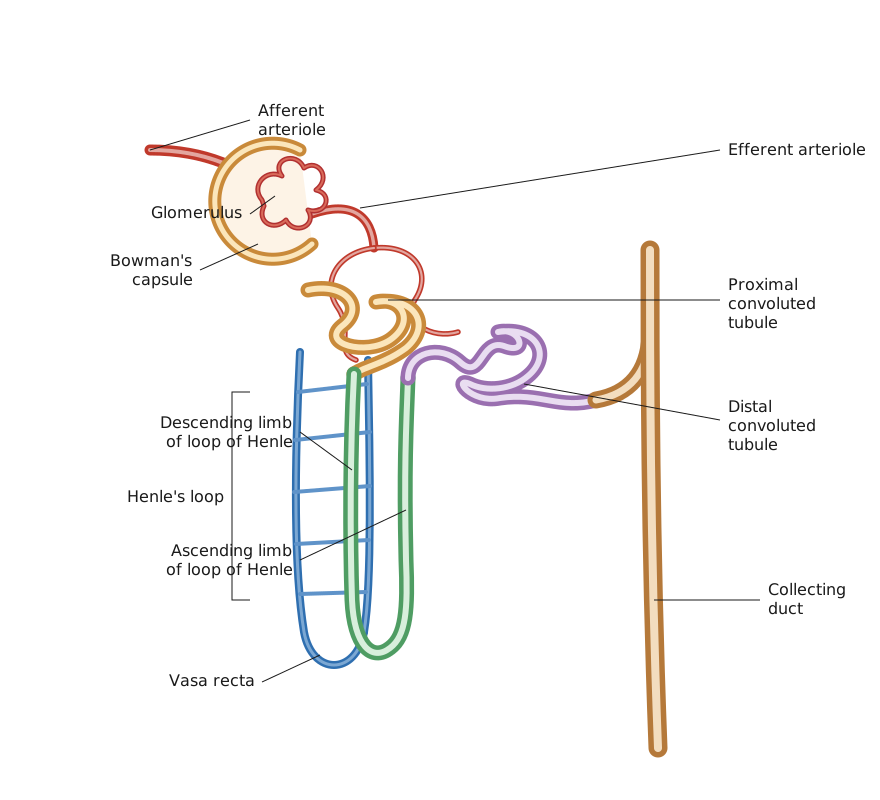
What is a nephron?
The nephron (uriniferous tubule) is the structural and functional unit of the kidney. Each human kidney contains about one million nephrons, which filter the blood and form urine.
Structure of a nephron:
A nephron has two main parts —
- Malpighian body (renal corpuscle):
-
Glomerulus — a tuft/network of blood capillaries formed by the afferent arteriole; blood is filtered here.
-
Bowman's capsule — a double-walled, cup-shaped structure that encloses the glomerulus and collects the filtrate.
- Renal tubule (arising from the Bowman's capsule):
- Proximal Convoluted Tubule (PCT) — the coiled first part; site of most reabsorption.
- Loop of Henle — a U-shaped loop with a descending limb and an ascending limb; concentrates the urine.
- Distal Convoluted Tubule (DCT) — the coiled last part; involved in reabsorption and secretion.
- The DCT opens into a collecting duct, which carries urine toward the renal pelvis. …
- CBSE 2026Set ANNUAL1 markMCQQ.Match the columns - Column 'A': Bowman's capsule. Choose its match from Column 'B'.(a) Adrenal gland(b) Vacuole(c) Podocytes(d) Hibiscus(e) Choanocytes
›Reveal solutionSolution
Podocytes are the specialised cells that form the inner (visceral) layer of Bowman's capsule, and their filtration slits are essential to glomerular ultrafiltration.
Each nephron begins with a double-walled cup-shaped structure, Bowman's capsule, which encloses a tuft of capillaries called the glomerulus. The inner wall of Bowman's capsule is lined by specialised cells called podocytes, which have foot-like projections (pedicels) that interdigitate, leaving narrow gaps called filtration slits or slit pores. Blood is filtered through the glomerular capillary wall, the basement membr …
- CBSE 2024Set HALF_YEARLY1 markQ.Write the answer in one sentence: Approximately, how many nephrons are found in each human kidney?
›Reveal solutionSolution
A human kidney contains roughly one million nephrons, each an independent structural and functional filtering unit.
The nephron is the structural and functional unit of the kidney, consisting of the glomerulus and Bowman's capsule (together the malpighian body) followed by the proximal convoluted tubule, loop of Henle, distal convoluted tubule and collecting duct. Each human kidney is estimated to contain approximately one million (about 10 lak …
- CBSE 2023Set ANNUAL1 markMCQQ.The structural and functional unit of human kidney is:(a) Glomerulus(b) Ureter(c) Nephron(d) Hilum
›Reveal solutionSolution
The nephron is the structural and functional unit of the human kidney; each kidney contains about a million nephrons.
Each nephron consists of a Bowman's capsule (surrounding a tuft of capillaries called the glomerulus), the proximal convoluted tubule, the loop of Henle, and the distal convoluted tubule opening into a collecting duct. Together these parts:
- Filter blood at the glomerulus (glomerular filtration) to form the filtrate.
- Reabsorb useful substances (glucose, amino acids, most water and ions) back into blood along the tubule.
- Secrete additional wastes (like H+, K+, ammonia) into the tubule. …
- CBSE 2023Set ANNUAL1 markMCQQ.Bowman's capsule is a part of :(a) neurons(b) nephron's(c) seminiferous tubule(d) blood vessels
›Reveal solutionSolution
Bowman's capsule is part of the nephron.
The nephron is the structural and functional unit of the kidney. Its first part is the cup-shaped Bowman's capsule, which surrounds the glomerulus and receives the filtrate. So Bowman's cap …
- CBSE 2023Set ANNUAL1 markMCQQ.Unit of kidney is :(a) nephron(b) ureter(c) glomerulus(d) seminiferous tubule
›Reveal solutionSolution
The nephron is the unit of the kidney.
Each kidney contains about a million nephrons, each consisting of a Malpighian body (glomerulus + Bowman's capsule) and a renal tubule. The nephron is therefore the structural and functional unit of the kidney; the ureter merely carries urine, and the glom …
- CBSE 2021Set ANNUAL1 markMCQQ.Glomerulus along with Bowman's capsule is called:(a) Proximal convoluted tubule(b) Distal convoluted tubule(c) Henle's loop(d) None of these
›Reveal solutionSolution
Glomerulus + Bowman's capsule = Malpighian corpuscle / renal corpuscle, a term not listed among the choices.
Each nephron begins with a tuft of capillaries called the glomerulus, which is enclosed within a double-walled cup-shaped structure called Bowman's capsule. Together, the glomerulus and Bowman's capsule constitute the Malpighian corpuscle (also called the renal corpuscle), the filtration unit of the nephron. The Proximal Convoluted Tubule, Distal Convoluted Tubule and Henle's Loop are the tubular part …
- CBSE 2021Set zoology1 markQ.The functional unit of kidney is ..................... . (Fill up)
›Reveal solutionSolution
The functional unit of the kidney is the nephron; each kidney has about a million of them, and each one filters blood and forms urine.
The kidney is a compound organ, but its work of filtering blood and making urine is done by repeating microscopic units called nephrons (uriniferous tubules). Each human kidney has roughly one million nephrons.
A nephron has two main parts:
- Malpighian body (renal corpuscle): a cup-shaped Bowman's capsule enclosing a tuft of capillaries called the glomerulus, where blood is filtered. …
- CBSE 2020Set ANNUAL1 markMCQQ.The basic functional unit of human kidney is :(a) Nepridia(b) Henle's loop(c) Nephron(d) Pyramid
›Reveal solutionSolution
The nephron is the basic unit of the kidney, responsible for filtration of blood and formation of urine; each kidney contains roughly a million nephrons.
Each nephron consists of a Malpighian/renal corpuscle (glomerus + Bowman's capsule, where blood filtration occurs) and a renal tubule (proximal convoluted tubule, loop of Henle, distal convoluted tubule) that reabsorbs useful substances and secretes wastes, eventually delivering urine to the collecting duct.
- (a) 'Nepridia' (nephridia) are the excretory units of annelids like earthworms, not the human kidney. …
- CBSE 2019Set ANNUAL1 markMCQQ.Match the following - Bowmen capsule:(a) Expiration(b) Regeneration(c) Solanaceae(d) Fluorine(e) Renal tubule
›Reveal solutionSolution
Bowman's capsule, together with the glomerulus it encloses, forms the renal corpuscle at the start of the nephron's renal tubule.
Each nephron (the functional unit of the kidney) begins with a cup-shaped Bowman's capsule that surrounds a tuft of capillaries called the glomerulus; together they form the Malpighian/renal corpuscle, where blood filtration begins. Bowman's capsule is directly continuous with the rest of the …
- CBSE 2018Set ANNUAL1 markMCQQ.The functional unit of the kidney is:(a) Nephron(b) Alveoli(c) Capsule(d) Medulla
›Reveal solutionSolution
The nephron is the structural and functional unit of the kidney; each kidney contains about a million nephrons.
Each nephron consists of a renal corpuscle (glomerulus + Bowman's capsule) that filters blood, followed by a renal tubule (proximal convoluted tubule, loop of Henle, distal convoluted tubule) that reabsorbs useful substances and secretes wastes, finally draining urine into a collecting duct. This entire sequence of filtration, reabsorption, and secretion happens independently within each nephron, which is why it is called the functional unit. Alveoli (b) are the gas-exchange sacs of the lungs, Capsule (c) refers only to the outer fibrous covering (Bowma …
- CBSE 2017Set ANNUAL1 markQ.Give significance of podocyte.
›Reveal solutionSolution
Podocytes are specialised epithelial cells with foot-like processes covering the glomerular capillaries; the filtration slits between their pedicels allow ultrafiltration of blood plasma into Bowman's capsule while re...
Podocytes form a selective filter around glomerular capillaries, letting small molecules pass into Bowman's capsule while holding back cells and large proteins.
Podocytes are specialised cells that make up the inner (visceral) layer of Bowman's capsule and are wrapped tightly around the glomerular capillaries in the nephron. Each podocyte extends numerous finger-like foot processes (pedicels) that interdigitate with those of neighbouring podocytes, leaving narrow gaps between them called filtration slits. Together with the capillary endothelium and the basement membrane, these filtration slits form a size-selective filtration barrier: small molecules such as water, glucose, amino acids, salts, and nitrogenous wastes (urea) can pass freely through into the lumen of Bowman's capsule as glomerular filtrate, while blood cells and large plasma pr …
🎓Unlock everything free for 14 days
- ✓Full step-by-step solutions
- ✓Concept-first explanations
- ✓Methods, shortcuts & mistakes
- ✓PYQ mapping + timed mock tests
Full access for 14 days. No credit card required.