Chemistry · Ch 3 — Classification of Elements and Periodicity in Properties
Modern Periodic Law and the Present Form of the Periodic Table
Modern Periodic Law and the Present Form of the Periodic Table
3.3 Modern Periodic Law and the Present Form of the Periodic Table
The Fundamental Shift: From Mendeleev to Modern
Mendeleev's periodic law stated that the properties of elements are a periodic function of their atomic masses. This was a brilliant empirical generalization for its time, but it had serious flaws — isotopes of the same element had different masses yet identical chemical behaviour, and a few pairs of elements (like tellurium and iodine) appeared in the wrong order if mass alone was used.
The modern periodic law, established after the discovery of atomic number by Henry Moseley in 1913, states:
The physical and chemical properties of elements are a periodic function of their atomic numbers.
Atomic number () — the number of protons in the nucleus — is the fundamental property that determines an element's identity. Unlike atomic mass, atomic number is an integer with no ambiguity: every atom of a given element has exactly the same . This single change resolved all the anomalies of Mendeleev's table.
Electronic Configuration and the Structure of the Modern Table
The modern periodic table is built directly from the electronic configurations of atoms. As electrons fill orbitals according to the Aufbau principle (in order of increasing energy: ), the periodic table arranges elements so that those with the same outer electronic configuration fall in the same vertical column — a group.
Drawn by us to help you understand the concept clearly, and verified to make sure it's accurate. For exams, practice from your textbook's own diagram.
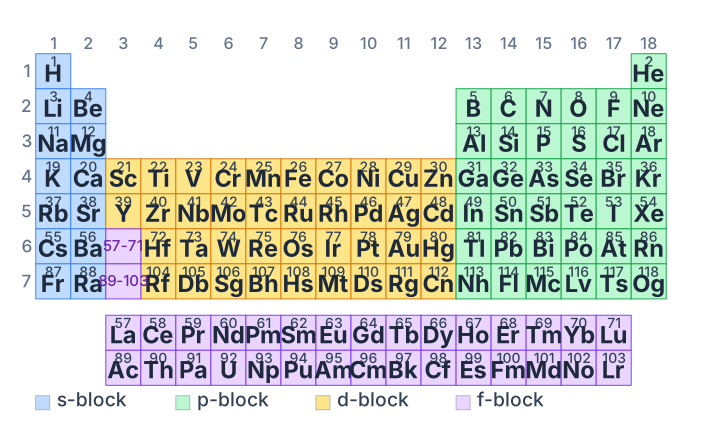
Fig. 3.2 is the modern long-form periodic table — the one you will use throughout your chemistry studies. It arranges all known elements in order of increasing atomic number () across 7 horizontal rows called periods and 18 vertical columns called groups (numbered 1–18, following the 1984 IUPAC convention).
In our rendition each cell carries the element's atomic number and symbol (the compact cell convention we use for dense tables); the book's own printing of this figure additionally squeezes each element's ground-state outer electronic configuration into the cell. That outer configuration — the arrangement of electrons in the outermost (valence) shell — is what determines chemical behaviour, and the block colouring below encodes exactly which subshell it ends in.
The periods are not all the same length. Period 1 contains only 2 elements (H and He). Periods 2 and 3 each contain 8 elements. Periods 4 and 5 each contain 18 elements. Period 6 contains 32 elements, and Period 7 is incomplete (it continues to be filled as new elements are synthesised). The reason for these lengths is rooted in how electron shells fill: the maximum number of electrons in a shell is , where is the principal quantum number of the period. For , ; for , ; for , — but the 3d subshell actually fills in Period 4, so Period 3 stops at 8. The pattern is governed by the order of orbital filling (the Aufbau principle).
The table is divided into four blocks — s-block, p-block, d-block, and f-block — based on which subshell receives the last electron. The s-block (groups 1–2) spans the left; the p-block (groups 13–18) spans the right; the d-block (groups 3–12) sits in the middle; the f-block (the 14 lanthanoids and 14 actinoids) is placed as two separate rows below the main body to keep the table compact. This block structure directly reflects the azimuthal quantum number () of the outermost electrons.
The period number equals the principal quantum number () of the valence shell. The group number (1–18) relates to the number of valence electrons — but the exact relationship differs for s-block, p-block, and d-block elements.
The physical idea the figure teaches is that elements in the same group have the same outer electronic configuration (same number of valence electrons in the same type of subshell), which is why they show similar chemical properties. Elements in the same period have the same but different numbers of valence electrons, leading to a gradual change in properties across the period.
The textbook develops several key ideas using this figure. One central formula is the relationship between the maximum number of elements in a period and the principal quantum number:
For , this gives — but the sixth period actually has only 32 elements. Why? Because the 4f, 5d, 6s, and 6p subshells fill in a specific order, and the rule applies only to the total capacity of the shell, not to the order of filling. The textbook asks you to justify the 32-element sixth period using quantum numbers: the sixth period corresponds to , and the orbitals that fill are 6s (2 electrons), 4f (14 electrons), 5d (10 electrons), and 6p (6 electrons) — total .
Another key idea is the block-wise outer electronic configuration:
- s-block:
- p-block:
- d-block:
- f-block:
These configurations are directly readable from the figure — each cell shows the ground-state outer configuration, and the block structure makes it easy to see the pattern. …
Periods: The Horizontal Rows
Each period corresponds to the filling of a particular principal quantum number shell (). The number of elements in a period equals the total number of electrons that can occupy the subshells being filled in that period.
| Period | value | Subshells filled | Maximum electrons | Number of elements |
|---|---|---|---|---|
| 1 | 1 | 2 | 2 | |
| 2 | 2 | 8 | ||
| 3 | 3 | 8 | ||
| 4 | 4 | 18 | ||
| 5 | 5 | 18 | ||
| 6 | 6 | 32 | ||
| 7 | 7 | 32 (incomplete) |
The sixth period has 32 elements because it involves the filling of the subshell (14 electrons) in addition to the , , and subshells. The quantum numbers justify this: for , the azimuthal quantum number can be 0, 1, 2, 3, 4, 5 — but only (6s), (6p), (5d, since for in this period), and (4f, since for ) are actually filled. The subshell has 7 orbitals × 2 electrons = 14 electrons, giving the total of 32.
Groups: The Vertical Columns
There are 18 groups in the modern periodic table. Elements in the same group have the same number of valence electrons and similar outer electronic configurations, which is why they exhibit similar chemical properties.
The groups are numbered 1 to 18 (IUPAC system), replacing the older Roman numeral notation (IA, IIA, IIIB, etc.).
The Four Blocks at a Glance
Based on which subshell receives the last electron, the table divides into four blocks — s (groups 1–2), p (groups 13–18), d (groups 3–12) and f (the lanthanoids and actinoids, placed separately below). Each block, and the special placements of hydrogen and helium, is examined in detail in Section 3.6.
Locating an Element from Its Electronic Configuration
Given the outer electronic configuration of an element, you can determine its position in the periodic table as follows:
- Block: Determined by the subshell receiving the last electron (, , , or ).
- Period: Equal to the highest principal quantum number present in the configuration.
- Group: Depends on the block and the total number of electrons in the outermost shells.
For s-block elements: Group number = number of valence electrons (1 or 2).
For p-block elements: Group number = 10 + number of valence electrons (since groups 13–18 correspond to ).
For d-block elements: Group number = number of electrons in subshell + number of electrons in subshell (usually 2). This gives group numbers 3–12.
For f-block elements: All belong to group 3, periods 6 and 7. …