Chemistry · Ch 12 — Organic Chemistry – Some Basic Principles and Techniques
Isomerism
Isomerism
The phenomenon where two or more compounds share the same molecular formula but differ in their properties is called isomerism, and the compounds themselves are called isomers. This difference in properties — physical, chemical, or both — arises because the atoms are arranged differently in space or are connected in a different order.
Isomerism is not a rare curiosity; it is a central feature of organic chemistry. The vast diversity of carbon compounds, despite being built from only a few elements, is largely due to isomerism. Understanding the types of isomerism is essential for predicting the behaviour of organic molecules.
The classification of isomerism is best understood through a branching diagram. The two broad divisions are structural isomerism (where the atoms are connected in a different order) and stereoisomerism (where the atoms are connected in the same order but arranged differently in space).
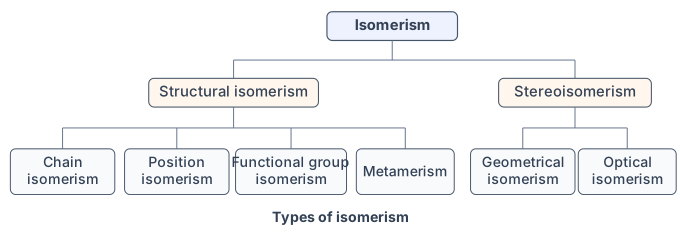
The chart splits isomerism into its two broad families. Structural isomers differ in how the atoms are linked together: by carbon skeleton (chain isomerism, e.g. the three isomers), by the position of a substituent or functional group (position isomerism, e.g. propan-1-ol vs propan-2-ol), by the functional group itself (functional group isomerism, e.g. an aldehyde vs a ketone for ), or by the alkyl groups flanking a polyvalent functional group (metamerism, e.g. the ethers). Stereoisomers have identical connectivity but different spatial arrangements — geometrical (cis/trans …
…