Mathematics · Ch 10 — Straight Lines
Conditions for Parallelism and Perpendicularity of Lines in Terms of Their Slopes
Conditions for Parallelism and Perpendicularity of Lines in Terms of Their Slopes
Conditions for Parallelism and Perpendicularity of Lines in Terms of Their Slopes
When two lines lie in the same coordinate plane, their slopes tell us everything about whether they are parallel or perpendicular — provided neither line is vertical. The reasoning rests entirely on the relationship between a line's inclination and its slope.
Recall that for a non-vertical line, the slope equals , where is the angle the line makes with the positive -axis, measured from to .
Parallel Lines
Consider two non-vertical lines and with slopes and , and inclinations and respectively.
If the lines are parallel, their inclinations must be equal: . Since the tangent function is one-to-one on the interval , equal angles give equal tangents:
But and , so:
Conversely, if the slopes are equal (), then . Because the tangent function is strictly increasing on and takes every real value exactly once in that interval, equal tangents force equal angles: . Hence the lines are parallel.
Two non-vertical lines and are parallel if and only if their slopes are equal:
This condition applies only to non-vertical lines. A vertical line has undefined slope, so you cannot compare slopes directly. However, any two vertical lines are always parallel to each other, and a vertical line is parallel to another line only if that other line is also vertical.
Perpendicular Lines
Again take two non-vertical lines and with slopes , and inclinations , .
If the lines are perpendicular, the angle between them is . Suppose (the steeper line has the larger inclination). Then:
Taking tangents on both sides:
Using the identity :
Since and :
Multiplying both sides by gives the more symmetric form:
Conversely, suppose , i.e. . Then:
Now and also . Since and both lie in , the only possibility consistent with the range is:
…
Drawn by us to help you understand the concept clearly, and verified to make sure it's accurate. For exams, practice from your textbook's own diagram.
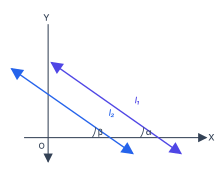
Fig 9.4 is a simple but essential diagram: it shows two straight lines, labelled and , drawn on the -plane. Both lines are marked with double arrows to indicate they extend infinitely in both directions. The line is drawn in indigo, in blue. Each line makes an angle with the positive -axis — the inclination of is labelled , and the inclination of is labelled . The critical visual fact is that and are drawn as equal angles. The -axis itself is shown, and the two lines are clearly parallel — they never meet, and they slant in exactly the same direction.
The physical idea the figure teaches is that parallelism is equivalent to equal inclination. Inclination is the angle a line makes with the positive direction of the -axis, measured anticlockwise from to . If two lines are parallel, they must be tilted at the same angle relative to the horizontal — so their inclinations are equal. Conversely, if two lines have the same inclination, they point in the same direction and are therefore parallel. The diagram makes this one-to-one correspondence visually obvious before any algebra is introduced.
From this geometric observation, the textbook derives the algebraic condition for parallelism. Since the slope of a non-vertical line is defined as , where is its inclination, equal inclinations imply equal slopes:
Here is the slope of , is the slope of , and the double arrow means the statement works both ways: if slopes are equal, the lines are parallel; if lines are parallel, their slopes are equal. The proof relies on the fact that the tangent function is one-to-one on the interval — so forces , and vice versa.
This condition holds only for non-vertical lines. A vertical line has an undefined slope (its inclination is ), so the slope comparison does not apply. Two vertical lines are always parallel to each other, but you cannot use the slope equality test for them. …
Drawn by us to help you understand the concept clearly, and verified to make sure it's accurate. For exams, practice from your textbook's own diagram.
What Fig. 9.5 Shows
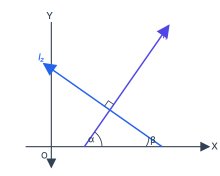
The figure depicts two straight lines, and , drawn on a standard -coordinate plane. Both lines pass through the origin, crossing each other at a point above the origin — the intersection is marked with a small square to indicate a right angle. Line has a positive slope (it rises as we move right), while has a negative slope (it falls as we move right). The line is drawn in blue to distinguish it visually.
At the bottom, each line makes an angle with the positive -axis. The angle for is labelled , and the angle for is labelled . The key geometric fact shown in the diagram is that — the two inclinations differ by exactly . This is the visual condition for perpendicularity.
The Physical Idea
The figure teaches a single, clean idea: two non-vertical lines are perpendicular if and only if their slopes are negative reciprocals of each other. The diagram makes this relationship visible by showing that when one line's inclination is , the other's must be for them to meet at a right angle. The small square at the intersection is the standard geometric marker for a angle.
The condition applies only to non-vertical lines. A vertical line (undefined slope) is perpendicular to a horizontal line (slope ), but the product rule does not hold in that case — you must handle vertical/horizontal pairs separately.
The Key Formula
From the geometry , the textbook derives the slope condition using the tangent function:
Here:
- is the slope of line , where is its inclination (angle with the positive -axis, measured anticlockwise).
- is the slope of line , where is its inclination.
The derivation works because:
So , which rearranges to .
The converse also holds: if , then the two lines are perpendicular. This is an "if and only if" condition — it works both ways.