Mathematics · Ch 10 — Straight Lines
Two-point Form
Two-point Form
The Two-Point Form of a Line
When you know two distinct points that lie on a line, you can write its equation directly. This is one of the most practical forms because you don't need to calculate the slope separately — the formula builds it in.
Suppose a line passes through two fixed points and . Let be any other point on the same line. Since all three points lie on the same straight line, they are collinear. For collinear points, the slope between any two of them must be the same.
Take the slope of segment and the slope of segment . They must be equal:
Writing each slope as rise over run gives:
This is the core relation. To get the equation of the line, multiply both sides by :
This is the two-point form of the equation of a straight line.
The formula works provided . If , the line is vertical and its equation is simply — the two-point form is not needed in that case.
A common mistake is to swap the coordinates in the slope fraction. Keep the order consistent: the numerator uses and the denominator uses . If you swap either pair, the sign of the slope flips and the equation becomes wrong.
Worked Example
Example 6: Write the equation of the line through the points and .
Here , , , . Substitute directly into the two-point form:
Simplify the numerator and denominator:
Now expand and rearrange to get the equation in a standard form:
…
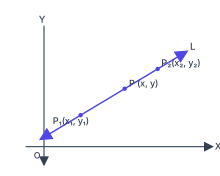
Drawn by us to help you understand the concept clearly, and verified to make sure it's accurate. For exams, practice from your textbook's own diagram.
The figure shows a straight line drawn in the first quadrant of the -plane. Three distinct points are marked on this line: , , and . The point is the leftmost of the three, is the rightmost, and lies somewhere between them. The axes are the standard -axis (horizontal) and -axis (vertical). No grid, no shading, no extra curves — just a single line with three labelled points on it.
The physical idea is simple: if you know two points on a line, you can find the equation of that line. The figure makes this concrete by showing a general point sliding along the line between the two fixed points and . Because all three points are collinear, the slope between and must equal the slope between and . That single equality is the entire geometric content of the diagram.
From that equality, the textbook derives the two-point form. The slope of is , and the slope of is . Setting them equal gives:
Rearranging this into the standard two-point form:
Here, and are the coordinates of the two given points, and is any point on the line. The fraction is the slope of the line. The formula works for any two distinct points — it does not matter which one you call and which , as long as you are consistent.
If , the denominator becomes zero and the formula breaks. That case is a vertical line, handled separately as . …