Q.Find the value of the trigonometric function csc(−1410∘).
🔒You're viewing a preview — the full solution, concept, methods & PYQ mapping are locked.
🔒 Start your 10-day free trial to unlock the full solution →Concept understanding — Trigonometric Functions in Quadrants
Trigonometric Functions in Quadrants
Imagine standing at the centre of a circle, facing east. If you turn by some angle, you end up pointing in a certain direction. That direction has both a horizontal component (east-west) and a vertical component (north-south). Trigonometric functions are just a way to describe those components — and whether they are positive or negative depends entirely on which quadrant you're facing.
The Four Quadrants
The coordinate plane is split into four quadrants, numbered anticlockwise starting from the top-right:
- Quadrant I (0° to 90°): x > 0, y > 0
- Quadrant II (90° to 180°): x < 0, y > 0
- Quadrant III (180° to 270°): x < 0, y < 0
- Quadrant IV (270° to 360°): x > 0, y < 0
Now, recall the definitions on the unit circle (radius = 1):
- cosθ = x-coordinate of the point on the circle
- sinθ = y-coordinate of that point
- tanθ=cosθsinθ
So the sign of cosθ follows the sign of x, and the sign of sinθ follows the sign of y. That's all there is to it.
The Sign Pattern
| Quadrant | sinθ | cosθ | tanθ |
|---|---|---|---|
| I (0–90) | + | + | + |
| II (90–180) | + | – | – |
| III (180–270) | – | – | + |
| IV (270–360) | – | + | – |
The mnemonic "All Students Take Coffee" helps you remember which functions are positive in each quadrant, starting from QI and going anticlockwise: All (all positive), Sine (sin positive), Tan (tan positive), Cos (cos positive).
Why This Matters
Suppose you're solving sinθ=21. The calculator gives you θ=30∘, but that's only one solution. Because sine is positive in both QI and QII, there's a second angle: 180∘−30∘=150∘. If you forget the quadrant rule, you lose half the answers.
Similarly, if cosθ=−23, cosine is negative in QII and QIII. So the solutions are 150∘ and 210∘ (plus full rotations). …
Concept: Trigonometric functions of negative angles and periodicity.
First, use the odd-function property of sine: csc(−θ)=−csc(θ), so csc(−1410∘)=−csc(1410∘).
Next, reduce 1410∘ using the 360∘ period of sine:
1410∘=3×360∘+330∘=1080∘+330∘
So csc(1410∘)=csc(330∘).
The angle 330∘=360∘−30∘ lies in the fourth quadrant, where sine is negative: …
−1410∘ is coterminal with 30∘, so sin(−1410∘)=21 and csc(−1410∘)=2.
Cosecant is the reciprocal of sine, and both are unchanged when we add whole turns of 360∘. Add 4×360∘=1440∘ to bring the angle into [0∘,360∘):
−1410∘+1440∘=30∘. …
- JEE Main 2026Set 2026-01-23-s14 marksMCQQ.Number of solutions of √3 cos 2θ + 8 cos θ + 3√3 = 0, θ ∈ [-3π, 2π] is: (A) 0 (B) 3 (C) 4 (D) 5
›Reveal solutionSolution
The equation collapses to a single valid value cosθ=−1/3; counting all angles with this cosine over the interval [−3π,2π] (length 5π, i.e. 2.5 full periods) gives 5 solutions.
Multi-angle trig equations in a wide domain are best handled by first reducing to a single-angle polynomial in cosθ, then counting solutions over the domain using the periodicity of cosine.
- Substitute cos2θ=2cos2θ−1: 3(2cos2θ−1)+8cosθ+33=0⟹23cos2θ+8cosθ+23=0.
- Divide by 2: 3cos2θ+4cosθ+3=0. Let x=cosθ: 3x2+4x+3=0.
x=23−4±16−12=23−4±2
- Roots: x=−31≈−0.577 (valid, since ∣x∣≤1) and x=−3≈−1.732 (rejected, outside range of cosine).
- So we need all θ∈[−3π,2π] with cosθ=−1/3. The general solution is θ=±α+2kπ where α=cos−1(−1/3)≈2.186 rad. …
- JEE Main 2026Set 2026-01-24-s14 marksMCQQ.If cot x = 5/12 for some x ∈ (π, 3π/2), then sin 7x (cos(13x/2) + sin(13x/2)) + cos 7x (cos(13x/2) − sin(13x/2)) is equal to (A) 1/√13 (B) 5/√13 (C) 6/√26 (D) 4/√26
›Reveal solutionSolution
The expression simplifies to sin(x/2)+cos(x/2), and squaring using sinx=−12/13 gives the value 1/13 (positive, since x/2 lies in the second quadrant where the sum stays non-negative).
Long expressions built from sinA,cosA at two different angles often collapse via the compound-angle formulas for sin(A−B) and cos(A−B) — spotting that pattern avoids a messy direct expansion.
- Since x∈(π,3π/2) (third quadrant), both sinx,cosx<0. With cotx=5/12, use the reference triangle 5,12,13: sinx=−1312, cosx=−135.
- Let A=7x, B=213x. The given expression is sinA(cosB+sinB)+cosA(cosB−sinB).
- Expand and regroup: (sinAcosB−cosAsinB)+(sinAsinB+cosAcosB)=sin(A−B)+cos(A−B).
A−B=7x−213x=2x
- So the expression =sin(x/2)+cos(x/2). …
- JEE Main 2024Set 2024-01-30-s24 marksMCQQ.For α,β∈(0,2π), let 3sin(α+β)=2sin(α−β) and a real number k be such that tanα=ktanβ. Then the value of k is equal to: (A) −32 (B) −5 (C) 32 (D) 5
›Reveal solutionSolution
Expand both sides and divide by cosαcosβ to get a relation between the tangents.
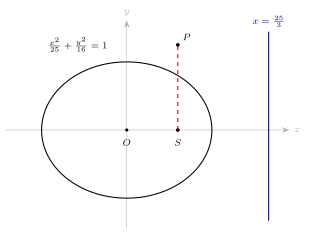
Ellipse x^2/25 + y^2/16 = 1 centered at O; focus S on the positive x-axis, directrix x=25/3 as a vertical line at right, point P above S wit - Expand: 3(sinαcosβ+cosαsinβ)=2(sinαcosβ−cosαsinβ). …
- JEE Main 2024Set 2024-04-08-s14 marksMCQQ.If sinx=−53, where π<x<23π, then 80(tan2x−cosx) is equal to: (A) 109 (B) 108 (C) 18 (D) 19
›Reveal solutionSolution
Use the quadrant to fix signs of cosx and tanx, then substitute.
-
π<x<23π is the third quadrant: cosx<0, tanx>0.
-
cosx=−1−sin2x=−1−259=−54.
-
tanx=cosxsinx=−4/5−3/5=43, so tan2x=169. …
-
- JEE Main 2022Set 2022-06-28-s24 marksMCQQ.If cot α = 1 and sec β = −5/3, where π < α < 3π/2 and π/2 < β < π, then the value of tan(α + β) and the quadrant in which α + β lies, respectively, are: (A) −1/7 and IVth quadrant (B) 7 and Ist quadrant (C) −7 and IVth quadrant (D) 1/7 and Ist quadrant
›Reveal solutionSolution
Pin down tanα,tanβ from the given data and quadrant restrictions, then use the tangent-addition formula and track the actual angle to find the quadrant.
- cotα=1⇒tanα=1; with π<α<3π/2 (third quadrant, tangent positive), α=π+π/4=5π/4=225∘.
- secβ=−5/3⇒cosβ=−3/5; with π/2<β<π (second quadrant, sine positive), sinβ=4/5, so tanβ=−4/3.
- tan(α+β)=1−tanαtanβtanα+tanβ=1−1⋅(−4/3)1−4/3=7/3−1/3=−71. …
- JEE Main 2021Set 2021-09-01-s14 marksMCQQ.cos⁻¹(cos(−5)) + sin⁻¹(sin(6)) − tan⁻¹(tan(12)) is equal to: (The inverse trigonometric functions take the principal values) (A) 3π − 11 (B) 4π − 9 (C) 4π − 11 (D) 3π + 1
›Reveal solutionSolution
Reduce each argument into the principal range of its inverse trig function, then add.
- cos−1(cos(−5))=cos−1(cos5) (cosine even). Since π<5<2π: cos−1(cos5)=2π−5.
- sin−1(sin6): since 3π/2<6<2π: sin−1(sin6)=6−2π. …
- JEE Main 2021Set 2021-09-01-s14 marksMCQQ.The range of the function, f(x) = log_√5 [3 + cos(3π/4 + x) + cos(π/4 + x) + cos(π/4 − x) − cos(3π/4 − x)] is: (A) (0, √5) (B) [−2, 2] (C) [1/√5, √5] (D) [0, 2]
›Reveal solutionSolution
Simplify the bracketed trig sum to 3+2cos(x+π/4)∈[1,5], then take log5 of this range.
- cos(3π/4+x)−cos(3π/4−x)=−2sin(3π/4)sinx=−2⋅22sinx=−2sinx.
- cos(π/4+x)+cos(π/4−x)=2cos(π/4)cosx=2cosx.
- Bracket =3−2sinx+2cosx=3+2(cosx−sinx)=3+2cos(x+π/4).
- Since cos(x+π/4)∈[−1,1], bracket ∈[1,5]. …
🎓Unlock everything free for 10 days
- ✓Full step-by-step solutions
- ✓Concept-first explanations
- ✓Methods, shortcuts & mistakes
- ✓PYQ mapping + timed mock tests
Full access for 10 days. No credit card required.