Physics · Ch 8 — Gravitation
Acceleration Due to Gravity Below and Above the Surface of Earth
Acceleration Due to Gravity Below and Above the Surface of Earth
Variation of Acceleration Due to Gravity with Height and Depth
The acceleration due to gravity is not a universal constant. Its value changes as we move away from the Earth's surface — either upward into the atmosphere or downward into the Earth's interior. The reason is simple: gravity depends on distance from the Earth's centre, and the effective mass that pulls you changes when you go inside the Earth.
We treat the Earth as a uniform sphere of radius and mass , with its centre at . On the surface, the acceleration due to gravity is
where is the universal gravitational constant.
1. Variation with Height (Above the Surface)
Consider a point at a height above the Earth's surface. Its distance from the Earth's centre is . The acceleration due to gravity at this height, call it , is given directly by Newton's law of gravitation:
We want to compare with the surface value . Divide the two expressions:
So
This is the exact formula. For practical calculations, especially when is small compared to (which is about 6400 km), we can expand it using the binomial theorem.
Write . Then
For , expand:
Neglecting terms of order and higher, we get the approximate formula:
This approximation is valid only when . For heights comparable to (e.g., geostationary orbit at km), you must use the exact formula .
Key result: As height increases, decreases. At a height (one Earth radius above the surface), .
2. Variation with Depth (Below the Surface)
Now consider a point at a depth below the Earth's surface. Its distance from the centre is . The crucial new idea is that the gravitational force at this point comes only from the mass of the Earth that lies inside the sphere of radius . The mass outside this sphere (the spherical shell between and ) exerts zero net gravitational force on a particle inside it — this is a consequence of the shell theorem.
Let be the mass of the Earth enclosed within radius . Assuming uniform density ,
Hence
The acceleration due to gravity at depth , call it , is then
Substitute :
But , the surface value. Therefore
Inside the Earth, decreases linearly with depth. At the centre (), . This makes physical sense: at the centre, the mass of the Earth pulls equally in all directions, so the net gravitational force is zero.
The linear decrease assumes uniform density. The real Earth has a denser core, so the actual variation is not perfectly linear — but the qualitative trend (decrease toward the centre) holds.
3. Comparison: Above vs. Below
| Location | Distance from centre | Formula for | Behaviour |
|---|---|---|---|
| Surface | Reference value | ||
| Height | Decreases as | ||
| Depth | Decreases linearly |
Drawn by us to help you understand the concept clearly, and verified to make sure it's accurate. For exams, practice from your textbook's own diagram.
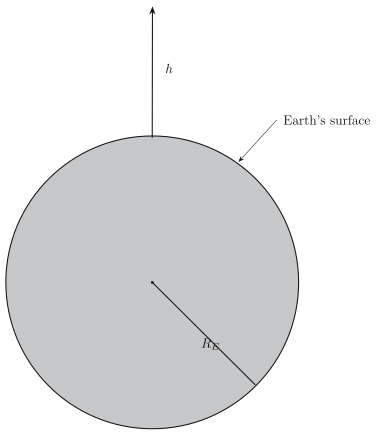
The figure shows a cross-section of the Earth drawn as a shaded disk. From the centre of the disk to a point on its lower-right edge, a straight line is drawn and labelled — this is the Earth’s radius. On the opposite side, at the top of the disk, a vertical arrow rises from the surface straight upward. The arrow is labelled , and at its tip sits a small dot representing a point mass (the object whose weight we are studying). The arrow makes it clear that is measured from the surface, not from the centre.
The physical idea is straightforward: as you move away from the Earth’s surface, the gravitational force weakens. The figure isolates the effect of altitude by showing the object at a height above ground, with the Earth’s full radius drawn for comparison. The key question the diagram helps answer is: how does the acceleration due to gravity change when you are no longer on the surface?
The textbook uses this geometry to derive the formula for at a height . At the surface, the distance from the Earth’s centre is , and the acceleration is
where is the universal gravitational constant and is the mass of the Earth. At a height above the surface, the distance from the centre becomes . The acceleration due to gravity at that height, call it , is therefore
Dividing the two expressions gives a compact relation:
This is the central result tied to Fig. 7.8.a. Every symbol is defined: is the surface value (), is the Earth’s radius (about ), and is the height above the surface. The formula shows that is always less than , and the decrease becomes significant only when is a substantial fraction of .
A common mistake is to use as the distance from the centre. The figure’s arrow starts at the surface, not at the centre — is the altitude above ground. The full distance from the centre is , not alone. …
Drawn by us to help you understand the concept clearly, and verified to make sure it's accurate. For exams, practice from your textbook's own diagram.
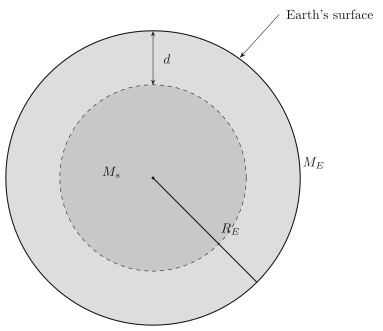
The figure shows a cross-section of the Earth as a perfect sphere of radius and total mass . A dashed circle of radius is drawn inside it, concentric with the outer surface. The region between the two circles — a spherical shell of thickness — is shaded or marked with a small double-arrow labelled at the top. The inner sphere (radius ) is labelled , and the outer shell is the part of the Earth that lies above a point at depth .
The physical idea is straightforward: if you go a distance below the Earth's surface, the gravitational acceleration you feel is not due to the whole Earth. The shell of material above you (thickness ) exerts zero net gravitational pull on you — a result from Newton's shell theorem. Only the mass of the smaller sphere beneath you, of radius , contributes. That inner sphere has mass , which is less than because the shell has been removed.
The textbook uses this picture to derive the formula for at depth . Assuming uniform density , the mass of the inner sphere is proportional to its volume:
while the Earth's total mass is .
The acceleration due to gravity at depth is then:
Substituting from above and simplifying gives the key result:
where is the acceleration at the surface. Each symbol: is at depth , is surface gravity, is depth below surface, is Earth's radius. …