Q.Estimate the volume of a water molecule using the data in Example 12.1.
🔒You're viewing a preview — the full solution, concept, methods & PYQ mapping are locked.
🔒 Start your 10-day free trial to unlock the full solution →Concept understanding — Molecular Volume Fraction
Molecular Volume Fraction
Kinetic theory begins with a bold assumption: gas molecules are so small compared to the space they roam in that we can treat them as point particles with essentially zero volume. The molecular volume fraction is the number that checks whether that assumption is actually reasonable — it compares the volume genuinely occupied by the molecules themselves to the total volume the gas fills.
The Intuition
Picture a large empty hall with a handful of tennis balls rolling around freely. The balls take up hardly any of the hall's floor space — most of what you see is empty air. That is exactly the picture kinetic theory paints of an ordinary gas: the molecules are the tennis balls, and the container is the hall. The molecular volume fraction simply asks: what fraction of the hall's volume is actually tennis ball?
The Precise Statement
If a gas has N molecules, each modelled as a sphere of radius r (so each molecule has volume 34πr3), and the gas occupies a total volume V, the molecular volume fraction is:
f=VN×34πr3
This is a pure number (no units) — a ratio of two volumes.
A Worked Example (STP Oxygen)
Take one mole of oxygen gas at STP, where N=NA=6.02×10²³ molecules and the molar volume is V=22.4 L=2.24×10⁻² m3. Taking the molecular diameter to be about 3 A˚=3×10⁻¹⁰ m (radius r=1.5×10⁻¹⁰ m):
Volume of one molecule=34πr3≈1.4×10⁻²⁹ m3
Total molecular volume=NA×1.4×10⁻²⁹≈8.5×10⁻⁶ m3
f=2.24×10−28.5×10−6≈4×10⁻⁴
So the molecules themselves occupy only about 0.04% of the space the gas fills — the remaining 99.96% is empty. This tiny number is exactly why kinetic theory can safely ignore the size of individual molecules for an ordinary gas.
This is also why the mean free path of a gas molecule (the average distance it travels between collisions) is far larger than the molecule's own diameter — there is enormous empty space to cross before the next collision.
Why It Matters: Ideal vs. Real Gas …
The key idea is to treat the water molecule as occupying a tiny cube whose side length is the average intermolecular separation, then compute its volume.
From Example 12.1, the density of water is ρ=1000 kg/m3 and the molar mass is M=18 g/mol=0.018 kg/mol. The number of molecules per unit volume is
n=MρNA=0.0181000×6.022×1023≈3.34×1028 m−3. …
Using the density of water and Avogadro’s number, the volume of a single water molecule is found to be about 3.0×10⁻²⁹m3, or roughly 30 cubic ångströms.
The idea is simple: if you know how much space one mole of water occupies, and you know how many molecules are in that mole, then dividing the molar volume by Avogadro’s number gives the volume per molecule. This is called the molecular volume fraction approach — it treats the molecules as tiny cubes or spheres that pack together to fill the bulk liquid.
From Example 12.1 (which I assume gives the density of water as 1000kg/m3 and the molar mass as 18g/mol), we can proceed step by step.
-
Find the volume of one mole of water.
Density ρ=1000kg/m3=106g/m3 (since 1kg=1000g).
Molar mass M=18g/mol.
Molar volume Vm=ρM=106g/m318g/mol=1.8×10−5m3/mol.
-
Divide by Avogadro’s number.
Avogadro’s number NA=6.022×10²³mol−1.
Volume per molecule v=NAVm=6.022×10231.8×10−5m3.
-
Calculate.
v=6.0221.8×10−28≈0.299×10−28=3.0×10⁻²⁹m3.
A cubic ångström is 10−30m3, so 3.0×10⁻²⁹m3=30A˚3. That’s a handy mental check: a water molecule is about 30 cubic ångströms in volume. …
A quick sanity check on 2.99×10⁻²⁹ m3: treat the molecule as a small sphere and back out its effective radius, r=(4π3V)1/3≈1.9×10−10 m=1.9 A˚. This matches the known scale of a water molecule (covalent O–H radii, roughly 1–2 \AA), confirming the density-based estimate is physically sensible. Converting a computed volum …
- JEE Main 2025Set 2025-04-04-s14 marksMCQQ.The mean free path and the average speed of oxygen molecules at 300 K and 1 atm are 3 × 10⁻⁷ m and 600 m/s, respectively. Find the frequency of its collisions. (A) 5 × 10⁸ /s (B) 9 × 10⁵ /s (C) 2 × 10¹⁰ /s (D) 2 × 10⁹ /s
›Reveal solutionSolution
The mean free path is, by definition, the average distance a molecule travels between successive collisions, so dividing the molecule's average speed by that distance directly yields how many collisions it undergoes each second.
Think of the molecule travelling at speed v and covering one mean-free-path length λ between each collision — the number of such lengths covered per second is the collision frequency. …
- JEE Main 2023Set 2023-04-13-s24 marksMCQQ.The mean free path of molecules of a certain gas at STP is 1500d, where d is the diameter of the gas molecules. While maintaining the standard pressure, the mean free path of the molecules at 373 K is approximately : (A) 750d (B) 1500d (C) 1098d (D) 2049d
›Reveal solutionSolution
From λ=2πd2PkBT, at fixed pressure λ∝T, so just scale the STP mean free path by the temperature ratio.
- λ=2πd2PkBT; at constant P and fixed molecular diameter d, λ∝T.
- At STP, T1=273 K and λ1=1500d. …
- JEE Main 2021Set 2021-03-16-s24 marksMCQQ.Calculate the value of mean free path (λ) for oxygen molecules at temperature 27°C and pressure 1.01×10⁵ Pa. Assume the molecular diameter 0.3 nm and the gas is ideal. (k = 1.38×10⁻²³ JK⁻¹) (A) 58 nm (B) 32 nm (C) 86 nm (D) 102 nm
›Reveal solutionSolution
Plugging the given kinetic-theory parameters into the mean-free-path formula gives λ≈102 nm.
- The mean free path of a gas molecule is given by λ=2πd2PkT, where d is the molecular diameter, k is Boltzmann's constant, T the absolute temperature, P the pressure.
- Convert temperature: 27∘C=300 K. kT=1.38×10−23×300=4.14×10⁻²¹ J.
- Molecular diameter d=0.3 nm =3×10⁻¹⁰ m, so d2=9×10⁻²⁰ m². πd2=2.827×10⁻¹⁹ m², and 2πd2=1.4142×2.827×10−19=3.999×10⁻¹⁹ m². …
- JEE Main 2021Set 2021-07-25-s24 marksQ.A system consists of two types of gas molecules A and B having same number density 2×10²⁵/m³. The diameter of A and B are 10 Å and 5 Å respectively. They suffer collision at room temperature. The ratio of average distance covered by the molecule A to that of B between two successive collisions is ______ × 10⁻².
›Reveal solutionSolution
Mean free path scales as 1/d2 for fixed number density, so the ratio for diameters 10 Å and 5 Å is (5/10)2=0.25.
λ=2πd2n1
- The mean free path formula is λ=2πd2n1, where d is the molecular diameter and n the number density. …
- JEE Main 2020Set 2020-01-08-s14 marksMCQQ.The plot that depicts the behavior of the mean free time τ (time between two successive collisions) for the molecules of an ideal gas, as a function of temperature (T), qualitatively, is: (Graphs are schematic and not drawn to scale) (A) Graph of τ vs T (straight line through the origin, positive slope) (B) Graph of τ vs 1/T (straight line through the origin, positive slope) (C) Graph of τ vs T (straight line through the origin, positive slope) (D) Graph of τ vs 1/T (straight line through the origin, positive slope)
›Reveal solutionSolution
Since λ depends only on density (fixed) while ⟨v⟩∝T, the mean free time τ is directly proportional to 1/T.
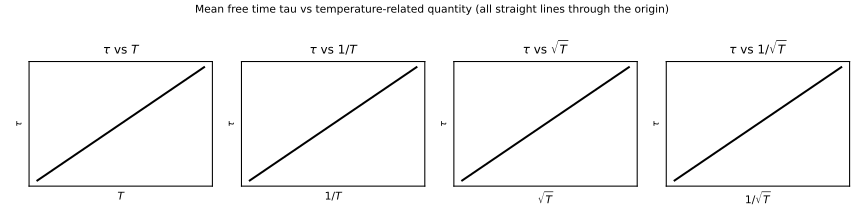
Four schematic option graphs of mean free time tau vs T, 1/T, sqrt(T), 1/sqrt(T) each a straight line through the origin with positive slope - Mean free time between collisions is τ=⟨v⟩λ, where λ is the mean free path and ⟨v⟩ is the average molecular speed.
- The mean free path λ=2nσ1 depends only on the number density n (molecules per unit volume) and the molecular cross-section σ — for a gas at fixed volume (and hence fixed n), λ does not depend on temperature. …
- JEE Main 2020Set 2020-01-09-s24 marksMCQQ.Two gases - argon (atomic radius 0.07 nm, atomic weight 40) and xenon (atomic radius 0.1 nm, atomic weight 140) have the same number density and are at the same temperature. The ratio of their respective mean free times is closest to: (A) 3.67 (B) 4.67 (C) 1.83 (D) 2.3
›Reveal solutionSolution
Combining mean-free-path's 1/d2 dependence with mean-speed's 1/M dependence gives τAr/τXe∝MAr/MXe×(dXe/dAr)2.
- Mean free time is τ=λ/vˉ, where mean free path λ=2nσ1 depends only on number density n and the collision cross-section σ∝d2 (with d the effective molecular diameter, here taken proportional to the given atomic radius), not on mass.
- Mean speed vˉ=πM8RT∝M1, where M is the molar mass.
- So τ∝σ1⋅M∝d2M.
- Ratio: τXeτAr=MXe/dXe2MAr/dAr2=MXeMAr(dArdXe)2.
- Substituting MAr=40, MXe=140, dAr=0.07 nm, dXe=0.1 nm: 40/140≈0.5345 and (0.1/0.07)2≈2.041, giving a ratio ≈0.5345×2.041≈1.09. …
- JEE Main 2020Set 2020-09-02-s24 marksMCQQ.An ideal gas in a closed container is slowly heated. As its temperature increases, which of the following statements are true? (A) the mean free path of the molecules decreases. (B) the mean collision time between the molecules decreases. (C) the mean free path remains unchanged. (D) the mean collision time remains unchanged. (A) (C) and (D) (B) (A) and (B) (C) (A) and (D) (D) (B) and (C)
›Reveal solutionSolution
In a sealed container, mean free path depends only on the (unchanged) molecular number density, so it stays constant as T rises, while the mean collision time falls because the average speed increases.
- Mean free path formula: λ=2πd2n1, where d is molecular diameter and n is number density (molecules per unit volume).
- In a closed container (fixed volume, fixed number of molecules), n does not change when the gas is heated — only the molecules' speeds increase. So λ remains unchanged as T increases: statement (C) is true.
- Mean collision time τ is the average time between successive collisions: τ=vavgλ, where vavg∝T (from kinetic theory). …
- JEE Main 2020Set 2020-09-06-s24 marksMCQQ.In a dilute gas at pressure P and temperature T, the mean time between successive collisions of a molecule varies with T as: (A) T (B) T1 (C) T1 (D) T
›Reveal solutionSolution
Combining the T-dependence of mean free path and mean molecular speed (at fixed pressure) gives a mean collision time proportional to T.
- The mean free path of a gas molecule, at a given pressure P and temperature T, is
λ=2πd2PkT.
At fixed pressure P, this is directly proportional to T: λ∝T.
Mean free path: λ=2πd2PkT. Mean molecular speed (kinetic theory): v∝T. Mean time between collisions: τ=λ/v. …
🎓Unlock everything free for 10 days
- ✓Full step-by-step solutions
- ✓Concept-first explanations
- ✓Methods, shortcuts & mistakes
- ✓PYQ mapping + timed mock tests
Full access for 10 days. No credit card required.