Business Studies · Ch 13 — Entrepreneurship Development
Introduction
Introduction
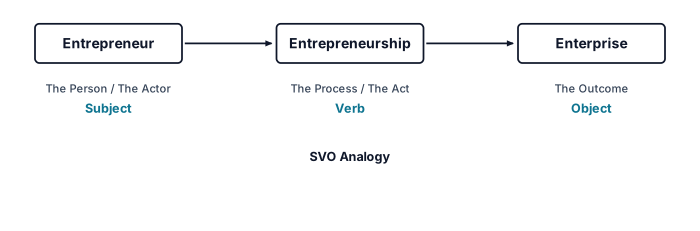
Entrepreneurship is the process of setting up one's own business, as distinct from pursuing any other economic activity such as taking up employment or practising a profession. The person who sets up the business is called an entrepreneur, and the output of the process — the business unit itself — is called an enterprise. A simple way to keep these three terms apart is to line them up against the subject-verb-object relationship of English grammar.
Drawn by us to help you understand the concept clearly, and verified to make sure it's accurate. For exams, practice from your textbook's own diagram.
Our own recreation of the book's SVO analogy. The three terms are best understood through the subject-verb-object relationship in English grammar: the entrepreneur is the Subject — the person / the actor; entrepreneurship is the Verb — the process / the act of setting up the business; and the enterprise is the Object — the outcome of the process, the business unit that is created.
Entrepreneurship does more than provide self-employment to the entrepreneur. By creating and expanding opportunities, it is also responsible to a great extent for the other two economic activities — employment and profession. Every new business gives rise to still more businesses: the suppliers of raw materials and components, and the service providers in transport, courier, telecom, distribution, advertising, accounting and legal services. In this way entrepreneurship becomes crucial for the overall economic development of a nation.
It is interesting that, despite this important role, not many people opt for a career in entrepreneurship. Traditionally it was believed that entrepreneurs are born. But no society can wait for the chance 'birth' of entrepreneurs to pursue its development plans. Entrepreneurship development is therefore treated as a deliberate process of making people aware of entrepreneurship as a career at an early age and creating situations in which they may actually choose to become entrepreneurs. When you make that choice you become a job-provider rather than a job-seeker, besides enjoying a host of other financial and psychological rewards — so taking to entrepreneurship is more a matter of aspiring to become an entrepreneur than of being born as one.
This chapter of the NCERT Class 12 Business Studies course explains the meaning and characteristics of entrepreneurship, its relationship with management, the need for entrepreneurship, the roles and functions of entrepreneurs, the process of entrepreneurship development, intellectual property rights, and the competencies, motivations, values and attitudes that lie behind entrepreneurial success.
Entrepreneurship Development was the last chapter of the older NCERT Class 12 Business Studies textbook and was later removed from the CBSE syllabus during the 2023-24 rationalisation. These notes are kept for reference and revision.