Biology · Ch 6 — Molecular Basis of Inheritance
The Lac Operon
The Lac Operon
The lac operon was the first transcriptionally regulated system to be understood, and its discovery came from the close collaboration of geneticist Francois Jacob and biochemist Jacque Monod. The word lac stands for lactose. In this system, a polycistronic structural gene — a single stretch of DNA that codes for multiple proteins — is controlled by a common promoter and by regulatory genes. This kind of arrangement is very common in bacteria and is called an operon. Other examples include the trp operon, ara operon, his operon, and val operon.
Components of the lac operon
The lac operon has one regulatory gene and three structural genes.
- Regulatory gene (the i gene): The letter i stands for inhibitor, not inducer. This gene codes for the repressor protein of the lac operon. The repressor is synthesised all the time — it is produced constitutively.
- Structural gene z: Codes for the enzyme beta-galactosidase (β-gal). This enzyme is primarily responsible for breaking down the disaccharide lactose into its monomers, glucose and galactose.
- Structural gene y: Codes for permease, a protein that increases the permeability of the bacterial cell to β-galactosides (including lactose).
- Structural gene a: Codes for a transacetylase.
All three gene products are needed together for the metabolism of lactose. In most operons, the genes present function in the same or a related metabolic pathway.
How lactose acts as an inducer
Lactose is the substrate for the enzyme beta-galactosidase, but it also regulates the switching on and off of the operon. For this reason, lactose is called the inducer.
In the absence of a preferred carbon source like glucose, if lactose is provided in the growth medium, the following happens:
- A very low, basal level of expression of the lac operon must always be present in the cell. Otherwise, lactose cannot even enter the cell. This basal expression provides a small amount of permease to transport lactose inside.
- Once inside, lactose (or its isomer allolactose) acts as the inducer.
- The repressor protein, which is always being made from the i gene, normally binds to the operator region of the operon. This binding physically blocks RNA polymerase from transcribing the structural genes.
- When the inducer is present, it binds to the repressor protein. This interaction inactivates the repressor, changing its shape so it can no longer bind to the operator.
- With the operator free, RNA polymerase gains access to the promoter, and transcription of the z, y, and a genes proceeds.
This system can be thought of as the regulation of enzyme synthesis by its substrate. The substrate (lactose) triggers the production of the enzymes that will break it down.
Important points about regulation …
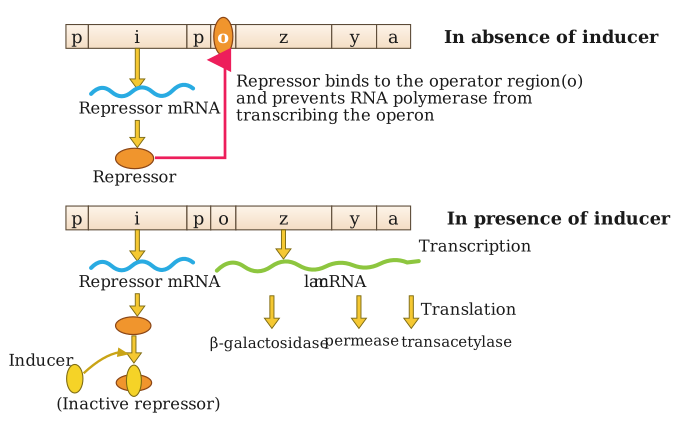
Drawn by us to help you understand the concept clearly, and verified to make sure it's accurate. For exams, practice from your textbook's own diagram.
The figure shows the lac operon as a linear stretch of bacterial DNA, with the regulatory and structural genes drawn as labelled boxes along the DNA line. The i gene (the regulatory gene, coding for the repressor) is placed to the left, followed by the promoter (where RNA polymerase binds), then the operator (where the repressor protein binds), and finally the three structural genes in order: z (β-galactosidase), y (permease), and a (transacetylase). The figure is divided into two panels to show the two states of the operon.
In the upper panel (operon switched off), the repressor protein — synthesised from the i gene — is shown as a small shape bound directly to the operator region. This binding physically blocks RNA polymerase from moving past the promoter into the structural genes, so transcription of z, y, and a does not occur. No mRNA or enzyme products are shown in this panel.
In the lower panel (operon switched on), the inducer — lactose (or its isomer allolactose) — is drawn as a small molecule binding to the repressor protein. This binding changes the repressor’s shape, inactivating it and causing it to fall off the operator. With the operator now free, RNA polymerase can bind the promoter and transcribe the three structural genes as a single polycistronic mRNA. The figure typically shows an arrow from the promoter through z, y, and a to indicate active transcription, and the resulting mRNA is depicted as a wavy line. The three enzyme products (β-galactosidase, permease, transacetylase) are then shown being synthesised from this mRNA. …