Chemistry · Ch 10 — Haloalkanes and Haloarenes
Nomenclature
Nomenclature
Halogenated hydrocarbons are named in two parallel systems — the older common (trivial) names, still widely used in the laboratory, and the systematic IUPAC names built on the parent-hydrocarbon rules learnt earlier. Both survive side by side in practice, so it helps to be fluent in reading either one.
Common Names
In the common-name system, a haloalkane is named by first naming the alkyl group attached to the halogen and then adding the name of the halide (chloride, bromide, iodide or fluoride) as a separate word. The "isopropyl"/"isobutyl" piece of the name describes the branching of the carbon skeleton exactly as it does for the corresponding alcohol or hydrocarbon (see the table below). This pattern extends to the more heavily branched skeletal names such as sec-, tert- and neo-, each simply describing how the carbon bearing (or adjacent to) the halogen is branched.
The book introduces the two systems side by side with three worked examples, printed exactly like this:
| Common name: n-Propyl bromide | Isopropyl chloride | Isobutyl chloride |
| IUPAC name: 1-Bromopropane | 2-Chloropropane | 1-Chloro-2-methylpropane |
| Structure | Common name | IUPAC name |
|---|---|---|
| sec-Butyl chloride | 2-Chlorobutane | |
| neo-Pentyl bromide | 1-Bromo-2,2-dimethylpropane | |
| tert-Butyl bromide | 2-Bromo-2-methylpropane | |
| Vinyl chloride | Chloroethene | |
| Allyl bromide | 3-Bromopropene | |
| o- | o-Chlorotoluene | 1-Chloro-2-methylbenzene or 2-Chlorotoluene |
| Benzyl chloride | Chlorophenylmethane | |
| Methylene chloride | Dichloromethane | |
| Chloroform | Trichloromethane | |
| Bromoform | Tribromomethane | |
| Carbon tetrachloride | Tetrachloromethane | |
| n-Propyl fluoride | 1-Fluoropropane |
The real Table 6.1 draws the two aryl halides in the table as ring structures — here they are, drawn out, so the condensed formulas above have a visual anchor: …
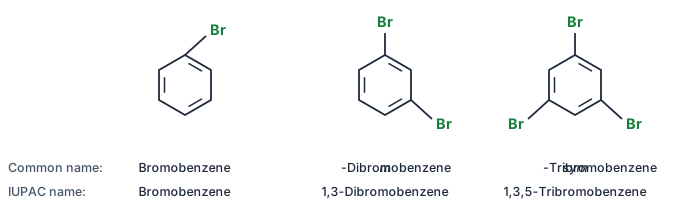
For a benzene ring carrying a single halogen, the common name and the IUPAC name coincide — both are simply built as halobenzene, e.g. is bromobenzene either way. Once a second halogen (or substituent) is added to the ring, the common system falls back on the familiar ortho- (o-), meta- (m-) and para- (p-) prefixes to describe relative ring positions, while a symmetrically trisubstituted ring is labelled sym-.
Drawn by us to help you understand the concept clearly, and verified to make sure it's accurate. For exams, practice from your textbook's own diagram.
A single halogen on a benzene ring needs no locant (bromobenzene serves as both the common and IUPAC name). Once a second halogen is added, the common system falls back on ortho/meta/para; a third halogen at the symmetric 1,3,5 positions is labelled sym- -- exactly the naming pattern this platform's own IUPAC names (1,3-di …
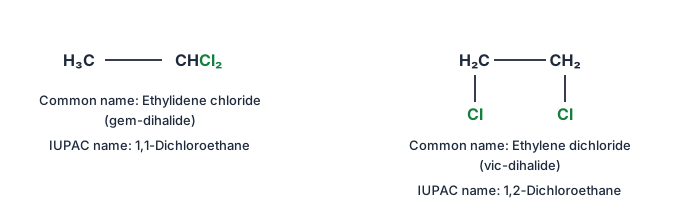
A dihaloalkane in which both halogen atoms sit on the very same carbon is called a gem-dihalide (from "geminal") in the common system, and is named as an alkylidene halide — for instance is ethylidene chloride.
A dihaloalkane in which the two halogens sit on adjacent carbons is called a vic-dihalide (from "vicinal"), and is named as an alkylene dihalide — for instance is ethylene dichloride.
Drawn by us to help you understand the concept clearly, and verified to make sure it's accurate. For exams, practice from your textbook's own diagram.
CH3CHCl2, both Cl atoms on the same carbon, is a gem-dihalide (common name ethylidene chloride, IUPAC 1,1-dichloroethane). ClCH2CH2Cl, Cl atoms on adjacent carbons, is a vic-dihalide (common name ethylene d …
IUPAC Names of Haloalkanes
The IUPAC system treats a halogen exactly like any other substituent on a hydrocarbon skeleton: the compound is named as a halo-substituted hydrocarbon rather than being given a distinct "halide" identity. The naming procedure follows the same logic used for substituted alkanes generally.
- Identify the longest continuous carbon chain that includes the carbon bearing the halogen atom; this becomes the parent chain, and it is named after the corresponding alkane.
- Number the parent chain from whichever end gives the substituent(s) the lowest possible locant(s), considering all substituents together as a set — not just the halogen.
- Cite the halogen as a prefix using the appropriate form — fluoro, chloro, bromo or iodo — placed in front of the locant that fixes its position on the chain.
- When more than one kind of substituent is present (say, a halogen together with an alkyl branch), the prefixes are listed alphabetically in the name, while the locants are still chosen to keep the overall numbering as low as possible.
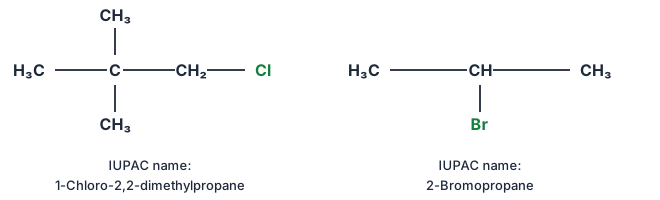
Applying this to the common-name examples above: , numbered from the end nearer the bromine, becomes 1-bromopropane; becomes 2-chloropropane, since the chlorine sits on the middle (second) carbon of propane; and becomes 1-chloro-2-methylpropane, where the chlorine fixes carbon-1, the branching methyl group fixes carbon-2, and the two prefixes "chloro" and "methyl" are already in alphabetical order. A more heavily branched case, , is named 1-chloro-2,2-dimethylpropane, with the two identical methyl branches on carbon-2 combined under the single "dimethyl" prefix, still alphabetised as chloro before methyl.
Drawn by us to help you understand the concept clearly, and verified to make sure it's accurate. For exams, practice from your textbook's own diagram.
(CH3)3C-CH2-Cl (neopentyl chloride) is IUPAC-named 1-chloro-2,2-dimethylpropane: the two identical methyl branches on carbon-2 combine under one 'dimethyl' prefix. (CH3)2CH-Br (isopropyl bromide) is 2-bromopropane. The real NCERT page gives only an IUPAC …
IUPAC Names of Haloarenes
For a benzene ring, the halogen is again treated as a ring substituent and named with the same halo- prefix. A single halogen on the ring needs no locant, since there is only one possible position relative to the point of attachment — hence bromobenzene serves as both the common and the IUPAC name. …