Q.What is peptization?
🔒You're viewing a preview — the full solution, concept, methods & PYQ mapping are locked.
🔒 Start your 14-day free trial to unlock the full solution →Concept understanding — Preparation and Purification of Colloids
Colloidal sols are made and cleaned by special methods because their particle size lies between true solutions and suspensions.
Preparation of lyophobic sols:
- Chemical methods — double decomposition, oxidation, reduction or hydrolysis (e.g. hydrolysis of FeCl3 gives a red hydrated ferric oxide sol).
- Electrical disintegration (Bredig's arc method) — an arc struck between metal electrodes in the medium vaporises and condenses the metal into a sol (for Au, Ag, Pt).
- Peptisation — converting a fresh precipitate back into a colloid by adding a suitable electrolyte (the peptising agent).
Purification of colloids (to remove excess electrolyte which would coagulate the sol): …
Peptization describes a specific way of converting a freshly formed precipitate back into a colloidal sol. …
Peptization = dispersing a fresh precipitate into a colloidal solution using a small amount of electrolyte.
Peptization is the process by which a freshly prepared precipitate is converted into a colloidal sol by shaking it with a small quantity of a suitable electrolyte, called the peptizing agent.
Mechanism: the particles of the precipitate preferentially adsorb one type of ion from the added electrolyte on their surface. This gives every particle the same kind of charge. Like charges repel one another, so the large aggregate breaks up into much smaller, dispersed colloidal particles.
…
- CBSE 2025Set ANNUAL1 markQ.What is peptization?
›Reveal solutionSolution
Peptization converts a precipitate into a colloidal sol using a small amount of electrolyte that gets preferentially adsorbed on the precipitate particles.
When a precipitate is freshly formed, its particles can be dispersed into a stable colloidal sol by shaking it with a small quantity of a suitable electrolyte (called the peptizing agent), rather than water alone.
How it works:
- Ions of the added electrolyte are preferentially adsorbed on the surface of the precipitate particles.
- This adsorption gives every particle a common (like) surface charge.
- The particles now repel one another electrostatically instead of clumping together, so the precipitate breaks up into colloidal-sized particles that stay dispersed in the liquid. …
- CBSE 2024Set ANNUAL1 markQ.Draw a neat labeled diagram for the preparation of metal sols by Bredig's Arc method.
›Reveal solutionSolution
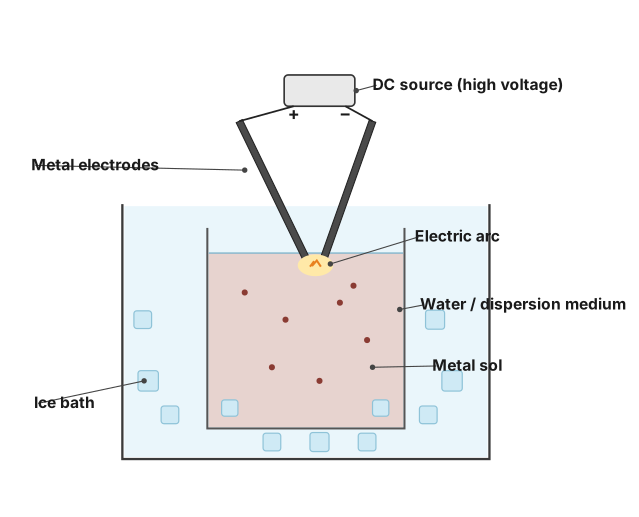
Figure — Labelled Bredig's arc (electrical-dispersion) apparatus for preparing metal sols. Two metal electrod Bredig's Arc method disperses a metal into colloidal particles using an electric arc struck under the dispersion medium.
Two rods of the metal (e.g. gold, silver, or platinum) are used as electrodes and dipped into the dispersion medium (usually water), which is kept cold by surrounding the container in an ice bath. A high-voltage electric arc is struck between the two electrode tips just below the liquid surface. The intense heat of the arc vaporises a little of the metal at the electrode tips; these hot metal atoms then come into contact with the surrounding cold liquid and condense immediately, forming very fine colloidal metal particles dispersed throughout the medium. This method combines dispersion (arcing/vaporising the bulk metal) and condensation (rapid cooling of the vapour) in a single step, and is used to prepare sols of metals like Ag, Au, and Pt.
…
- CBSE 2023Set F1 markMCQQ.By which of the following processes colloidal sols are purified?(a) Peptisation(b) Coagulation(c) Dialysis(d) Flocculation
›Reveal solutionSolution
Colloidal sols are purified by dialysis — option (C).
A freshly prepared sol often contains dissolved electrolyte impurities. Dialysis removes them: the sol is placed in a parchment/cellophane bag suspended in running water. The small ions and molecules diffuse out through the semi-permeable membrane, while the larger colloidal particles are retained, giving a purified sol. (Electro-dialysis speeds this up using an electric field.)
…
- CBSE 2023Set ANNUAL1 markQ.Draw labeled diagram of electro-dialysis.
›Reveal solutionSolution
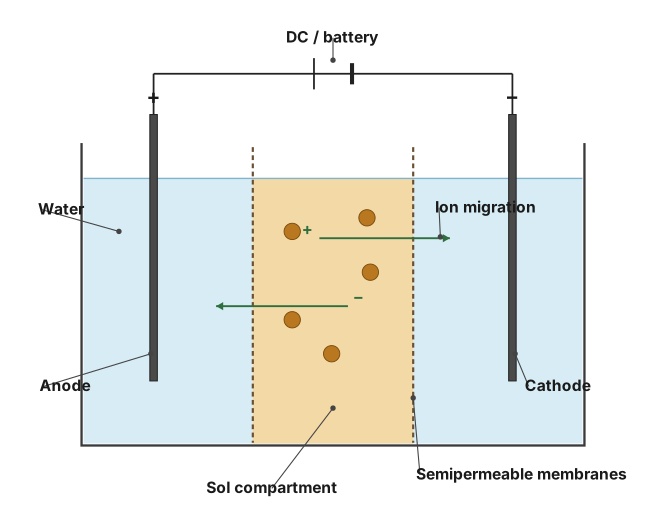
Figure — Labelled electrodialysis apparatus. A central compartment holding the impure colloidal sol is enclos Electrodialysis is ordinary dialysis assisted by an applied electric field, which makes the removal of electrolyte impurities from a colloidal sol much faster.
Apparatus/diagram description (labelled parts):
- A parchment paper (or cellophane) membrane bag containing the impure colloidal solution (sol + dissolved electrolyte ions) is suspended in a large vessel of pure/distilled water.
- Two metal electrodes (a cathode and an anode) are dipped into the outer water on either side of the membrane bag, connected to a DC source (battery).
- The membrane is a semi-permeable membrane: small electrolyte ions can pass through its pores, but the large colloidal particles cannot.
- When the electric field is switched on, the cations in the impure sol migrate through the membrane towards the cathode, and the anions migrate through the membrane towards the anode, both moving out into the surrounding water much faster than by ordinary diffusion alone. …
- CBSE 2020Set ANNUAL1 markQ.Draw a labelled diagram of electrical dispersion method for preparation of colloidal solution.
›Reveal solutionSolution
Figure — Labelled Bredig's arc (electrical-dispersion) apparatus for preparing metal sols. Two metal electrod Electrical dispersion (Bredig's arc method) makes a metal colloidal sol by vaporising metal electrodes with an electric arc struck under the dispersion medium.
This method is used to prepare colloidal sols of metals such as gold, silver and platinum, and combines dispersion and condensation.
Setup (described, since only text output is possible here):
- A glass vessel is filled with the dispersion medium (usually water), containing a trace of an electrolyte such as KOH to stabilise the colloid.
- The vessel is kept in an ice bath to keep the liquid cold.
- Two metal rods (of the metal to be dispersed) are immersed in the liquid, close to each other, connected to a source of high-voltage DC current — these act as the two electrodes.
- An electric arc is struck between the submerged electrode tips.
Process: …
- CBSE 2020Set ANNUAL1 markMCQQ.Bredig's arc method is used to prepare which of the following sol?(a) Silver sol(b) Gelatine sol(c) CdS sol(d) As2S3 sol
›Reveal solutionSolution
Bredig's arc method is an electrical dispersion method used to prepare sols of metals such as silver, gold and platinum.
In Bredig's arc method, an electric arc is struck between electrodes of the metal (e.g. silver) immersed in the dispersion medium (water), cooled in an ice bath. The intense heat of the arc vaporises some of the metal, and the vapour condenses immediately in the cold surrounding liquid to form colloidal-sized particles, giving a colloidal sol of the metal.
…
- CBSE 2018Set ANNUAL1 markQ.Draw a labelled diagram of dialysis method, for purification of colloidal solutions.
›Reveal solutionSolution
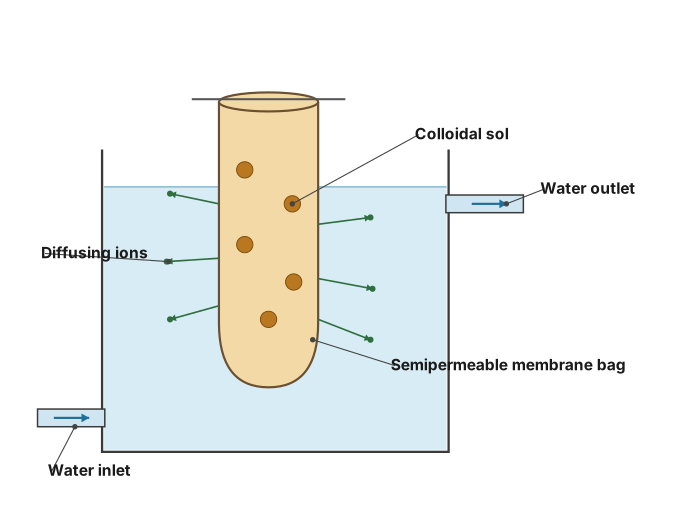
Figure — Labelled dialysis apparatus for purifying a colloidal sol. An outer vessel with a fresh-water inlet Dialysis purifies a colloidal solution by letting dissolved crystalloid impurities (ions, small molecules) diffuse out through a semipermeable membrane while the larger colloidal particles are held back.
Principle: The pores of a semipermeable membrane (parchment paper or cellophane) are large enough to allow small ions/molecules (crystalloids, e.g. NaCl) to pass through by diffusion, but too small to allow the much larger colloidal particles to pass.
Set-up/diagram description (since no image can be drawn here):
- A bag made of a semipermeable membrane (parchment paper/cellophane) containing the impure colloidal sol is tied and suspended inside a larger vessel.
- Fresh water is continuously passed into the outer vessel (through an inlet near the bottom) and the water carrying the diffused-out impurities is continuously drained out (through an outlet near the top), i.e. water keeps flowing around the bag. …
🎓Unlock everything free for 14 days
- ✓Full step-by-step solutions
- ✓Concept-first explanations
- ✓Methods, shortcuts & mistakes
- ✓PYQ mapping + timed mock tests
Full access for 14 days. No credit card required.