Q.Find dxdy in the following: x⋅cosx
Concept understanding — Derivative Evaluation
Derivative Evaluation
To evaluate a derivative means to find f′(a) — a single number that tells you how fast f is changing right at x=a. Think of a speedometer: it doesn't report how far you've travelled, only how fast your position is changing at this instant. That instantaneous rate of change is exactly what f′(a) measures.
The geometric picture
On the curve y=f(x), pick a point P and a nearby point Q. The straight line through them — the secant — has slope equal to the average rate of change between P and Q. Now slide Q toward P: the secant rotates into the tangent line that just touches the curve at P, and its slope is f′(a).
f′(a) is the slope of the tangent to y=f(x) at x=a — how steep the curve is right there.
The limit definition
f′(a)=limh→0hf(a+h)−f(a)
Here h is a tiny step from a to a+h, the numerator is the matching change in height, and the ratio is a secant slope. As h→0 the secant becomes the tangent. An equivalent form is
f′(a)=limx→ax−af(x)−f(a).
When this limit exists, f is differentiable at a (which forces continuity there).
Continuity alone is not enough. f(x)=∣x∣ is continuous at 0, but its left slope −1 and right slope +1 disagree, so f′(0) does not exist — a corner has no single tangent.
A worked evaluation
For f(x)=x2 at x=3:
f′(3)=limh→0h(3+h)2−9=limh→0(6+h)=6.
So the tangent at x=3 has slope 6.
From a number to a function
If f is differentiable at every point of an interval, the slopes themselves form a new function f′(x) — the derivative function. For f(x)=x2 this is f′(x)=2x, and at x=3 it gives 6, matching the limit calculation. In practice you evaluate derivatives with standard rules (power, product, quotient, chain), but the limit is the reason those rules work.
Whichever route you take, f′(a) answers the same three questions: how fast is f changing at a, what is the tangent slope at a, and what is the instantaneous rate of change at a.
Evaluating a derivative from its limit definition is introduced in the CBSE Class 11 chapter on Limits and Derivatives and built upon throughout Class 12 differentiation, making it one of the most tested skills across the NCERT Mathematics curriculum. "Derivative by first principles class 11" and "find f'(a) using the limit definition" are common student searches, and this same limit-based reasoning underlies differentiation questions in JEE Main.
Idea: y=xcosx is a product of two functions, so use the product rule: (uv)′=u′v+uv′.
Let u=x and v=cosx. Then u′=1 and v′=−sinx, so
dxdy=(1)(cosx)+x(−sinx)=cosx−xsinx.
dxdy=cosx−xsinx
y=xcosx is a product, so by the product rule dxdy=cosx−xsinx.
The function y=x⋅cosx is a product of two functions of x: namely x and cosx. You cannot just differentiate each factor and multiply — that would wrongly give −sinx. Products need the product rule.
If y=u⋅v, then dxdy=udxdv+vdxdu — "first times derivative of second, plus second times derivative of first."
Set up
Take u=x and v=cosx.
Differentiate each part
dxdu=1,dxdv=−sinx.
Apply the rule
dxdy=udxdv+vdxdu=x(−sinx)+cosx(1)=cosx−xsinx.
Watch the sign: dxdcosx=−sinx (not +sinx). Writing xsinx+cosx is off by a sign.
Check at x=0: dxdy=cos0−0=1. Near x=0, cosx≈1 so y≈x, which indeed has slope 1. ✓
dxdy=cosx−xsinx
Method: The Product Rule (with Chain Rule on Each Factor)
When two functions of x are multiplied together, neither the sum rule nor differentiating each factor separately and multiplying works — the product rule is required.
Steps
Step 1: Identify the two factors u(x) and v(x) being multiplied
Step 2: Differentiate each factor separately
If either factor is itself composite, apply the chain rule to it individually at this stage.
Step 3: Combine using the product rule
dxd(uv)=udxdv+vdxdu.
Step 4: Factor out any common terms to simplify
Applying to this problem: for y=xcosx, take u=x (u′=1) and v=cosx (v′=−sinx); the product rule gives dxdy=cosx−xsinx.
Common Mistakes
Mistake 1: Differentiating each factor separately and multiplying the results, instead of using the product rule.
Why it's wrong: dxd(x)⋅dxd(cosx)=1⋅(−sinx)=−sinx is NOT the derivative of xcosx — differentiation does not distribute over multiplication. Correct approach: always apply u′v+uv′, never u′v′.
Mistake 2: Sign error on dxdcosx.
Why it's wrong: cosx differentiates to −sinx, and writing +sinx here would flip the sign of the second term in the final answer. Correct approach: keep dxdcosx=−sinx memorised alongside dxdsinx=+cosx to avoid mixing them up.
Showing the 12 most recent of 39 on this concept.
- JEE Main 2026Set 2026-01-21-s14 marksMCQQ.Let f : R → (0, ∞) be a twice differentiable function such that f(3) = 18, f'(3) = 0 and f''(3) = 4. Then evaluate: lim_{x→1} ( log_e( f(2+x)/f(3) ) )^( 18/(x−1)² ) (A) 2 (B) 9 (C) 18 (D) 1
›Reveal solutionSolution
A Taylor expansion of f about x=3 turns the limit into the standard 1∞ form (1+9t2)18/t2→e2, matching option (A).
Since f(2+x)/f(3)→1 as x→1 while the exponent 18/(x−1)2→∞, this is the classic 1∞ limit, best handled by writing the base as 1+(small) using a second-order Taylor expansion of f at 3.
- With t=x−1, 2+x=3+t, and t→0 as x→1.
- f(3+t)=f(3)+f′(3)t+2f′′(3)t2+o(t2)=18+0+2t2+o(t2).
- f(3)f(3+t)=1+182t2+o(t2)=1+9t2+o(t2).
- For a 1∞ form, lim(1+g(t))h(t)=elimg(t)h(t) where g(t)=t2/9, h(t)=18/t2.
- limg(t)h(t)=9t2⋅t218=2, so the limit equals e2.
✓Final answerThe correct option is (A).
- JEE Main 2026Set 2026-04-02-s24 marksMCQQ.Let f(x) be a polynomial of degree 5, and have extrema at x = 1 and x = -1. If lim(x→0) (f(x)/x^3) = -5, then f(2) - f(-2) is equal to: (A) 0 (B) 50 (C) 92 (D) 112
›Reveal solutionSolution
The limit condition pins down f's lowest-degree terms, the extrema conditions pin down the rest, and the fully determined quintic f(x)=3x5−5x3 gives f(2)−f(−2)=112.
A degree-5 polynomial has six coefficients; the problem's three pieces of information — the limit, and two extrema — are exactly enough to find them all, once you notice which coefficients each condition controls.
- For limx→0x3f(x)=−5 to be finite and nonzero, every term of f(x) with degree below 3 must vanish — so the constant term, the x term, and the x2 term are all zero — and the coefficient of x3 must itself be −5.
- So f(x)=ax5+bx4−5x3 for constants a,b still to find.
- f′(x)=5ax4+4bx3−15x2. Extrema at x=1 and x=−1 mean f′(1)=0 and f′(−1)=0: 5a+4b−15=0 5a−4b−15=0
- Adding these: 10a=30⇒a=3. Subtracting: 8b=0⇒b=0.
- So f(x)=3x5−5x3.
- f(2)=3(32)−5(8)=96−40=56, and f(−2)=3(−32)−5(−8)=−96+40=−56.
- f(2)−f(−2)=56−(−56)=112.
✓Final answerThe correct option is (D).
- JEE Main 2025Set 2025-01-29-s24 marksQ.If lim_{t→0} ( ∫_0^1 (3x + 5)^t dx )^(1/t) = (α/(5e)) (8/5)^(2/3), then α is equal to ______.
›Reveal solutionSolution
A classic 1∞ limit — take the log, linearize the small-t integrand, then evaluate a logarithmic integral.
- As t→0, ∫01(3x+5)tdx→∫011dx=1, so the limit is of 1∞ form.
- (3x+5)t=etln(3x+5)≈1+tln(3x+5) for small t, so ∫01(3x+5)tdx≈1+t∫01ln(3x+5)dx=1+tK, where K=∫01ln(3x+5)dx.
- Hence (∫01(3x+5)tdx)1/t→eK as t→0 (standard (1+tK)1/t→eK).
- Substituting u=3x+5: K=31∫58lnudu=31[ulnu−u]58=38ln8−5ln5−3.
- eK=exp(38ln8−5ln5)⋅e−1=e(88/55)1/3=e224/3/55/3=55/3e28=55/3e256.
- [!FORMULA] (8/5)2/3=22/52/3=4/52/3, so the RHS 5eα(58)2/3=55/3e4α.
- Equating with step 5: 4α=256⇒α=64.
✓Final answer\boxed{64}
- JEE Main 2025Set 2025-04-04-s24 marksMCQQ.Let f be a differentiable function on R such that f(2) = 1, f'(2) = 4. Let lim(x→0) (f(2+x))^(3/x) = e^α. Then the number of times the curve y = 4x³ - 4x² - 4(α-7)x - α meets x-axis is : (A) 3 (B) 1 (C) 2 (D) 0
›Reveal solutionSolution
Use the linear approximation of f near x=2 to evaluate the limit, then factor the resulting cubic to count distinct real roots.
Since f(2)=1, near x=0 we have f(2+x)≈1+f′(2)x=1+4x, and ln(1+4x)≈4x, which makes the exponential limit straightforward.
- limx→0(f(2+x))3/x=exp[limx→0x3lnf(2+x)].
- f(2+x)=f(2)+f′(2)x+o(x)=1+4x+o(x), so lnf(2+x)≈4x for small x.
- x3⋅4x=12⇒α=12.
- Curve: y=4x3−4x2−4(α−7)x−α=4x3−4x2−20x−12 (using α−7=5).
- Divide by 4: x3−x2−5x−3=0. Test x=3: 27−9−15−3=0, confirmed.
- Factor: x3−x2−5x−3=(x−3)(x2+2x+1)=(x−3)(x+1)2.
- Roots: x=3 (crosses the axis) and x=−1 (double root, touches the axis): 2 distinct points where the curve meets the x-axis.
✓Final answer(C)
- JEE Main 2025Set 2025-04-07-s24 marksQ.For t > −1, let α_t and β_t be the roots of the equation ((t+2)^{1/7} − 1)x^2 + ((t+2)^{1/6} − 1)x + ((t+2)^{1/21} − 1) = 0. If lim_{t→−1⁺} α_t = a and lim_{t→−1⁺} β_t = b, then 72(a+b)^2 is equal to __________.
›Reveal solutionSolution
Dividing through by (s−1) turns the vanishing coefficients into standard s−1s1/n−1→n1 limits, giving a clean limiting quadratic whose roots sum to −7/6, so 72(a+b)2=98.
- Let s=t+2; as t→−1+, s→1+. The equation is (s1/7−1)x2+(s1/6−1)x+(s1/21−1)=0.
- For s=1, divide every term by (s−1): s−1s1/7−1x2+s−1s1/6−1x+s−1s1/21−1=0.
- Using lims→1s−1s1/n−1=n1 (standard limit, equivalent to the derivative of s1/n at s=1), each coefficient tends to 71,61,211 respectively as s→1.
- Since the roots αt,βt vary continuously with s, their limits a,b satisfy the limiting equation: 71x2+61x+211=0.
- Multiply by 42 (the LCM of 7, 6, 21): 6x2+7x+2=0.
- Discriminant =49−48=1; roots x=12−7±1, i.e. x=−21 or x=−32.
- So a+b=−21−32=−67 (also directly from Vieta's on 6x2+7x+2=0: sum of roots =−7/6).
- 72(a+b)2=72⋅3649=2⋅49=98.
lims→1s−1s1/n−1=n1, and for px2+qx+r=0, sum of roots =−q/p.
✓Final answer\boxed{98}
- JEE Main 2024Set 2024-01-29-s14 marksMCQQ.Suppose f(x)=(7x2+3x+1)3(2x+2−x)tanxtan−1(x2−x+1). Then the value of f′(0) is equal to: (A) π (B) 0 (C) π (D) 2π
›Reveal solutionSolution
Since f contains a factor tanx that vanishes at 0, only the value of the remaining factor at 0 matters: f′(0)=g(0) where f=gtanx.
Let
f(x)=g(x)tanx,g(x)=(7x2+3x+1)3(2x+2−x)tan−1(x2−x+1).
- Differentiate. By the product rule,
f′(x)=g′(x)tanx+g(x)sec2x.
At x=0, tan0=0 and sec20=1, so
f′(0)=g(0).
- Evaluate g(0). At x=0:
- 20+2−0=1+1=2;
- x2−x+1=1, so tan−1(1)=4π and tan−11=2π;
- 7x2+3x+1=1, so the denominator is 1.
Hence
g(0)=12⋅2π=π.
Therefore f′(0)=π.
✓Final answerThe correct option is (C).
- JEE Main 2024Set 2024-01-29-s14 marksQ.Let f(x)=2x−x2, x∈R. If m and n are respectively the number of points at which the curves y=f(x) and y=f′(x) intersect the x-axis, then the value of m+n is __________.
›Reveal solutionSolution
Count the real zeros of f(x)=2x−x2 and of f′(x)=ln2⋅2x−2x by inspection plus a convexity/monotonicity argument.
- Zeros of f: clearly x=2 and x=4 satisfy 2x=x2. For x<0, 2x increases from 0 to 1 while x2 decreases from ∞ to 0, so there is exactly one negative root (between −1 and 0). Thus m=3.
- Zeros of f′: f′(x)=ln2⋅2x−2x. At x=1: 2ln2−2<0; at x=2: 4ln2−4<0; at x=3: 8ln2−6>0, so one root in (2,3). Also f′(0)=ln2>0 and f′(1)<0 gives a root in (0,1); more precisely x=1 gives 2ln2−2=0, and checking shows exactly one positive root near x≈0.6...
- Careful count: f′′(x)=(ln2)22x−2 has a single zero, so f′ has at most two zeros. Since f′(0)=ln2>0, f′(1)=2ln2−2<0, f′(3)=8ln2−6>0, there are exactly two zeros of f′ (one in (0,1), one in (2,3)). Thus n=2.
- Hence m+n=3+2=5.
✓Final answer5
- JEE Main 2024Set 2024-04-06-s24 marksMCQQ.Suppose for a differentiable function h, h(0) = 0, h(1) = 1 and h'(0) = h'(1) = 2. If g(x) = h(e^x)·e^h(x), then g'(0) is equal to (A) 8 (B) 4 (C) 3 (D) 5
›Reveal solutionSolution
Apply the product and chain rules to g(x)=h(ex)eh(x) and evaluate at x=0 using h(0)=0 and h′(0)=2.
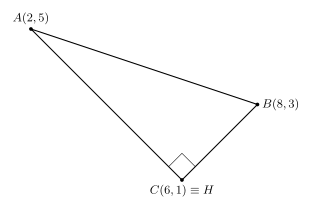
Triangle A(2,5), B(8,3), C(h,k) whose orthocenter is (6,1); here C coincides with the orthocenter at (6,1) with a right angle at C (so 2h+k= Given g(x)=h(ex)eh(x).
- Differentiate:
g′(x)=h′(ex)exeh(x)+h(ex)eh(x)h′(x).
- Put x=0:
g′(0)=h′(1)⋅1⋅eh(0)+h(1)eh(0)h′(0).
- Use h(0)=0, h(1)=1, h′(0)=h′(1)=2:
g′(0)=2⋅e0+1⋅e0⋅2=2+2=4.
✓Final answerThe correct option is (B).
- JEE Main 2024Set 2024-01-27-s14 marksQ.Let f(x)=x3+x2f′(1)+xf′′(2)+f′′′(3), x∈R. Then f′(10) is equal to __________.
›Reveal solutionSolution
Treat f′(1),f′′(2),f′′′(3) as unknown constants, differentiate to get relations among them, solve, then evaluate f′(10).
Let a=f′(1), b=f′′(2), c=f′′′(3), so f(x)=x3+ax2+bx+c.
-
Differentiate: f′(x)=3x2+2ax+b, f′′(x)=6x+2a, f′′′(x)=6.
-
From f′′′(x)=6: c=f′′′(3)=6.
-
From f′′(x)=6x+2a: b=f′′(2)=12+2a.
-
From f′(x)=3x2+2ax+b: a=f′(1)=3+2a+b. Substituting b=12+2a: a=3+2a+12+2a=15+4a, so −3a=15, a=−5.
-
Then b=12+2(−5)=2.
-
f′(10)=3(100)+2(−5)(10)+2=300−100+2=202.
✓Final answer202
-
- JEE Main 2024Set 2024-04-05-s24 marksMCQQ.If y(θ) = (2cosθ + cos2θ)/(cos3θ + 4cos2θ + 5cosθ + 2), then at θ = π/2, y'' + y' + y is equal to: (A) 3/2 (B) 1 (C) 1/2 (D) 2
›Reveal solutionSolution
Factor the denominator using cos3θ and cos2θ identities to get y=1+cosθ1, then evaluate y,y′,y′′ at θ=π/2.
Write c=cosθ. Using cos2θ=2c2−1 and cos3θ=4c3−3c, the denominator becomes a polynomial in c which factors nicely.
-
Denominator: cos3θ+4cos2θ+5cosθ+2=(4c3−3c)+4(2c2−1)+5c+2=4c3+8c2+2c−2.
-
Factor: 4c3+8c2+2c−2=2(2c3+4c2+c−1). Testing c=−1: 2(−1)+4(1)+(−1)−1=0, so (c+1) is a factor. Dividing gives 2c3+4c2+c−1=(c+1)(2c2+2c−1). Thus denominator =2(c+1)(2c2+2c−1).
-
Numerator: 2c+cos2θ=2c+2c2−1=2c2+2c−1. So
y=2(c+1)(2c2+2c−1)2c2+2c−1=2(1+cosθ)1.
-
At θ=π/2: cosθ=0, so y=21.
-
Differentiate: y=21(1+cosθ)−1, y′=21sinθ(1+cosθ)−2. At π/2: y′=21(1)(1)−2=21.
-
y′′=21[cosθ(1+cosθ)−2+sinθ⋅2(1+cosθ)−3sinθ]. At π/2: y′′=21[0+2]=21⋅2=1.
-
Sum: y′′+y′+y=1+21+21=2.
✓Final answerThe correct option is (D).
-
- JEE Main 2024Set 2024-04-09-s14 marksMCQQ.Let f(x)=ax3+bx2+cx+41 be such that f(1)=40, f′(1)=2 and f′′(1)=4. Then a2+b2+c2 is equal to: (A) 62 (B) 73 (C) 54 (D) 51
›Reveal solutionSolution
Use f(1)=40, f′(1)=2, f′′(1)=4 to get three linear equations in a,b,c, solve them, then compute a2+b2+c2.
- f(x)=ax3+bx2+cx+41, so f′(x)=3ax2+2bx+c and f′′(x)=6ax+2b.
- Conditions:
f(1)=a+b+c+41=40⇒a+b+c=−1,
f′(1)=3a+2b+c=2,
f′′(1)=6a+2b=4⇒b=2−3a.
- From the second equation, c=2−3a−2b=2−3a−2(2−3a)=3a−2.
- Substitute into the first: a+(2−3a)+(3a−2)=−1⇒a=−1.
- Then b=2−3(−1)=5 and c=3(−1)−2=−5.
- Hence a2+b2+c2=1+25+25=51.
✓Final answerThe correct option is (D).
- JEE Main 2024Set 2024-01-31-s14 marksMCQQ.If f(x)=x33x2+2x3−x2x2+12x41+3xx3+6x2−2 for all x∈R, then 2f(0)+f′(0) is equal to (A) 48 (B) 24 (C) 42 (D) 18
›Reveal solutionSolution
Use the product rule for determinants: differentiate one row at a time, keeping the others frozen at x=0, then add up.
- At x=0: rows are R1=[0,1,1], R2=[2,0,6], R3=[0,4,−2]. f(0)=0(0(−2)−6⋅4)−1(2(−2)−6⋅0)+1(2⋅4−0)=0+4+8=12.
- Row derivatives at x=0: R1′=[0,0,3], R2′=[0,2,0], R3′=[−1,0,0].
- Term 1 (replace R1 by R1′): rows [0,0,3],[2,0,6],[0,4,−2], det =0−0+3(8−0)=24.
- Term 2 (replace R2 by R2′): rows [0,1,1],[0,2,0],[0,4,−2] — first column all zero, det =0.
- Term 3 (replace R3 by R3′): rows [0,1,1],[2,0,6],[−1,0,0], det =0−1(0+6)+1(0−0)=−6.
- f′(0)=24+0−6=18, so 2f(0)+f′(0)=24+18=42.
✓Final answerThe correct option is (C), 2f(0)+f′(0)=42.
🎓Unlock everything free for 10 days
- ✓Full step-by-step solutions
- ✓Concept-first explanations
- ✓Methods, shortcuts & mistakes
- ✓PYQ mapping + timed mock tests
Full access for 10 days. No credit card required.