Q.If 𝑓(𝑥) = 𝑥 tan−1 𝑥 , then 𝑓′(1)is equal to
(A) 𝜋 4 − 1 2
(B) 𝜋 4 + 1 2
(C) − 𝜋 4 − 1 2
(D) − 𝜋 4 + 1 2
🔒You're viewing a preview — the full solution, concept, methods & PYQ mapping are locked.
🔒 Start your 10-day free trial to unlock the full solution →Concept understanding — Derivative Evaluation
Derivative Evaluation
To evaluate a derivative means to find f′(a) — a single number that tells you how fast f is changing right at x=a. Think of a speedometer: it doesn't report how far you've travelled, only how fast your position is changing at this instant. That instantaneous rate of change is exactly what f′(a) measures.
The geometric picture
On the curve y=f(x), pick a point P and a nearby point Q. The straight line through them — the secant — has slope equal to the average rate of change between P and Q. Now slide Q toward P: the secant rotates into the tangent line that just touches the curve at P, and its slope is f′(a).
f′(a) is the slope of the tangent to y=f(x) at x=a — how steep the curve is right there.
The limit definition
f′(a)=limh→0hf(a+h)−f(a)
Here h is a tiny step from a to a+h, the numerator is the matching change in height, and the ratio is a secant slope. As h→0 the secant becomes the tangent. An equivalent form is
f′(a)=limx→ax−af(x)−f(a).
When this limit exists, f is differentiable at a (which forces continuity there).
Continuity alone is not enough. f(x)=∣x∣ is continuous at 0, but its left slope −1 and right slope +1 disagree, so f′(0) does not exist — a corner has no single tangent.
A worked evaluation
For f(x)=x2 at x=3:
f′(3)=limh→0h(3+h)2−9=limh→0(6+h)=6.
So the tangent at x=3 has slope 6.
From a number to a function …
Concept: Derivative Evaluation – differentiate f(x)=xtan−1x using the product rule, then substitute x=1.
Step 1: Apply product rule:
f′(x)=(1)⋅tan−1x+x⋅1+x21.
Step 2: Simplify:
f′(x)=tan−1x+1+x2x.
Step 3: Substitute x=1: …
The derivative of f(x)=xtan−1x is found using the product rule. Evaluating at x=1 gives f′(1)=4π+21, which corresponds to option (B).
The key here is recognizing that f(x) is a product of two functions: x and tan−1x (inverse tangent, also written as arctanx). When you see a product, your first instinct should be the product rule — not expanding or simplifying, because there’s nothing to simplify here. The derivative of tan−1x is a standard result: dxdtan−1x=1+x21. That’s the only “tricky” part; everything else is straightforward algebra.
Let’s walk through it.
-
Apply the product rule.
For f(x)=u(x)⋅v(x), we have f′(x)=u′(x)v(x)+u(x)v′(x).
Here, let u(x)=x and v(x)=tan−1x.
Then u′(x)=1, and v′(x)=1+x21.
So:
f′(x)=(1)⋅tan−1x+x⋅1+x21=tan−1x+1+x2x.
- Evaluate at x=1. Substitute x=1 into the derivative:
f′(1)=tan−1(1)+1+121=tan−1(1)+21.
Now, tan−1(1) is the angle whose tangent is 1. That angle is 4π (since tan4π=1).
Therefore:
f′(1)=4π+21.
- Match with the options. The options are given as combinations of 4π and 21 with plus/minus signs. Our result 4π+21 exactly matches option (B). …
Method: Differentiating a Product Involving an Inverse Trigonometric Function
Use this method whenever f(x) is a product of a simple algebraic factor (like x) and an inverse trig function (like tan−1x, sin−1x, etc.), and you need f′(a) at a specific point.
Steps
Step 1: Recognize the product structure
Identify the two factors being multiplied, u(x) and v(x), so you know to reach for the product rule rather than trying to simplify the expression first (there is usually nothing to simplify before differentiating).
Step 2: Recall the standard derivative of the inverse trig factor
Memorize (or quickly re-derive) the standard results:
dxdtan−1x=1+x21,dxdsin−1x=1−x21,dxdcos−1x=1−x2−1. …
Common Mistakes
Mistake 1: Skipping the product rule
A student might try to differentiate xtan−1x as if it were a single function, or differentiate only the tan−1x part and ignore the leading x. Why it's wrong: whenever two functions of x are multiplied together, both factors contribute to the derivative through the product rule; dropping one term silently loses information. Correct approach: explicitly label u(x)=x and v(x)=tan−1x before differentiating, so both terms are accounted for.
Mistake 2: Confusing the derivative of tan−1x with the derivative of tanx …
Showing the 12 most recent of 39 on this concept.
- JEE Main 2026Set 2026-01-21-s14 marksMCQQ.Let f : R → (0, ∞) be a twice differentiable function such that f(3) = 18, f'(3) = 0 and f''(3) = 4. Then evaluate: lim_{x→1} ( log_e( f(2+x)/f(3) ) )^( 18/(x−1)² ) (A) 2 (B) 9 (C) 18 (D) 1
›Reveal solutionSolution
A Taylor expansion of f about x=3 turns the limit into the standard 1∞ form (1+9t2)18/t2→e2, matching option (A).
Since f(2+x)/f(3)→1 as x→1 while the exponent 18/(x−1)2→∞, this is the classic 1∞ limit, best handled by writing the base as 1+(small) using a second-order Taylor expansion of f at 3.
- With t=x−1, 2+x=3+t, and t→0 as x→1.
- f(3+t)=f(3)+f′(3)t+2f′′(3)t2+o(t2)=18+0+2t2+o(t2). …
- JEE Main 2026Set 2026-04-02-s24 marksMCQQ.Let f(x) be a polynomial of degree 5, and have extrema at x = 1 and x = -1. If lim(x→0) (f(x)/x^3) = -5, then f(2) - f(-2) is equal to: (A) 0 (B) 50 (C) 92 (D) 112
›Reveal solutionSolution
The limit condition pins down f's lowest-degree terms, the extrema conditions pin down the rest, and the fully determined quintic f(x)=3x5−5x3 gives f(2)−f(−2)=112.
A degree-5 polynomial has six coefficients; the problem's three pieces of information — the limit, and two extrema — are exactly enough to find them all, once you notice which coefficients each condition controls.
- For limx→0x3f(x)=−5 to be finite and nonzero, every term of f(x) with degree below 3 must vanish — so the constant term, the x term, and the x2 term are all zero — and the coefficient of x3 must itself be −5.
- So f(x)=ax5+bx4−5x3 for constants a,b still to find. …
- JEE Main 2025Set 2025-01-29-s24 marksQ.If lim_{t→0} ( ∫_0^1 (3x + 5)^t dx )^(1/t) = (α/(5e)) (8/5)^(2/3), then α is equal to ______.
›Reveal solutionSolution
A classic 1∞ limit — take the log, linearize the small-t integrand, then evaluate a logarithmic integral.
- As t→0, ∫01(3x+5)tdx→∫011dx=1, so the limit is of 1∞ form.
- (3x+5)t=etln(3x+5)≈1+tln(3x+5) for small t, so ∫01(3x+5)tdx≈1+t∫01ln(3x+5)dx=1+tK, where K=∫01ln(3x+5)dx.
- Hence (∫01(3x+5)tdx)1/t→eK as t→0 (standard (1+tK)1/t→eK).
- Substituting u=3x+5: K=31∫58lnudu=31[ulnu−u]58=38ln8−5ln5−3. …
- JEE Main 2025Set 2025-04-04-s24 marksMCQQ.Let f be a differentiable function on R such that f(2) = 1, f'(2) = 4. Let lim(x→0) (f(2+x))^(3/x) = e^α. Then the number of times the curve y = 4x³ - 4x² - 4(α-7)x - α meets x-axis is : (A) 3 (B) 1 (C) 2 (D) 0
›Reveal solutionSolution
Use the linear approximation of f near x=2 to evaluate the limit, then factor the resulting cubic to count distinct real roots.
Since f(2)=1, near x=0 we have f(2+x)≈1+f′(2)x=1+4x, and ln(1+4x)≈4x, which makes the exponential limit straightforward.
- limx→0(f(2+x))3/x=exp[limx→0x3lnf(2+x)].
- f(2+x)=f(2)+f′(2)x+o(x)=1+4x+o(x), so lnf(2+x)≈4x for small x.
- x3⋅4x=12⇒α=12.
- Curve: y=4x3−4x2−4(α−7)x−α=4x3−4x2−20x−12 (using α−7=5). …
- JEE Main 2025Set 2025-04-07-s24 marksQ.For t > −1, let α_t and β_t be the roots of the equation ((t+2)^{1/7} − 1)x^2 + ((t+2)^{1/6} − 1)x + ((t+2)^{1/21} − 1) = 0. If lim_{t→−1⁺} α_t = a and lim_{t→−1⁺} β_t = b, then 72(a+b)^2 is equal to __________.
›Reveal solutionSolution
Dividing through by (s−1) turns the vanishing coefficients into standard s−1s1/n−1→n1 limits, giving a clean limiting quadratic whose roots sum to −7/6, so 72(a+b)2=98.
- Let s=t+2; as t→−1+, s→1+. The equation is (s1/7−1)x2+(s1/6−1)x+(s1/21−1)=0.
- For s=1, divide every term by (s−1): s−1s1/7−1x2+s−1s1/6−1x+s−1s1/21−1=0.
- Using lims→1s−1s1/n−1=n1 (standard limit, equivalent to the derivative of s1/n at s=1), each coefficient tends to 71,61,211 respectively as s→1.
- Since the roots αt,βt vary continuously with s, their limits a,b satisfy the limiting equation: 71x2+61x+211=0.
- Multiply by 42 (the LCM of 7, 6, 21): 6x2+7x+2=0. …
- JEE Main 2024Set 2024-01-29-s14 marksMCQQ.Suppose f(x)=(7x2+3x+1)3(2x+2−x)tanxtan−1(x2−x+1). Then the value of f′(0) is equal to: (A) π (B) 0 (C) π (D) 2π
›Reveal solutionSolution
Since f contains a factor tanx that vanishes at 0, only the value of the remaining factor at 0 matters: f′(0)=g(0) where f=gtanx.
Let
f(x)=g(x)tanx,g(x)=(7x2+3x+1)3(2x+2−x)tan−1(x2−x+1).
- Differentiate. By the product rule,
f′(x)=g′(x)tanx+g(x)sec2x.
At x=0, tan0=0 and sec20=1, so
f′(0)=g(0).
- Evaluate g(0). At x=0:
- 20+2−0=1+1=2; …
- JEE Main 2024Set 2024-01-29-s14 marksQ.Let f(x)=2x−x2, x∈R. If m and n are respectively the number of points at which the curves y=f(x) and y=f′(x) intersect the x-axis, then the value of m+n is __________.
›Reveal solutionSolution
Count the real zeros of f(x)=2x−x2 and of f′(x)=ln2⋅2x−2x by inspection plus a convexity/monotonicity argument.
- Zeros of f: clearly x=2 and x=4 satisfy 2x=x2. For x<0, 2x increases from 0 to 1 while x2 decreases from ∞ to 0, so there is exactly one negative root (between −1 and 0). Thus m=3. …
- JEE Main 2024Set 2024-04-06-s24 marksMCQQ.Suppose for a differentiable function h, h(0) = 0, h(1) = 1 and h'(0) = h'(1) = 2. If g(x) = h(e^x)·e^h(x), then g'(0) is equal to (A) 8 (B) 4 (C) 3 (D) 5
›Reveal solutionSolution
Apply the product and chain rules to g(x)=h(ex)eh(x) and evaluate at x=0 using h(0)=0 and h′(0)=2.
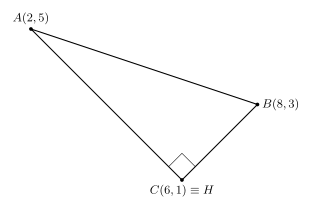
Triangle A(2,5), B(8,3), C(h,k) whose orthocenter is (6,1); here C coincides with the orthocenter at (6,1) with a right angle at C (so 2h+k= Given g(x)=h(ex)eh(x).
- Differentiate:
g′(x)=h′(ex)exeh(x)+h(ex)eh(x)h′(x).
- Put x=0: …
- JEE Main 2024Set 2024-01-27-s14 marksQ.Let f(x)=x3+x2f′(1)+xf′′(2)+f′′′(3), x∈R. Then f′(10) is equal to __________.
›Reveal solutionSolution
Treat f′(1),f′′(2),f′′′(3) as unknown constants, differentiate to get relations among them, solve, then evaluate f′(10).
Let a=f′(1), b=f′′(2), c=f′′′(3), so f(x)=x3+ax2+bx+c.
-
Differentiate: f′(x)=3x2+2ax+b, f′′(x)=6x+2a, f′′′(x)=6.
-
From f′′′(x)=6: c=f′′′(3)=6.
-
From f′′(x)=6x+2a: b=f′′(2)=12+2a. …
-
- JEE Main 2024Set 2024-04-05-s24 marksMCQQ.If y(θ) = (2cosθ + cos2θ)/(cos3θ + 4cos2θ + 5cosθ + 2), then at θ = π/2, y'' + y' + y is equal to: (A) 3/2 (B) 1 (C) 1/2 (D) 2
›Reveal solutionSolution
Factor the denominator using cos3θ and cos2θ identities to get y=1+cosθ1, then evaluate y,y′,y′′ at θ=π/2.
Write c=cosθ. Using cos2θ=2c2−1 and cos3θ=4c3−3c, the denominator becomes a polynomial in c which factors nicely.
-
Denominator: cos3θ+4cos2θ+5cosθ+2=(4c3−3c)+4(2c2−1)+5c+2=4c3+8c2+2c−2.
-
Factor: 4c3+8c2+2c−2=2(2c3+4c2+c−1). Testing c=−1: 2(−1)+4(1)+(−1)−1=0, so (c+1) is a factor. Dividing gives 2c3+4c2+c−1=(c+1)(2c2+2c−1). Thus denominator =2(c+1)(2c2+2c−1).
-
Numerator: 2c+cos2θ=2c+2c2−1=2c2+2c−1. So
y=2(c+1)(2c2+2c−1)2c2+2c−1=2(1+cosθ)1.
- At θ=π/2: cosθ=0, so y=21. …
-
- JEE Main 2024Set 2024-04-09-s14 marksMCQQ.Let f(x)=ax3+bx2+cx+41 be such that f(1)=40, f′(1)=2 and f′′(1)=4. Then a2+b2+c2 is equal to: (A) 62 (B) 73 (C) 54 (D) 51
›Reveal solutionSolution
Use f(1)=40, f′(1)=2, f′′(1)=4 to get three linear equations in a,b,c, solve them, then compute a2+b2+c2.
- f(x)=ax3+bx2+cx+41, so f′(x)=3ax2+2bx+c and f′′(x)=6ax+2b.
- Conditions:
f(1)=a+b+c+41=40⇒a+b+c=−1,
f′(1)=3a+2b+c=2,
f′′(1)=6a+2b=4⇒b=2−3a.
- From the second equation, c=2−3a−2b=2−3a−2(2−3a)=3a−2. …
- JEE Main 2024Set 2024-01-31-s14 marksMCQQ.If f(x)=x33x2+2x3−x2x2+12x41+3xx3+6x2−2 for all x∈R, then 2f(0)+f′(0) is equal to (A) 48 (B) 24 (C) 42 (D) 18
›Reveal solutionSolution
Use the product rule for determinants: differentiate one row at a time, keeping the others frozen at x=0, then add up.
- At x=0: rows are R1=[0,1,1], R2=[2,0,6], R3=[0,4,−2]. f(0)=0(0(−2)−6⋅4)−1(2(−2)−6⋅0)+1(2⋅4−0)=0+4+8=12.
- Row derivatives at x=0: R1′=[0,0,3], R2′=[0,2,0], R3′=[−1,0,0].
- Term 1 (replace R1 by R1′): rows [0,0,3],[2,0,6],[0,4,−2], det =0−0+3(8−0)=24. …
🎓Unlock everything free for 10 days
- ✓Full step-by-step solutions
- ✓Concept-first explanations
- ✓Methods, shortcuts & mistakes
- ✓PYQ mapping + timed mock tests
Full access for 10 days. No credit card required.