Q.Let be the set of all lines in a plane and be the relation in defined as . Show that is symmetric but neither reflexive nor transitive.
You're viewing a preview — the full solution, concept, methods & PYQ mapping are locked.
Start your 14-day free trial to unlock the full solution →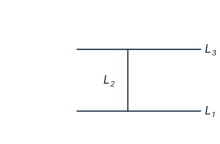
The relation "is perpendicular to" on lines in a plane is symmetric because if then , but it is not reflexive (no line is perpendicular to itself) and not transitive (if and , then is parallel to , not perpendicular).
Why This Approach Works
The question asks us to check three properties of a relation: reflexivity, symmetry, and transitivity. Each property has a precise definition, and we test the relation against each one using geometric facts about perpendicular lines.
The key geometric facts you need:
- A line is never perpendicular to itself (perpendicular means meeting at , which requires two distinct lines).
- Perpendicularity is mutual: if , then .
- If and , then and are parallel (or coincident), not perpendicular.
Let's test each property one by one.
1. Checking Reflexivity
Definition: A relation on a set is reflexive if every element is related to itself. That is, for every line , we must have .
For our relation, would mean is perpendicular to itself. But a line cannot be perpendicular to itself — perpendicularity requires two distinct lines intersecting at . A single line does not make an angle with itself.
A common mistake is to think a line is perpendicular to itself because "the angle is ". No — perpendicular means exactly , and a line with itself has (or ), not .
So for any line . Therefore, is not reflexive.
2. Checking Symmetry
Definition: is symmetric if whenever , then .
Suppose . This means is perpendicular to . But perpendicularity is a mutual relationship: if makes a angle with , then also makes a angle with . So is perpendicular to , which means .
Symmetry here is immediate from the definition of perpendicular — it's an "if and only if" relationship. No extra work needed.
Thus, is symmetric.
3. Checking Transitivity …
Unlock everything free for 14 days
- Full step-by-step solutions
- Concept-first explanations
- Methods, shortcuts & mistakes
- PYQ mapping + timed mock tests
Full access for 14 days. No credit card required.