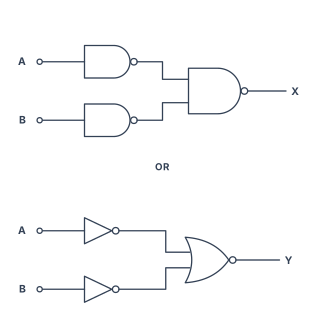
The AND Gate: The "All-or-Nothing" Gate
Imagine you are trying to start a car. Two things must happen: you must turn the key, and you must press the brake pedal. If either one is missing — you turn the key without pressing the brake, or you press the brake without the key — the engine stays off. Only when both actions happen together does the car start.
That is exactly what an AND gate does. It is the "all-or-nothing" gate: the output is 1 only when every single input is 1. If even one input is 0, the output is 0.
The Precise Statement
An AND gate takes two (or more) binary inputs — each either 0 (false, off) or 1 (true, on) — and produces one binary output. The rule is:
The dot (⋅) is the Boolean multiplication symbol. It does not mean ordinary arithmetic multiplication; it means logical AND. The output Y is 1 if and only if A=1 and B=1.
Truth Table (for two inputs)
| Input A | Input B | Output Y = A · B |
|---|
| 0 | 0 | 0 |
| 0 | 1 | 0 |
| 1 | 0 | 0 |
| 1 | 1 | 1 |
Only the last row — both inputs high — gives a high output.
Why "Multiplication"?
The name "AND" comes from everyday language: "I will go to the park if it is sunny and I have free time." Both conditions must be true. The symbol ⋅ (dot) is used because, in Boolean algebra, AND behaves like multiplication in ordinary arithmetic when you only use 0 and 1:
- 0×0=0
- 0×1=0
- 1×0=0
- 1×1=1
So A⋅B literally gives the same result as multiplying the two bits. That is why the AND gate is also called a product gate.
Do not confuse this with the OR gate, which outputs 1 if any input is 1. AND is stricter — it demands all inputs be 1.
More Than Two Inputs
An AND gate can have three, four, or more inputs. The rule stays the same: output is 1 only when every input is 1. For a 3-input AND gate:
Y=A⋅B⋅C
Truth table (abbreviated):
| A | B | C | Y |
|---|
| 0 | 0 | 0 | 0 |
| 0 | 0 | 1 | 0 |
| 0 | 1 | 0 | 0 |
| 0 | 1 | 1 | 0 |
| 1 | 0 | 0 | 0 |
| 1 | 0 | 1 | 0 |
| 1 | 1 | 0 | 0 |
| 1 | 1 | 1 | 1 |
Only the very last combination — all three inputs 1 — lights up the output.
Real-World Analogy …