Question
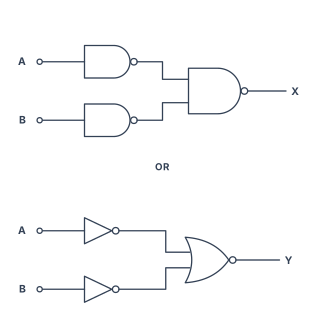
Q.Identify the equivalent gate for the circuit of a combination of gates shown in the figure. Write its symbol.
(OR)
Draw the logic symbol of the gate shown by the combination of gates and write its name.
CBSECBSE Class XII Board 2019Subjective· 1mImportance★★★★★
You're viewing a preview — the full solution, concept, methods & PYQ mapping are locked.
Start your 14-day free trial to unlock the full solution →Main question: three NAND gates arranged as NAND(A,A)=, NAND(B,B)=, then NAND() — by De Morgan's theorem this equals , an OR gate.
OR alternative: two NOT gates feeding a NOR gate give, by De Morgan's theorem, — an AND gate.
Main Question — three-NAND network
The real figure wires into one NAND gate with both its inputs tied together (so it outputs ), and similarly into a second NAND gate wired as an inverter (). These two inverted signals then feed a third NAND gate:
Apply De Morgan's theorem :
The output is exactly the OR operation, so this three-NAND combination behaves as one OR gate. …
Unlock everything free for 14 days
- Full step-by-step solutions
- Concept-first explanations
- Methods, shortcuts & mistakes
- PYQ mapping + timed mock tests
Full access for 14 days. No credit card required.