Geography · Ch 13 — Composition and Structure of Atmosphere
Structure of the Atmosphere
Structure of the Atmosphere
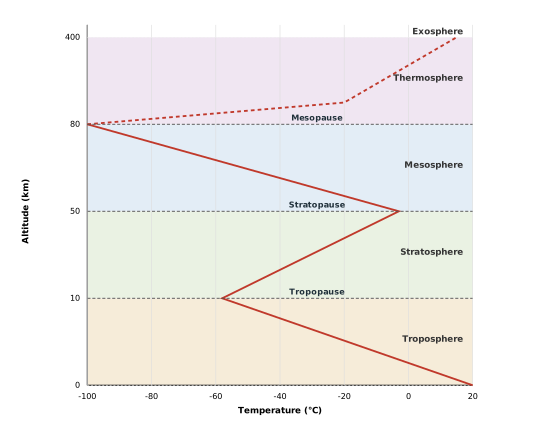
The diagram is a single line graph, and its entire message is carried by the shape of one zigzag curve. The vertical axis is altitude in kilometres, marked at 0, 10, 50, 80, and 400. The horizontal axis is temperature in degrees Celsius, running from about −100°C to +20°C. There are no other panels, arrows, or objects — just the curve, the axes, and labels placed beside each segment of the curve.
The curve itself is the story. It starts at the surface (0 km) and falls steadily with height. This falling segment is the troposphere, and the point where it stops falling is the tropopause, at roughly 10 km. From there the curve reverses and climbs through the stratosphere, rising all the way to the stratopause at about 50 km. Then it turns downward again through the mesosphere, dropping to its coldest point at the mesopause near 80 km. Finally, the curve rises steeply through the thermosphere and continues as a dashed line into the exosphere above 400 km. Every layer and every boundary is labelled beside the part of the curve it belongs to: Troposphere, Tropopause, Stratosphere, Stratopause, Mesosphere, Mesopause, Thermosphere, Exosphere.
What the graph teaches is that the atmosphere is not a single uniform blanket but a stack of layers defined by how temperature changes with altitude. The sign of the slope — whether the curve is falling or rising — is what separates one layer from the next. In the troposphere and mesosphere, temperature decreases with height; in the stratosphere and thermosphere, it increases. The boundaries are simply the turning points where the trend reverses, and each one has its own name. …
The atmosphere is not a uniform blanket of air. It is built as a series of layers, each with its own character, and the two properties that change most noticeably as you go up are density and temperature. Density is highest at the earth's surface and keeps decreasing with altitude. Temperature, however, does not follow one simple pattern — it falls in some layers and rises in others. It is on the basis of this temperature behaviour that the entire column of atmosphere is divided into five distinct layers: the troposphere, stratosphere, mesosphere, thermosphere and exosphere.
Troposphere — the lowermost layer. Its average height is 13 km, but that figure is misleading because the layer is far from uniform in thickness. Near the poles it extends only to about 8 km, while at the equator it reaches roughly 18 km. The reason for this difference is convection: at the equator, intense heating produces strong convectional currents that transport heat to great heights, literally pushing the top of the layer upward. This layer holds dust particles and water vapour, and it is where all weather and climate changes take place. Temperature here decreases at a steady rate of 1°C for every 165 metres of height. For all biological activity, this is the most important layer of the atmosphere.
The boundary between the troposphere and the stratosphere is called the tropopause. Its temperature is nearly constant, which is why it is given the name 'pause'. The actual temperature at this boundary varies with latitude: about minus 80°C over the equator and about minus 45°C over the poles.
Stratosphere — found above the tropopause, extending up to a height of 50 km. Its defining feature is the ozone layer. This layer absorbs ultra-violet radiation and thereby shields life on earth from an intense, harmful form of energy. Without it, the sun's UV rays would reach the surface largely unchecked.
Mesosphere — lies above the stratosphere and extends up to 80 km. Here the pattern reverses once again: temperature starts decreasing with altitude and falls to about minus 100°C at the 80 km mark. The upper limit of this layer is known as the mesopause.
Thermosphere — above the mesopause, located between 80 and 400 km. This region is also called the ionosphere because it contains electrically charged particles known as ions. Its practical importance is enormous: radio waves transmitted from the earth are reflected back to the earth by this layer, which is what makes long-distance radio communication possible. Temperature here starts increasing with height.
Exosphere — the uppermost layer, above the thermosphere. Very little is known about it. Whatever matter exists here is extremely rarefied, and the layer gradually merges with outer space. …
The atmosphere consists of different layers with varying density and temperature. Density is highest near the surface of the earth and decreases with increasing altitude. The column of atmosphere is divided into five different layers depending upon the temperature condition: troposphere, stratosphere, mesosphere, thermosphere and exosphere.
The troposphere is the lowermost layer of the atmosphere. Its average height is 13 km, and it extends roughly to a height of 8 km near the poles and about 18 km at the equator. The thickness of the troposphere is greatest at the equator, because heat is transported to great heights by strong convectional currents. This layer contains dust particles and water vapour -- all changes in climate and weather take place in this layer. The temperature in this layer decreases at the rate of 1 degree C for every 165 m of height; this is the most important layer for all biological activity. The zone separating the troposphere from the stratosphere is known as the tropopause -- the air temperature at the tropopause is about minus 80 degree C over the equator and about minus 45 degree C over the poles. The temperature here is nearly constant, and hence it is called the tropopause.
The stratosphere is found above the tropopause and extends up to a height of 50 km. One important feature of the stratosphere is that it contains the ozone layer, which absorbs ultra-violet radiation and shields life on the earth from intense, harmful forms of energy.
The mesosphere lies above the stratosphere, extending up to a height of 80 km. In this layer, once again, temperature starts decreasing with the increase in altitude, and reaches up to minus 100 degree C at the height of 80 km. The upper limit of the mesosphere is known as the mesopause.
The ionosphere is located between 80 and 400 km above the mesopause. It contains electrically charged particles known as ions, and hence is known as the ionosphere. Radio waves transmitted from the earth are reflected back to the earth by this layer -- temperature here starts increasing with height. …