Geography · Ch 11 — Geomorphic Processes
Exogenic Processes
Exogenic Processes
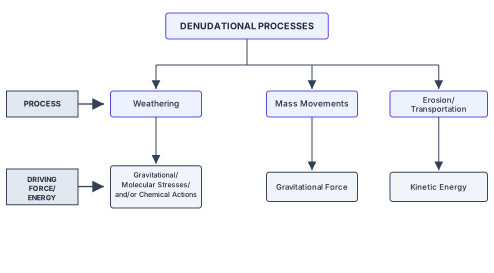
The diagram is a flow chart built around one central idea: every denudational process is driven by a specific energy source. At the top sits a single box labelled DENUDATIONAL PROCESSES. From it, three arrows branch downward into three process boxes: Weathering, Mass Movements, and Erosion/Transportation. Each of these three boxes then has its own arrow pointing down to a separate driving-force box, so the chart reads as a clean two-tier structure — process on top, energy below.
The driving forces are matched one-to-one with their processes. Weathering connects to Gravitational/Molecular Stresses/and or Chemical Actions — a long label reflecting that weathering is not powered by a single mechanism but by a combination of gravity, internal molecular stresses, and chemical activity. Mass Movements connects simply to Gravitational Force, since sliding, slumping, and falling debris are all gravity-driven. Erosion/Transportation connects to Kinetic Energy, the energy of motion that moving agents like water, wind, and ice carry and use to pick up and carry material.
On the left side of the chart sits a small legend with two boxes. One is labelled PROCESS, with an arrow pointing horizontally to the row of process boxes. The other is labelled DRIVING FORCE/ENERGY, with an arrow pointing to the row of driving-force boxes. This legend is the key to reading the whole figure: it tells you that the top row answers "what is happening?" and the bottom row answers "what makes it happen?" …
The exogenic processes are the great sculptors of the Earth's surface, but their energy does not come from within the planet. Instead, they are powered by the atmosphere, which itself is ultimately driven by solar energy. On top of this, they also work with the gradients, or slopes, that tectonic forces have created. This is why the book asks why tectonic factors create slopes — because without those initial differences in elevation, there would be little for the external processes to act upon.
Gravity is the key player here. It acts upon all earth materials that lie on a sloping surface, pulling them in a down-slope direction. When a force is applied per unit area, it is called stress. Stress is produced in a solid by pushing or pulling, and this induces deformation. Forces that act along the faces of earth materials are called shear stresses — they are separating forces. It is this shear stress that breaks rocks and other earth materials, resulting in angular displacement or slippage.
But gravity is not the only source of stress. Earth materials also become subjected to molecular stresses, which can be caused by several factors, the most common being temperature changes, crystallisation, and melting. Chemical processes also play a role, as they normally lead to the loosening of bonds between grains, the dissolving of soluble minerals, or the dissolving of cementing materials. So the basic reason that leads to weathering, mass movements, and erosion is the development of stresses within the body of the earth materials themselves.
Two climatic elements stand out as the most important controls on these processes: temperature and precipitation. All the exogenic geomorphic processes are covered under a single general term — denudation. The word 'denude' means to strip off or to uncover. Denudation includes weathering, mass wasting (or mass movements), erosion, and transportation.
Even within a single climatic region, there can be local variations in the effects of these climatic elements. These variations arise due to:
- Altitudinal differences
- Aspect variations (the direction a slope faces)
- The variation in insolation received by north and south facing slopes as compared to east and west facing slopes
- Differences in wind velocities and directions
- The amount and kind of precipitation, and its intensity
- The relation between precipitation and evaporation
- The daily range of temperature
- The frequency of freezing and thawing
- The depth of frost penetration
All these factors cause the geomorphic processes to vary even within the same climatic region.
The sole driving force behind all exogenic processes is gravitational force.
Climatic factors being equal, the intensity of action of exogenic geomorphic processes depends upon the type and structure of rocks. The term 'structure' here is broad and includes:
- Folds and faults
- Orientation and inclination of beds
- Presence or absence of joints and bedding planes
- Hardness or softness of constituent minerals
- Chemical susceptibility of mineral constituents
- Permeability or impermeability …