Geography · Ch 9 — Interior of the Earth
Earthquake Waves
Earthquake Waves
The diagram is a single seismograph trace, the kind of squiggly line a pen scratches onto a rotating drum of paper when the ground shakes. It reads left to right like a timeline, starting with a calm, flat horizontal line — the quiet before the earthquake arrives. Then the line suddenly breaks into three distinct bursts of oscillation, each separated by a short stretch of relative calm. These three groups are the heart of the figure, and each one is labelled directly beneath it: first P-waves, then S-waves, and finally Surface waves.
Between the first and second group, and again between the second and third, small vertical marks or ticks are drawn on the trace, with arrival times noted beside them. These ticks mark the exact moment each wave type reached the seismograph station. The key visual point is that the three groups are not evenly spaced — the gaps between them grow wider as you move right. That widening gap is the whole lesson of the diagram: the waves leave the earthquake focus at the same instant, but they travel at different speeds, so they arrive at the station at different times. The P-wave, being fastest, arrives first; the S-wave comes later; and the surface wave, slowest of all, lags behind the most.
The third group, the surface waves, is drawn differently from the other two. Its oscillations are noticeably larger in amplitude — the peaks and troughs swing much higher and lower than those of the P and S waves. An amplitude bracket, a vertical line with arrows or a brace, is drawn alongside this group to highlight just how big those swings are. This is the diagram's second lesson: surface waves may be the slowest, but they carry the most energy to the surface, which is exactly why the text calls them the most damaging waves. The P-waves, by contrast, show small, tight oscillations — they arrive first but with far less punch. …
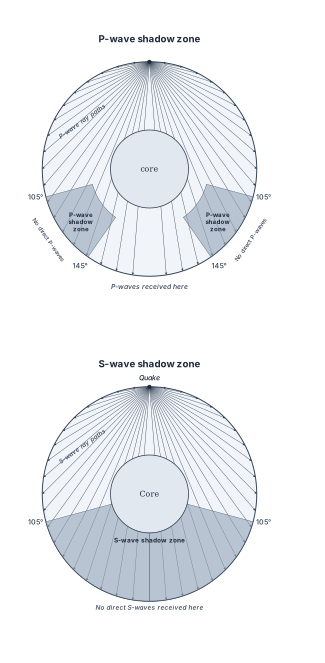
The diagram is built from two circular cross-sections of the Earth, drawn side by side and labelled (a) and (b). Each circle shows the same basic anatomy: a solid core circle at the centre, representing the Earth’s interior layers, and a single point at the top of the circle marking the epicentre of an earthquake. From that epicentre, curved ray paths radiate downward and outward through the body of the Earth, bending as they travel, until they emerge at points along the surface of the circle. These rays are the P-waves and S-waves whose paths are being traced.
Panel (a) is the P-wave shadow zone. The ray paths spread symmetrically from the epicentre, and the surface of the circle is marked with angular distances measured from the epicentre. Up to 105° on both sides, the rays arrive directly at the surface — this region is fully lit by P-waves. Then comes a shaded band running between 105° and 145° on both sides of the epicentre. This band is the P-wave shadow zone: no direct P-waves reach the surface here, because the rays have been refracted by the core and bent away from this region. Beyond 145° on both sides, the rays reappear and P-waves are recorded again, all the way around to the far side of the globe. So the P-wave shadow zone is not a single patch but a pair of symmetrical bands, one on each side of the epicentre, each spanning 40° of angular distance.
Panel (b) is the S-wave shadow zone, and it tells a starker story. The ray paths again radiate from the epicentre, and again the surface receives direct S-waves up to 105° on both sides. But beyond that 105° mark, the rays simply stop — no S-wave paths are drawn continuing through the Earth, and the entire remainder of the circle, from 105° on one side all the way through 180° (the point diametrically opposite the epicentre) and back to 105° on the other side, is shaded as a shadow zone. Unlike the P-waves, S-waves never reappear at the surface. The reason is physical: S-waves cannot travel through liquid, and the outer core is liquid, so the rays are absorbed at the core boundary and never emerge on the far side. This is why the S-wave shadow zone is so much larger — it covers just over 40% of the Earth’s surface, whereas the P-wave shadow zone is only a narrow band. …
All natural earthquakes originate in the lithosphere, the rigid outer shell of the earth that extends to a depth of about 200 km from the surface. When an earthquake occurs, the energy released at the source travels outward as waves, and these are recorded by an instrument called a seismograph. The trace produced on the seismograph is not a single smooth curve — it shows three distinct sections, each corresponding to a different type of wave pattern. This tells us that earthquake waves are not all alike; they are broadly divided into two families: body waves and surface waves.
Body waves are generated by the release of energy at the focus, the point inside the earth where the earthquake originates. From there they move in all directions, travelling through the body of the earth — hence the name. As these body waves reach the surface, they interact with the surface rocks and give rise to a fresh set of waves called surface waves, which, as the name suggests, travel along the surface rather than through the interior.
The behaviour of these waves depends on the material they pass through. The velocity of a wave changes as it travels through materials of different densities — the denser the material, the higher the velocity. Their direction also changes: when a wave encounters a material of different density, it may be reflected or refracted, bending from its original path.
There are four distinct types of earthquake waves in total. One of them, the P-wave, vibrates parallel to the direction of propagation. This means it exerts pressure on the material in the direction in which it is moving, creating density differences that cause the material to be alternately stretched and squeezed. The other three waves vibrate perpendicular to the direction of propagation. Among these, the S-wave vibrates perpendicular to the wave direction in the vertical plane, producing troughs and crests in the material through which it passes.
Surface waves are considered the most damaging of all earthquake waves, even though they are generated only after body waves reach the surface.
The Shadow Zone
Seismographs located far from the earthquake's origin do record the arrival of waves, but not everywhere. There are specific areas on the earth where the waves are simply not reported. Such an area is called the shadow zone. A striking observation from the study of many earthquakes is that each earthquake has its own shadow zone — the zone is not the same for every event.
The shadow zones of P-waves and S-waves are different, and the geometry is precise. Seismographs located at any distance within 105° from the epicentre record the arrival of both P-waves and S-waves. Beyond 145° from the epicentre, however, seismographs record P-waves but not S-waves. This leaves a band between 105° and 145° from the epicentre where neither type of wave is recorded — this band is the shadow zone for both types of waves. …