Geography · Ch 12 — Landforms and their Evolution
Sand Dunes
Sand Dunes
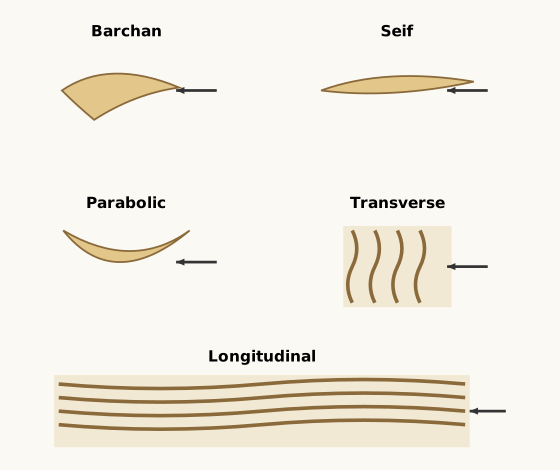
The diagram is a single composite figure, a grid of five separate sketches, each showing a different dune form in plan view — as if you were looking straight down at the desert floor from above. Every panel carries a small arrow marking the wind direction, and each dune is drawn as a labelled shape so the eye can compare the forms side by side.
The first panel shows Barchan. It is drawn as a crescent, with its two pointed horns or wings trailing away from the arrow — that is, pointing downwind. The sketch makes the key point visually: the crescent opens in the direction the wind is blowing, not against it. Next to it is Seif, which looks like a barchan that has lost one wing. Only a single long point extends downwind, and the drawing shows that this lone wing can stretch out into a long, high ridge. The contrast between the two panels is deliberate — one crescent with two horns, one with a single horn.
The third panel, Parabolic, is the visual reversal of the barchan. Here the crescent's points curve forward, into the wind, so the horns face the arrow rather than trailing away from it. The sketch makes it obvious why the textbook calls it a "reversed barchan" — same crescent, opposite orientation. The fourth panel, Transverse, abandons the crescent entirely. It shows a set of long, parallel, wave-like ridges running crosswise to the wind arrow, like ripples on a beach but drawn as straight, elongated bars. The ridges sit perpendicular to the arrow, and the sketch emphasises their length and low profile.
The final panel, Longitudinal, shows another set of parallel ridges, but this time they run parallel to the wind arrow, not across it. The ridges are drawn long, straight, and low, stretching in the same direction the arrow points. The two ridge panels together teach the core distinction: transverse dunes lie across the wind, longitudinal dunes lie along it. …
Sand dunes are mounds or ridges of sand built by wind, and they form only where three things come together: a dry, hot desert climate, a supply of loose sand, and an obstacle that interrupts the wind and causes sand to pile up. The obstacle matters as much as the desert itself — without something to slow the wind and trap the grains, the sand just keeps moving. Once dune formation begins, the shape the dune takes depends on wind direction, wind strength, the amount of sand available, and whether vegetation is present. Because these factors vary, deserts show a great variety of dune forms.
The most famous dune type is the barchan, a crescent-shaped dune whose points, or wings, point downwind — that is, away from the direction the wind is blowing. Barchans form where the wind direction is constant and moderate, and where the surface over which the sand moves is almost uniform. Under these steady conditions, the dune builds into a smooth crescent with its horns trailing downwind.
Parabolic dunes look like barchans turned inside out. They form when sandy surfaces are partially covered with vegetation. The plants anchor the arms of the dune, so the crescent shape is reversed — the points face upwind while the middle moves forward. In effect, a parabolic dune is a reversed barchan, even though the wind direction is the same in both cases.
Seif is a form similar to a barchan but with only one wing, or point, instead of two. This happens when there is a shift in wind conditions — a change in wind direction breaks the symmetry of the crescent, leaving a single elongated arm. The lone wing of a seif can grow very long and very high, stretching far across the desert.
Longitudinal dunes appear as long ridges of considerable length but low height. They form when the supply of sand is poor and the wind direction is constant. With little sand to build upward, the dune stretches out along the direction of the wind instead.
Transverse dunes are aligned perpendicular to the wind direction. They form when the wind direction is constant and the source of sand is an elongated feature lying at right angles to the wind. Like longitudinal dunes, they can be very long but low in height.
When sand is plentiful, the regular, well-defined dunes often coalesce — they merge together and lose their individual characteristics, blending into a more irregular sandy landscape. Most desert dunes are constantly shifting as the wind moves sand from one side to the other, but a few become stabilised, especially near human habitations, where vegetation or human activity holds the sand in place. …
Wind is a good sorting agent -- depending upon the velocity of wind, different sizes of grains are moved along the floors by rolling or saltation and carried in suspension, and in this process of transportation the materials get sorted. When the wind slows or begins to die down, depending upon the sizes of grains and their critical velocities, the grains begin to settle; so depositional landforms made by wind show good sorting of grains. Dry hot deserts are good places for sand dune formation; obstacles to initiate dune formation are equally important, and there can be a great variety of dune forms. Crescent shaped dunes called barchans, with the points or wings directed away from wind direction (downwind), form where wind direction is constant and moderate and the original surface over which sand is moving is almost uniform. Parabolic dunes form when sandy surfaces are partially covered with vegetation -- parabolic dunes are reversed barchans, with wind direction being the same. Seif is similar to a barchan with a small difference: seif has only one wing or point, happening when there is a shift in wind conditions; the lone wings of seifs can grow very long and high. Longitudinal dunes form when the supply of sand is poor and wind direction is constant -- they appear as long ridges of considerable length but low in height. Transverse dunes are aligned perpendicular to wind direction, forming when the wind direction is constant and the source of sand is an elongated feature at right angles to …