Geography · Ch 6 — Natural Hazards and Disasters
Classification of Natural Disasters
Classification of Natural Disasters
| Atmospheric | Terrestrial | Aquatic | Biological |
|---|---|---|---|
| Blizzards | Earthquakes | Floods | Plants and Animals as colonisers (Locusts etc.) |
| Thunderstorms | Volcanic Eruptions | Tidal Waves | Insect infestation -- fungal, bacterial and viral diseases such as bird flu, dengue etc. |
| Lightning | Landslides | Storm Surge | |
| Tornadoes | Avalanches | Tsunami | |
| Tropical Cyclone | Subsidence |
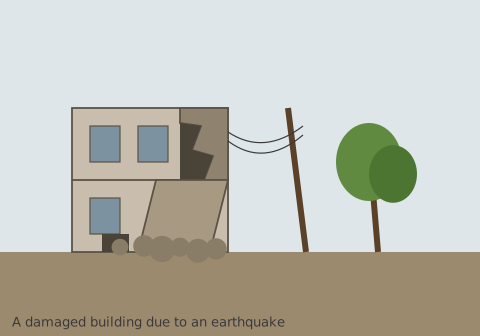
The photograph shows the aftermath of a strong earthquake in a built-up area. In the centre stands a two-storey building that has taken the brunt of the shaking. The upper storey is the most damaged: a jagged, crumbled section has collapsed, exposing the dark interior of the rooms behind. The lower storey appears comparatively intact, which is typical of how earthquake damage concentrates in the weaker, less rigid upper portions of a structure.
At the base of the building, a pile of rubble and debris has collected — fallen bricks, concrete chunks and fragments of the collapsed wall. Beside the building, a utility pole leans at an angle, its sagging wires drooping towards the ground, a sign that the earthquake has also disrupted basic infrastructure like electricity supply. A tree stands nearby, apparently unharmed, contrasting the natural world with the fragility of human construction. …
People everywhere have lived through disasters, and for most of history they simply endured them. That is changing. Across the world, governments and communities are now taking deliberate steps to reduce the damage disasters cause, and the first of those steps is simply knowing what they are dealing with. Identifying and classifying disasters is treated as a scientific, practical move — you cannot respond quickly and efficiently to something you have not properly named and understood.
Natural disasters are broadly grouped into four categories. India is among the countries that have experienced nearly all of them, and every year these calamities cost thousands of lives and property worth millions of rupees. The classification is not an academic exercise; it is the foundation on which mitigation efforts are built.
| Category | Examples |
|---|---|
| Atmospheric | cyclones, tornadoes, hailstorms, heat and cold waves, droughts |
| Terrestrial | earthquakes, volcanic eruptions, landslides, avalanches |
| Aquatic | floods, tidal waves, ocean currents, storm surges |
| Biological | epidemics, pest attacks, locust swarms, forest fires |
The table is the book's core content here — the four headings and their typical members. The atmospheric group covers weather-driven events that strike from the sky. The terrestrial group is rooted in the earth's own movements and surface processes. The aquatic group involves the sea and inland waters. The biological group is distinct: it arises from living organisms, whether disease spreading among people or pests destroying crops. …
For an effective disaster management strategy, we need to identify and classify these disasters and hazards, whether these are natural or human-induced, and know their spatial and temporal patterns of occurrence. Table 6.1 shows a broad classification of natural disasters into four types: Atmospheric, Terrestrial, Aquatic and Biological. …