Geography · Ch 5 — Natural Vegetation
Biosphere Reserves
Biosphere Reserves
The map is a political and thematic hybrid. It shows the outline of India with international boundaries and the neighbouring countries labelled, so you can immediately place the reserves in their geographic context. A graticule of latitude and longitude lines is drawn across the whole frame, which lets you read off the approximate coordinates of each reserve — useful if you want to compare, say, the high-latitude Himalayan sites against the near-equatorial ones in the south.
The heart of the map is the set of 18 labelled dots, each marking the location of a biosphere reserve. These are not clustered randomly; they trace the ecological diversity of the country. In the Himalayas you get Nanda Devi and Khangchendzonga; in the northeast, Dehang Debang, Dibru-Saikhowa, Manas and Nokrek; running down the central belt, Pachmarhi, Achanakmar-Amarkantak and Similipal; on the eastern coast, Sunderbans; and in the south, Nilgiri, Agasthyamalai, Gulf of Mannar and Great Nicobar. The remaining sites complete the set of 18, all matching the list in Table 5.1. Each dot is labelled directly on the map, so you can see at a glance how unevenly these protected zones are spread — the northeast and the Western Ghats stand out as dense clusters, while the arid northwest has none.
A scale bar running 0 to 600 km sits on the map, letting you measure real distances between reserves. That matters because the map is not just a locator — it is a tool for understanding the logic of the biosphere reserve programme. The reserves are chosen to represent distinct ecosystems, not to be evenly spaced. The map makes this visible: a Himalayan reserve, a deltaic mangrove reserve, an island reserve and a tropical rainforest reserve are all part of one network, even though they are thousands of kilometres apart. …
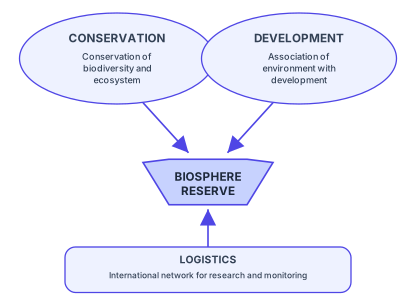
The diagram is a flow schematic built around a central hexagonal box labelled BIOSPHERE RESERVE. Everything in the figure points toward or away from this core, making it the conceptual anchor of the entire scheme.
Two ellipse boxes sit at the top, side by side. The left one is labelled CONSERVATION, with the sub-label Conservation of biodiversity and ecosystem. The right one is labelled DEVELOPMENT, with the sub-label Association of environment with development. Each of these sends a downward arrow that converges into the central Biosphere Reserve box. The message is that a biosphere reserve is not a single-purpose entity — it is the meeting point of two distinct mandates: protecting nature and allowing human activity to proceed in an environmentally sound way.
Below the central box sits a rounded box labelled LOGISTICS, with the sub-label International network for research and monitoring. This box points upward into the Biosphere Reserve with an upward arrow. So the third objective is not a parallel input like the first two, but a supporting function that feeds into the reserve from below — research and monitoring are what make conservation and development actually work on the ground. …
| Sl. No. | Name of the Biosphere Reserve | Year of Designation | States/UT |
|---|---|---|---|
| 1 | Nilgiri | 1986 | Tamil Nadu, Kerala and Karnataka |
| 2 | Nanda Devi | 1988 | Uttarakhand |
| 3 | Nokrek | 1988 | Meghalaya |
| 4 | Manas | 1989 | Assam |
| 5 | Sunderban | 1989 | West Bengal |
| 6 | Gulf of Mannar | 1989 | Tamil Nadu |
| 7 | Great Nicobar | 1989 | Andaman and Nicobar Islands |
| 8 | Similipal | 1994 | Odisha |
| 9 | Dibru-Saikhowa | 1997 | Assam |
| 10 | Dehang Debang | 1998 | Arunachal Pradesh |
| 11 | Pachmarhi | 1999 | Madhya Pradesh |
| 12 | Khangchendzonga | 2000 | Sikkim |
| 13 | Agasthyamalai | 2001 | Tamil Nadu, Kerala |
| 14 | Achanakmar-Amarkantak | 2005 | Madhya Pradesh, Chhattisgarh |
| 15 | Kachchh | 2008 | Gujarat |
| 16 | Cold Desert | 2009 | Himachal Pradesh |
| 17 | Seshachalam | 2010 | Andhra Pradesh |
| 18 | Panna | 2011 | Madhya Pradesh |
A Biosphere Reserve is, at its core, a protected area that stands for something bigger than itself: it represents a whole ecosystem type. The idea is to conserve a living example of a natural region, not just a single species or a patch of forest. These reserves are set up in both terrestrial (land-based) and coastal areas, and their international recognition comes through a specific framework — UNESCO’s Man and Biosphere Programme, commonly shortened to the MAB Programme.
The purpose of a Biosphere Reserve is not one-dimensional. It is designed to achieve three clear objectives at the same time. First, it must conserve the biodiversity and the ecosystems within its boundaries — protecting plants, animals, and the natural processes that sustain them. Second, it must promote economic development that is sustainable, meaning the local communities can use the resources without destroying them. Third, it must support research, monitoring, and education, so that scientists and students can learn from the reserve and share that knowledge. These three goals work together; a reserve that only protects but ignores people, or only develops but ignores nature, fails its purpose. …