Geography · Ch 14 — Solar Radiation, Heat Balance and Temperature
Variability of Insolation at the Surface of the Earth
Variability of Insolation at the Surface of the Earth
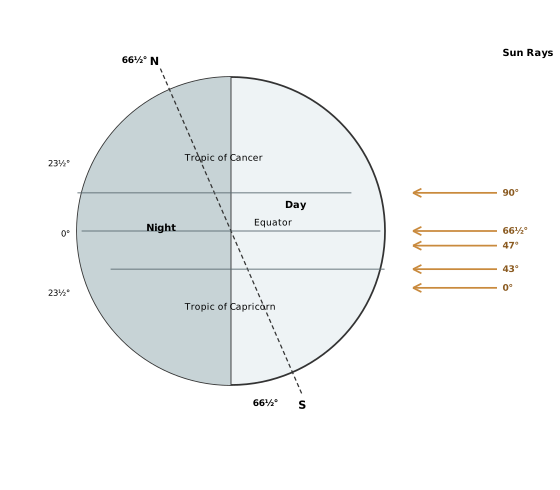
The diagram shows the Earth as a globe at the moment of the summer solstice, with the axis tilted 66.5° away from the vertical. The North Pole is labelled N at the top, the South Pole S at the bottom. Three latitude lines are drawn as horizontal parallels: the Equator at 0°, the Tropic of Cancer at 23.5°N, and the Tropic of Capricorn at 23.5°S. Parallel horizontal arrows labelled “Sun Rays” enter from the right side of the globe.
A diagonal line divides the globe into two halves: the left half is shaded and labelled “Night,” the right half is unshaded and labelled “Day.” This terminator is not vertical — it slants because the axis is tilted, so the day–night boundary cuts across latitudes obliquely rather than running straight down the middle.
The key teaching element is the set of angle labels showing how the sun’s rays strike the surface at different latitudes. At the Tropic of Cancer the rays are marked at 90° — they fall vertically, or overhead. At the Equator the angle is 66.5°. Moving poleward from the Tropic of Cancer, the angle drops to 47°, then 43°, and near the Tropic of Capricorn and beyond it reaches 0°. These numbers trace a steady decrease in the angle of incidence as you move away from the Tropic of Cancer.
What the diagram teaches is the geometric reason behind the variability of insolation. The angle of inclination of the sun’s rays is the second major factor controlling how much solar energy a place receives. Where rays strike vertically, as at the Tropic of Cancer on this day, the same amount of energy is concentrated over a smaller surface area, so each unit of ground receives more heat. Where rays strike obliquely, the same energy is spread over a larger area, so the intensity per unit area falls. The slant rays also travel through a greater depth of atmosphere, losing more energy to absorption, scattering, and diffusion before reaching the surface. …
The amount and intensity of insolation reaching the Earth’s surface are not constant. They change through the day, across a season, and from one year to the next. Five factors drive these variations: the rotation of the Earth on its axis, the angle of inclination of the sun’s rays, the length of the day, the transparency of the atmosphere, and the configuration of land in terms of its aspect. Of these, the last two — atmospheric transparency and land aspect — have a comparatively smaller influence.
The single most powerful control on insolation is the tilt of the Earth’s axis. The axis makes an angle of 66½ degrees with the plane of the Earth’s orbit around the sun, and this tilt largely determines how much insolation different latitudes receive. Because of this inclination, the sun’s rays strike different parts of the globe at different angles through the year. …
The amount and the intensity of insolation vary during a day, in a season and in a year. The factors that cause these variations in insolation are: (i) the rotation of earth on its axis; (ii) the angle of inclination of the sun's rays; (iii) the length of the day; (iv) the transparency of the atmosphere; (v) the configuration of land in terms of its aspect. The last two, however, have less influence.
The fact that the earth's axis makes an angle of 66 and a half degrees with the plane of its orbit round the sun has a greater influence on the amount of insolation received at different latitudes. The second factor that determines the amount of insolation received is the angle of inclination of the rays -- this depends on the latitude of a place. The higher the latitude, the less is the angle the rays make with the surface of the earth, resulting in slant sun rays. The area covered by vertical rays is always less than the area covered by slant rays. If more area is covered, the energy gets distributed and the net ene …